
An Phu, Kinh Chu and Nham Duong make a rewarding heritage day in the former Kinh Mon area of western Hai Phong. Choose this route for a hilltop temple, a cave covered with historical inscriptions and a Buddhist pagoda within an archaeological landscape. The three places are separate road stops, so arrange transport between them and allow a full day when coming from Hanoi or central Hai Phong.
The most useful distinction is what you want to see. An Phu offers the mountain setting and Tran-dynasty family history; Kinh Chu is the strongest stop for carved writing in its original setting; Nham Duong adds Buddhist tradition and archaeology. If time or walking ability is limited, select the sites that match your interests instead of rushing through all three.
Where the three sites are now
This area formerly belonged to Hai Duong Province. It is now within Hai Phong municipality, well outside the familiar central streets around the Opera House and Hai Phong Railway Station. The Hai Phong and Hai Duong address guide explains why older and newer location labels can describe the same destination.
Save a separate map pin for each site and give your driver these Vietnamese names:
- Đền Cao An Phụ: the hilltop temple in Phạm Sư Mạnh ward. Older references may say An Sinh, Kinh Mon.
- Động Kính Chủ: the cave on Duong Nham mountain, also in Phạm Sư Mạnh ward. Older addresses may use Pham Menh or Pham Thai.
- Chùa Nhẫm Dương: the pagoda in Nhị Chiểu ward, formerly associated with Duy Tan, Kinh Mon.
Do not navigate using “An Phu” alone: similar names occur elsewhere. “An Phu–Kinh Chu–Nham Duong” names a heritage complex, not a single gate or a continuous walking trail.
An Phu: a hilltop temple and two generations of Tran history
Den Cao An Phu honors Tran Lieu, the father of the commander Tran Hung Dao, also known as Tran Quoc Tuan. This distinction makes the visit easier to understand: the main temple is dedicated to the father, while the large monument elsewhere on the mountain commemorates his son.
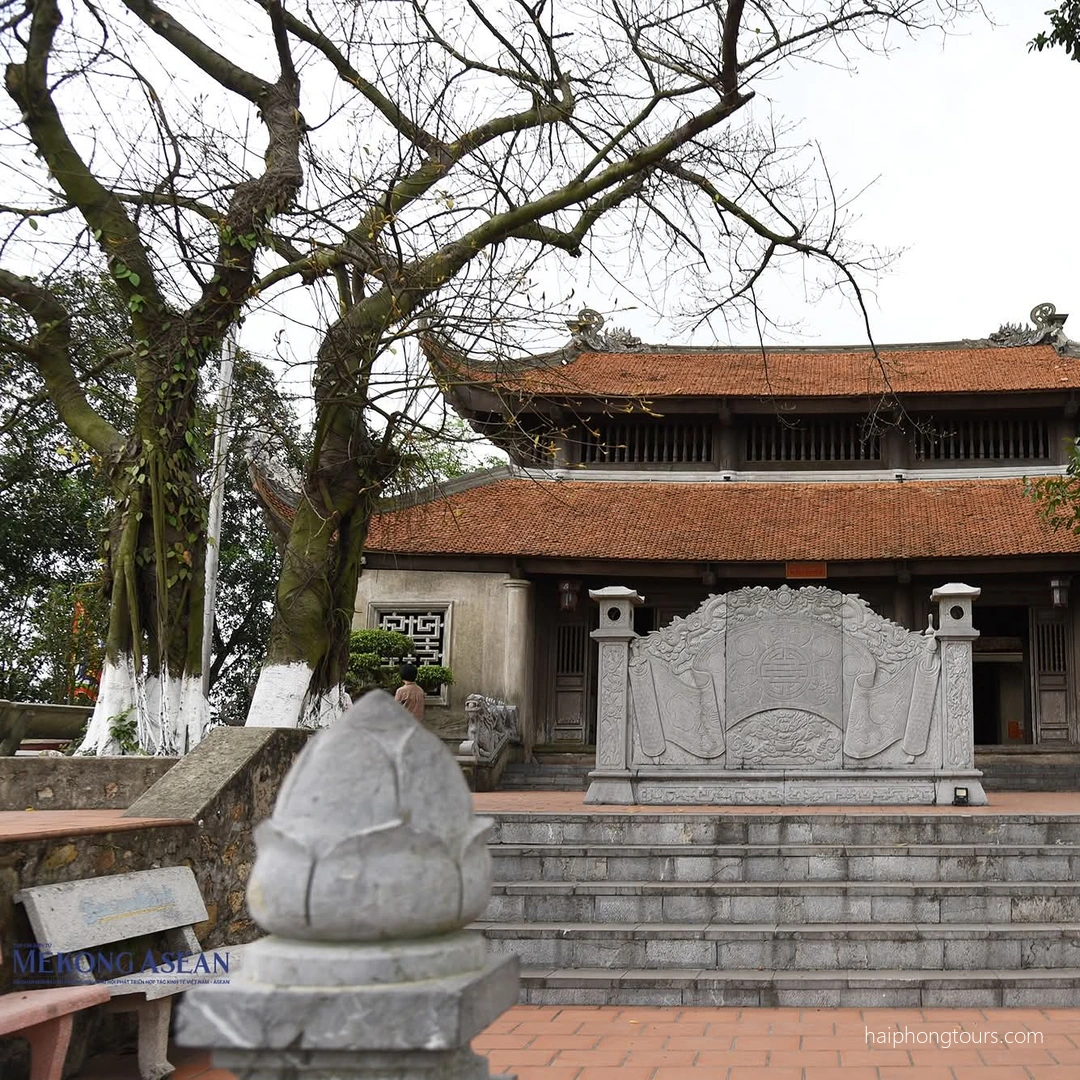 The facade of Den Cao An Phu on An Phu Mountain.
The temple stands on the highest summit of the An Phu range, approximately 246 meters above sea level. That figure describes the summit’s elevation, not the distance you must climb from your vehicle. The approach and final drop-off determine how much uphill walking your visit involves.
Include the Tran Hung Dao monument and its terracotta relief if you have time. The relief depicts the Dai Viet resistance to the Yuan–Mongol invasions and was made with the involvement of Cay village ceramic artisans. Look at how the figures, boats and battle scenes tell the story across the surface; this is a more tangible introduction to the period than trying to memorize a list of reigns.
Tuong Van Pagoda is another part of the hilltop religious setting. Allow time for the temple grounds as well as the view, and avoid treating the worship spaces as scenery for a summit photograph.
Choose An Phu when: the landscape and Tran-family connections interest you and your group is comfortable with slopes or steps. On a wet day, reconsider the amount of climbing rather than assuming the full hillside circuit is essential.
Kinh Chu: spend time with the writing, not just the cave
Kinh Chu combines a natural limestone cave with Buddhist worship and texts carved directly into the rock. These inscriptions, called ma nhai, make it a different visit from a cave chosen primarily for dramatic formations. Stone steps lead toward the entrance, so this is not a step-free alternative to An Phu.
The carved texts include poetry and records of donations, repairs and community activity. Their subjects help you see the cave as a place used and interpreted over centuries, rather than an untouched natural chamber.
Two useful points of focus are the writing associated with the Tran-dynasty scholar Pham Su Manh and the poem attributed to King Le Thanh Tong high on the cave surface. Ask an interpreter to identify these in place and explain one short passage. One understood inscription adds more than quickly photographing every panel.
At Kinh Chu, look for the heritage-information QR board before studying the inscriptions. The complex’s digital materials include Vietnamese and English background, with a location diagram to help you place the separate monuments. Hai Phong Tours recommends opening the English material while you have mobile data and saving the pages relevant to your visit. Use it as an introduction; for a close reading of a particular inscription, arrange an interpreter rather than expecting a phone camera to translate the historical characters reliably.
The characters include historical Chinese and Vietnamese scripts. A general English-speaking driver may be able to help you arrive but should not automatically be expected to translate them. If the inscriptions are the reason for your trip, arrange a guide who can explain the site’s history before setting out.
Stay on the visitor route and keep your hands, chalk and paper off the carved surfaces. Examine the letters and the relationship between the inscriptions and the cave’s natural contours without making rubbings or touching the stone.
Choose Kinh Chu when: you enjoy historical writing, religious spaces and seeing heritage in its original physical setting. It is the most distinctive single stop on this route for that combination.
Nham Duong: a living pagoda with an archaeological landscape
Nham Duong Pagoda, also known as Thanh Quang Tu, stands among limestone outcrops and caves. Its history connects an early Truc Lam Buddhist setting with its later importance to the Tao Dong tradition, associated with the masters Thuy Nguyet and Tong Dien.
Focus first on the worship halls, ancestral area and stone stupas. The pagoda has been rebuilt over time; the age of the religious foundation does not mean that every visible building is an unchanged medieval structure. This is a place of continuing Buddhist practice as well as a historic monument.
The surrounding caves have yielded animal fossils and archaeological objects from different periods. Thanh Hoa Cave has particular significance in the story of Thuy Nguyet and the site’s archaeological discoveries. These associations add depth to the landscape, but they do not turn every cave into an equipped visitor attraction.
Ask the caretaker which areas are accessible during your visit and whether any objects or interpretation can be viewed. Plan around the pagoda and permitted paths; do not build the day around entering an excavation area or seeing a particular fossil. A guide familiar with the site can connect the religious and archaeological stories without requiring access to restricted spaces.
Choose Nham Duong when: Buddhist history and the relationship between a pagoda and its surrounding landscape interest you. It works best as an unhurried cultural stop, rather than a promise of an underground adventure.
What the UNESCO designation covers
Kinh Chu and Nham Duong are components of the Yen Tu–Vinh Nghiem–Con Son, Kiep Bac World Heritage property inscribed in 2025. The property comprises 12 components across a much wider region. An Phu belongs to the nationally protected An Phu–Kinh Chu–Nham Duong complex, but it is not itself one of those UNESCO components.
Neither designation means the sites share one visitor entrance or that a single ticket covers every stop. If you also want to visit Con Son and Kiep Bac, give that pair its own itinerary rather than trying to collect the whole heritage property in one day.
A workable day without rushing
For a dedicated day, a useful starting plan is An Phu while the morning is cooler, Kinh Chu with time to study the inscriptions, then Nham Duong after a meal break. Ask the driver to adjust the order to your actual origin and the day’s access conditions. This is a planning sequence, not a fixed tour timetable.
Reserve roughly one to two hours for An Phu if you want the temple and monument, and around an hour each for a focused Kinh Chu and Nham Duong visit. These are planning allowances, not official visit durations; guiding, worship, climbing and rest stops can extend them. Add the road journeys and lunch separately.
With only half a day in the area, An Phu and Kinh Chu give a clear contrast between a hilltop monument and an inscribed cave. Travelers especially interested in Buddhism may prefer Kinh Chu and Nham Duong. Avoid compressing all three into short photo stops simply because they appear under one complex name.
Transport, access and comfort
A car with a driver who stays for the complete route is a practical choice. Agree on all three pins, your return destination, waiting time and parking before departure. A one-way fare to the first temple does not arrange the rest of the day.
Confirm the current entrance arrangements and any charges with the site management or your local organizer. Keep admission, parking and guiding separate in the quote. If mobility is a concern, request the actual drop-off position and the remaining steps at each site; a general description such as “easy visit” is not enough to assess the route.
Wear shoes with grip and clothing suitable for active temples. Carry water, sun or rain protection, and small-denomination Vietnamese dong. In wet weather, shorten exposed or slippery sections. For a quieter visit, choose a normal weekday; if ceremonies are your priority, use the announced festival program for that year and allow more time for traffic and worshippers.
The strongest version of this day is selective: understand who is honored at An Phu, have one inscription explained at Kinh Chu, and leave enough time to appreciate Nham Duong as a living pagoda. Those three experiences give the route its purpose.
Useful guides for your trip
Would you like help fitting this experience into your trip? Contact us with your travel dates, starting point, available time and group size. Tell us about walking limits or special interests so we can suggest a practical itinerary.