
Ba De Temple is a small seaside place of worship at the foot of Độc Mountain in Do Son, Hai Phong. It is worth adding to a Do Son half-day if you want local cultural context, a quiet coastal stop or a respectful visit connected with the story of Đào Thị Hương. For the temple and its immediate surroundings, allow roughly 30–60 minutes as a planning estimate.
The temple is not the best stand-alone trip for a traveller with very limited time in central Hai Phong. It works more naturally with Bảo Đại Villa, K15 historical pier or Tường Long Tower. Visit during daylight, confirm access before an unusually early or late arrival, and postpone the seafront stop when strong wind, heavy rain or rough waves make the area uncomfortable.
Ba De Temple at a glance
- Vietnamese name: Đền Bà Đế.
- Location: beside the sea below Độc Mountain in present-day Do Son Ward, Hai Phong.
- Best for: travellers interested in local belief, coastal culture and a compact Do Son route.
- Time to allow: about 30–60 minutes, with more time during ceremonies or festival crowds.
- Main festival: the 24th–26th days of the second lunar month; the international-calendar dates change every year.
- Important limit: daily access, event arrangements and on-site service charges should be confirmed for the date of your visit.
Is Ba De Temple worth visiting?
Choose Ba De Temple when a cultural stop matters more than beach time. Its setting is distinctive: the sanctuary rests against the mountain while the forecourt faces the sea. The combination helps explain why the site is closely connected with the beliefs and seafaring life of Do Son.
Skip or shorten the visit if your schedule requires a special journey from the city center, if the weather is unsafe on the coast, or if you need guaranteed step-free access. The temple is compact, so it is most rewarding when a guide or informed companion can explain the altars, local vocabulary and folk story.
The legend of Đào Thị Hương
Ba De Temple is associated with a folk legend about Đào Thị Hương, a young woman from the old Ngọc area of Do Son who was remembered for her beauty and singing voice. The story says that a visiting Trịnh lord heard her sing, became attached to her and promised to return for her.
According to the legend, Hương later became pregnant while waiting. Village authorities demanded a penalty that her poor family could not pay, and she was taken to the shore and drowned. Before her death, she asked heaven to witness her innocence; the account says that she rose from the water three times.
When the lord learned what had happened, the story continues, he ordered a shrine and a ceremony to clear her name. Later generations remembered her as Bà Đế and came to the site with prayers for peace, good fortune and relief from injustice.
This is a devotional folk narrative, and retellings differ in chronology and in the identity of the Trịnh lord. Treat it as part of the community’s cultural memory rather than a fully documented biography. The most useful point for a visitor is how the story shapes the temple’s meaning today.
What to notice inside the temple
The main sanctuary honors Bà Đế and her parents. Other worship spaces are associated with the Sea King, mountain and earth deities and the Tam Tòa Thánh Mẫu, or Three Mother Goddesses. Altars for the Buddha and Hưng Đạo Vương Trần Quốc Tuấn show how several strands of Vietnamese belief meet within the same site.
In front of the sanctuary, a boat-shaped feature with a Bodhisattva figure and dragon decoration reflects the temple’s coastal setting. Look from the marked visitor area and keep entrances, prayer spaces and offering tables clear. Do not move ritual objects for a photograph.
The seaward view is part of the visit, but the shoreline is not a controlled viewpoint. Stone can be wet with rain or sea spray, and waves may reach exposed edges. Keep children close and stay away from wave-washed rocks in rough weather.
The annual festival
The main commemoration is held on the 24th, 25th and 26th days of the second lunar month. Because these are lunar dates, their international-calendar equivalents change each year. Check the current program, traffic arrangements and ceremony times before making a journey specifically for the festival.
The festival offers more ritual and community atmosphere but also brings heavier traffic, incense smoke and crowding. Travellers who want a quiet architectural visit should choose an ordinary weekday outside the festival and the busiest days around Tết. During a ceremony, follow the movement of local worshippers and wait rather than stepping across a procession or prayer line.
How to reach Ba De Temple
Search the map by the Vietnamese name Đền Bà Đế and check that the result is in Do Son. Older pages may still use former ward or district names, while current official material places the site in Do Son Ward. Sending the map pin as well as the name reduces confusion with other shrines.
A taxi or private car is the practical choice from central Hai Phong. Agree on waiting time and the next stop before departure because finding a return vehicle can be less predictable than in the city center. If the driver leaves, save the vehicle details and confirm the exact pickup point.
For a guided route, the current Hai Phong city tour to Do Son includes Ba De Temple in both morning and afternoon programs. The listed route continues to Bảo Đại Villa, K15 historical pier and Tường Long Tower, with a private vehicle, an English-speaking guide and entrance tickets included; meals are separate.
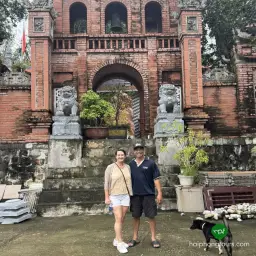
The service is described as a half-day, but the detailed pickup and return windows span more than four hours. Confirm the exact hotel return, the operating sequence and any mobility needs before booking, especially when you have a flight, train or cruise connection afterward.
Temple etiquette for international visitors
- Dress for worship: cover shoulders and knees even when the temple is combined with a beach visit.
- Keep your voice low: step aside when a family or worship group is performing a ritual.
- Ask before taking photographs: permission matters for people, ceremonies and close images of altars.
- Follow incense guidance: use only the designated holders and do not assume that more incense or a larger offering brings a better result.
- Check prices first: ask the cost of parking, prepared offerings or other optional services before accepting them.
- Carry small cash: digital payment may not be available for every small vendor, but a donation or offering remains a personal choice.
- Leave no waste: take packaging with you and avoid releasing plastic or paper objects toward the sea.
Mobility, children and weather
The sanctuary sits at the foot of the mountain rather than at the end of a major hike, but thresholds, steps and uneven or wet surfaces can still affect access. Ask how close the vehicle can stop and which parts of the visit can be completed without stairs. A traveller using a wheelchair should not assume the entire worship route is step-free.
Families can make a short visit, provided children stay close around incense, candles and the shoreline. In summer, carry water and protect yourself from heat between vehicle and temple. During a storm warning, avoid the coast and move the visit to another day rather than waiting beside the sea for conditions to improve.
How to build a Do Son half-day
A practical sequence is Ba De Temple, Bảo Đại Villa, K15 historical pier and Tường Long Tower, adjusted for current access and weather. The temple gives cultural context; the later stops add royal, wartime and hilltop perspectives. Do not add every beach and attraction to the same half-day.
Choose one meal stop after the cultural route and ask the restaurant to confirm any dietary need before arrival. If you have only enough time for two sites, pair Ba De Temple with the place that best matches your interest and leave a clear return margin. A calm, respectful 40-minute visit is more useful than rushing through the sanctuary to collect another stop.