
Choose an overnight Bai Tu Long Bay cruise if your priority is limestone scenery and you want a cabin, meals, navigation, and scheduled activities organized into one compact trip. Choose a Quan Lan Island stay if beaches, sleeping on shore, and controlling your own mornings and evenings matter more. For most first-time visitors with only one night, the cruise is the simpler fit; for beach-first travelers with at least two island nights, Quan Lan usually makes better use of the destination.

This is not a choice between two unrelated places. Quan Lan lies within the wider Bai Tu Long setting. The real difference is travel format: a cruise moves through the bay on an operator-led schedule, while an island stay gives you a fixed onshore base and more responsibility for ferries, local transport, meals, and daily plans.
Quick choice
- Choose a Bai Tu Long Bay cruise for a short, structured sightseeing trip centered on being on the water.
- Choose Quan Lan Island for repeated beach time, an adjustable daily pace, and a choice of onshore accommodation.
- Combine both only when you have enough days to protect the connection between the cruise port and your confirmed island ferry.
 Overnight Cruise
Bai Tu Long Bay
Signature Cruise 2 day 1 night tour
 Overnight Cruise
Bai Tu Long Bay
Renea Cruise 2 day 1 night tour
 Overnight Cruise
Bai Tu Long Bay
Larissa Cruise 2 day 1 night tour
Overnight Cruise
Bai Tu Long Bay Larissa Cruise 3 day 2 night tour
Overnight Cruise
Bai Tu Long Bay Signature Cruise 3 day 2 night tour
Overnight Cruise
Bai Tu Long Bay Renea Cruise 3 day 2 night tour
What an overnight Bai Tu Long Bay cruise gives you
The main advantage is continuity. You travel through the bay while eating, resting, and sleeping, so much of your available time remains inside the limestone seascape. The crew handles navigation and organizes meals, briefings, and activities around the vessel’s route.

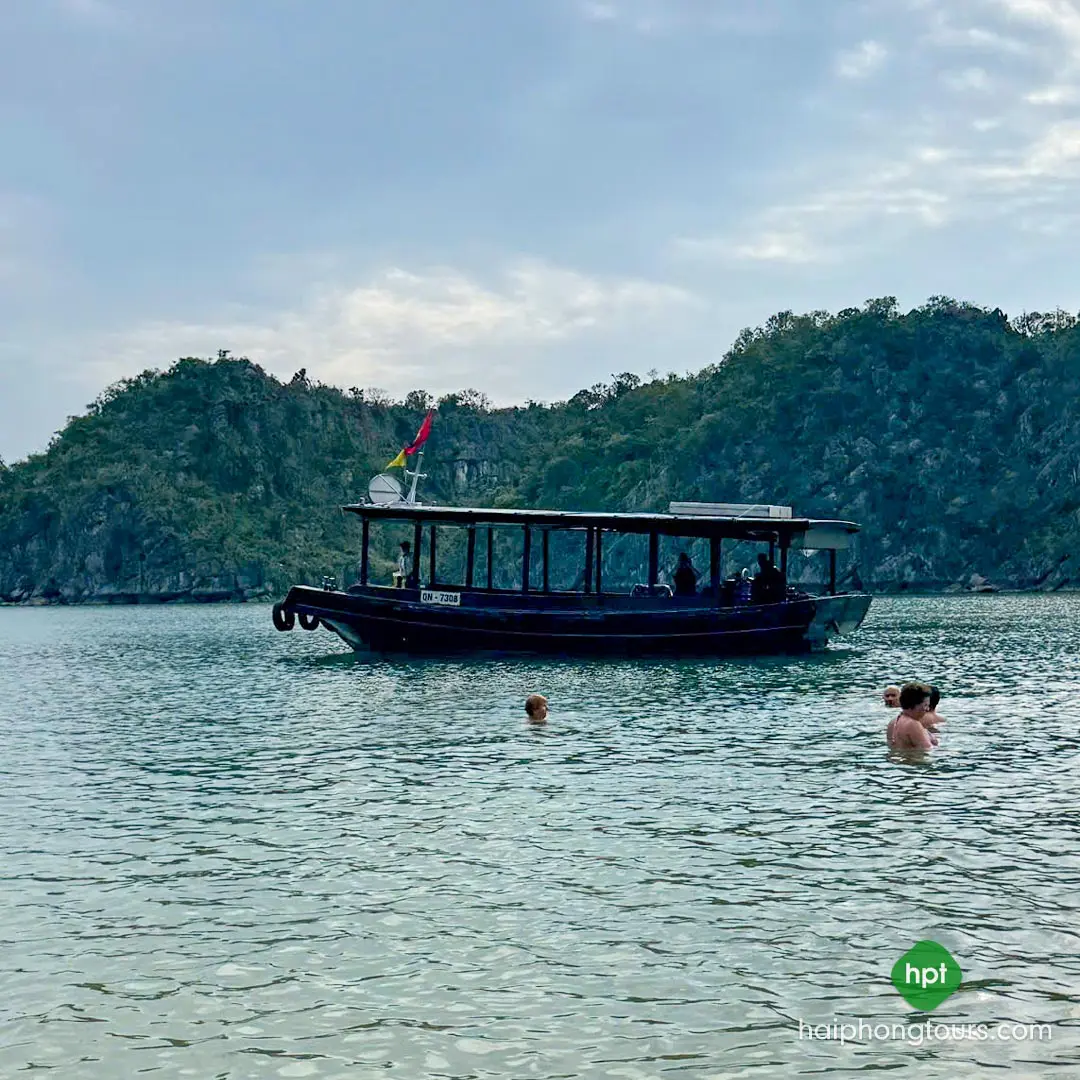

Bai Tu Long Bay scenery, swimming and kayaking during a cruise.
The trade-off is control. Kayaking, a cave visit, a tender ride, a cooking activity, or a swimming stop may appear at set times. A stop can also change with the season, weather, tide, local authorization, or the operating vessel. The bay name alone is not enough; read the exact day-by-day itinerary before paying.
A cruise is best understood as a moving sightseeing package, not a beach resort. Even when an itinerary includes swimming, the beach window may be short or replaced. If your main goal is to spend several hours on sand, return after lunch, or choose the calmest part of the day, an island stay offers more room to adapt.
The current Hai Phong Tours selection is built around 2-day/1-night and 3-day/2-night packages. A one-night cruise suits a tight schedule, while a second night can reduce the rushed feeling and add a fuller middle day. The exact value still depends on the named route, not only the number of nights.
What a Quan Lan Island stay gives you
Quan Lan is an inhabited island destination with beaches, accommodation, restaurants, local transport, and cultural sites. Quan Lan, Son Hao, and Minh Chau are the best-known beach areas, while the Quan Lan communal house, pagoda, temple, and nearby historical sites add a reason to leave the sand for part of the day.

Sleeping on the island lets you decide when to start, how long to remain at a beach, and whether to change the plan after seeing the conditions. You can choose a homestay, hotel, or resort and organize the day around that location. This flexibility is useful, but it also means checking distances, arranging a pier pickup, and deciding where to eat rather than following one onboard program.
Do not assume Quan Lan will always feel empty. Summer weekends and holidays can bring busy ferries, full rooms, and active beach areas. Reserve accommodation and both ferry directions early for peak dates, then reconfirm close to departure.
Scenery or beach time: the biggest difference
Choose the cruise for time inside the seascape
From a cruise, the changing view is the experience. Limestone islands, channels, anchorages, and the light at different times of day remain around you between activities. This is the stronger option when you want the bay itself to occupy most of a short trip.
A cabin also removes the need to return to shore after sightseeing. You unpack once, eat onboard, and wake up on the route. The limitation is that you see what the approved itinerary and operating conditions allow, in the order chosen by the crew.
Choose Quan Lan for repeat access to shore
Quan Lan gives you more chances to spend a morning or afternoon at a named beach rather than treating swimming as one excursion slot. Staying two nights also gives you a second opportunity if the first day’s sea conditions are poor.

More beach time is not a guarantee of safe swimming. Use managed beaches, follow flags and lifeguard instructions, and do not enter an informal cove because it looks calm. Ask your accommodation which beach is operating and suitable that day.
Fixed schedule or independent time
The cruise removes decisions
A cruise works well when you prefer one booking to organize most of the experience. Meals, cabin, route movement, and scheduled activities are combined. This reduces daily planning, although you still need to confirm transport to the correct port, inclusions, cabin assignment, and the exact operating vessel.
The same structure can feel restrictive. Breakfast, excursions, check-out, and disembarkation happen on a timetable. You can sometimes skip an activity, but you cannot move the whole ship’s schedule around your preferred beach hour or a late morning.
Quan Lan gives freedom but adds coordination
On the island, you can slow the day down, return to the hotel, choose a different restaurant, or replace a beach visit with a heritage circuit. Families and travelers who need rest breaks may value that control.
The hidden cost is coordination rather than necessarily money. You must align mainland transport, ferry check-in, the correct arrival pier, an island vehicle, hotel check-in, and the return sailing. A missed or changed ferry affects the whole plan more than a late meal on a cruise.
Accommodation and evenings
On a cruise, the cabin and evening program are part of the same product. Sunset, dinner, any cooking demonstration, squid fishing, bar time, or quiet deck time all happen within the vessel’s schedule. You do not need to choose a neighborhood, but you also cannot go ashore to change the atmosphere.
Quan Lan offers a broader accommodation choice, from homestays and hotels to a full-service resort. Your location matters: a room near Quan Lan, Son Hao, or Minh Chau can lead to a different beach routine and a different transfer from the arrival pier. Select the property for the shore experience you want, not simply because its listing says “Quan Lan.”
An island evening is self-directed. You can eat near your accommodation, walk locally, or use the property’s facilities, and seasonal walking routes or events may add activity. It is still an island stay, not a guaranteed urban nightlife destination. Ask what is open near the hotel on your dates, especially outside busy summer periods.
Access, ports, and luggage
If the cruise voucher or Quan Lan boat ticket names Ao Tien, book the Hanoi to Ao Tien private transfer from the Old Quarter or the Halong to Ao Tien private transfer from Halong. These private cars cover the mainland road leg to the port, with vehicle choice based on your group and luggage. Send the dated check-in instructions when arranging pickup.
For a cruise, start with the exact product page. Confirm the embarkation port, check-in time, pickup zone, return location, and what happens if the vessel changes. Do not book a separate car from a generic “Ha Long port” label; more than one passenger port serves the region.
For Quan Lan, the journey normally has three parts: travel to the mainland passenger port, take a ferry or speedboat, then transfer from the island pier to the accommodation. In 2026, local authorities directed tourists using Van Don island routes through Ao Tien, while some accommodation and operator pages continued to advertise other gateways. Use the port printed on your current ticket and reconfirm it shortly before departure.
Also confirm whether the vessel arrives at Quan Lan or Minh Chau. The place name on the hotel address does not tell you which pier your ticket uses. Send the ticket details to the accommodation and arrange pickup before leaving the mainland.
A cruise usually means fewer luggage handoffs. An island stay means moving bags through a port, onto a passenger vessel, and into a local vehicle. Pack so that you can manage those transfers, and ask the ferry operator about baggage limits or special items rather than relying on airline rules.
Physical effort and accessibility
A cruise removes much of the route planning but can still involve tender boarding, steps between decks, wet surfaces, kayaking, and cave stairs. Ask which activities can be skipped and whether the route from your cabin to the restaurant and boarding point has unavoidable stairs.
Quan Lan requires more transfers, but the daily plan can be adjusted. Electric vehicles operate in the island area, and an accommodation may arrange pickup, yet that does not make every beach entrance or heritage stop step-free. Travelers with limited mobility should request the complete pier-to-room and room-to-beach route in writing.
How weather changes each trip
Both choices depend on sea conditions. On a cruise, authorities or the operator may change the route, replace an activity, delay departure, or cancel a sailing. On a Quan Lan trip, the island remains in place, but the ferry connection can be delayed or canceled and swimming may be suspended.
The practical difference is where the disruption appears. A cruise operator manages the revised onboard program, while an independent island traveler may need to change a hotel night, mainland transfer, or return connection. Read cancellation and rebooking terms for the cruise, ferry, and accommodation separately.
Do not place a nonrefundable flight, international train, or other critical departure immediately after either sea trip. A weather buffer is useful even when the forecast looks favorable at booking time.
Can you combine a cruise and Quan Lan?
Yes, but they should be treated as two separate trips. A practical outline is a 2-day/1-night cruise followed by two nights on Quan Lan. That uses at least four calendar days if the cruise return and island departure connect safely; adding a mainland night makes the plan more resilient.
Do not buy the island ferry from an assumed cruise return time. First confirm the cruise’s actual disembarkation port and time. Then allow for baggage collection, the land transfer to the ticketed ferry port, passenger check-in, and delays. If the margin is narrow, stay on the mainland and travel to Quan Lan the next morning.
The combination works best when you want two different rewards: limestone scenery and boat life first, followed by slower beach time. If your whole northern Vietnam trip is only two or three days, choose one experience and do it properly.
Which experience fits your trip?
- First visit and only one night: choose the cruise for a concentrated bay experience.
- Beaches are the main reason for traveling: choose Quan Lan and give the island at least two nights.
- You dislike planning several transfers: choose a cruise package after verifying its pickup and return details.
- You want flexible meal times and rest breaks: choose an island stay near the beach area that suits you.
- You want changing limestone views from morning to night: choose the cruise.
- You want a resort or homestay base and control over each day: choose Quan Lan.
- You have four or more days and accept a separate port connection: consider combining both, with a buffer when timings are uncertain.
What to confirm before paying
- For a cruise: the exact vessel, cabin, embarkation port, return port, and day-by-day route.
- For Quan Lan: the ferry operator, ticketed mainland port, island arrival pier, and return sailing.
- For either option: cancellation, weather-change, and rebooking terms.
- For beach time: which swimming area is managed and operating on the day.
- For mobility: every tender, stair, threshold, vehicle transfer, and beach access point.
- For luggage: the operator’s allowance and the number of times you must carry your bags.
- For an island stay: pickup from the actual arrival pier and the distance to your preferred beach.
- For a combined trip: a realistic port-to-port margin or a mainland buffer night.
If the cruise format fits your priorities, compare the current Bai Tu Long Bay overnight cruise options by exact itinerary and duration. Choose Quan Lan instead when the trip should revolve around beaches and independent shore time, and book only after the ferry, arrival pier, accommodation transfer, and return plan all agree.
Useful guides for your trip
Need help choosing the cruise or coordinating the shore transfer? Contact us with your date, preferred route, group size and starting point. Tell us about any dietary, mobility or onward-connection needs before booking.