
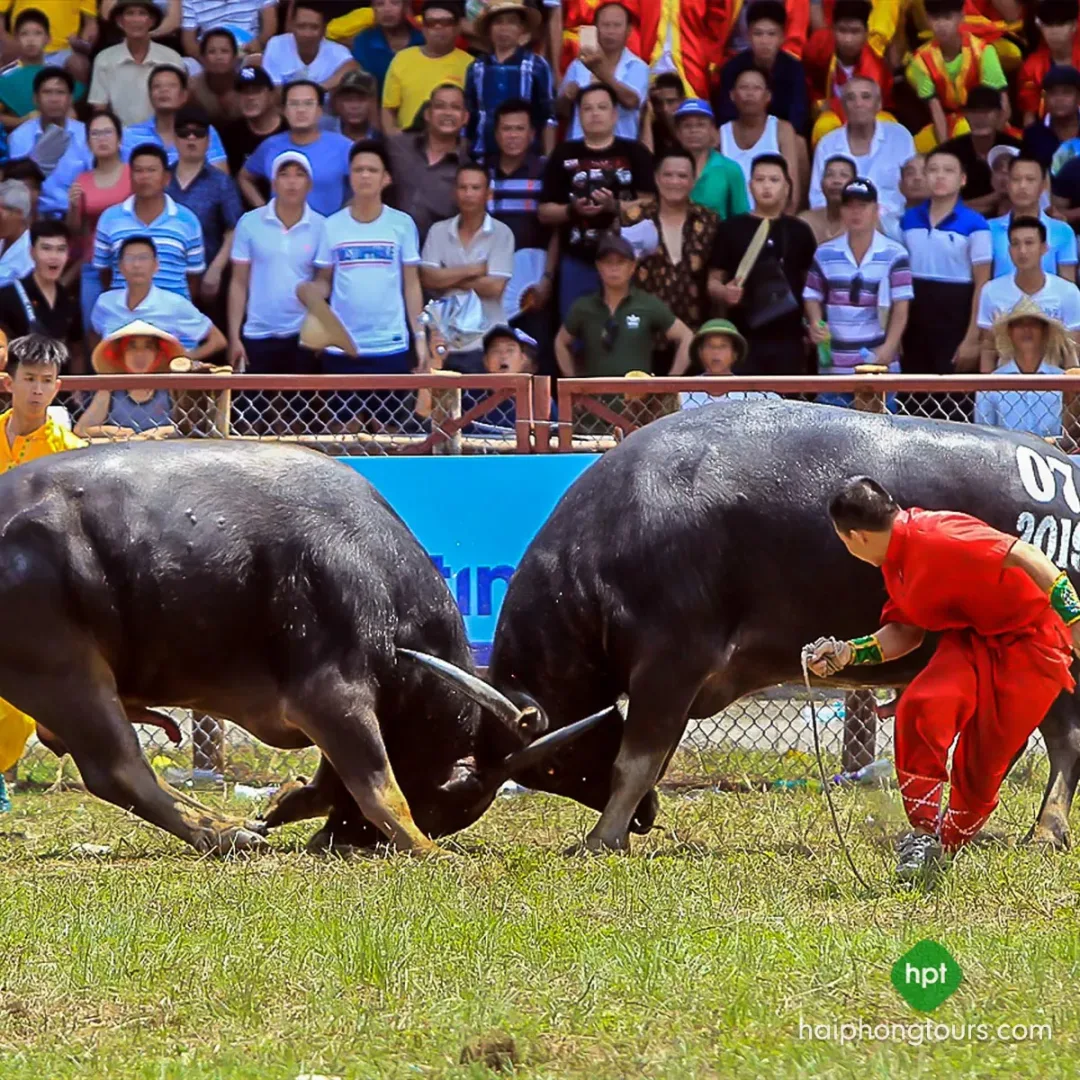
The Do Son Buffalo Fighting Festival is held in Do Son, Hai Phong, with the main contests at the Do Son Ward Central Stadium. It is not a buffalo fight on Do Son Beach. The annual final is associated with the ninth day of the eighth lunar month, so its Gregorian date changes each year.
For 2026, the final round is scheduled for 7:30 am on September 19. Admission arrangements and road controls can change close to the event. Confirm the latest notice from Do Son Ward, arrange transport in advance and arrive well before the announced start.
Do Son Buffalo Fighting Festival at a glance
- Main venue: Do Son Ward Central Stadium, Hai Phong.
- Traditional final date: the ninth day of the eighth lunar month.
- 2026 final: 7:30 am on September 19.
- Best plan for visitors: stay in Do Son the night before and use locally arranged transport to the stadium.
- Admission: never assume walk-in entry; follow the current official ticket or invitation instructions.
- Important content warning: this is real animal fighting, not a staged performance. Animals may be injured, and the tradition has included slaughter after competition.
How the festival calendar works
The festival is built around the lunar calendar rather than a fixed date in September. Older articles often describe only the final on the ninth day of the eighth lunar month, but the wider program can include ceremonies and qualifying matches on earlier lunar dates.
In 2026, organizers restored a qualifying round after an eight-year pause. Ceremonial activities began in July, and 32 buffaloes entered the qualifying stage. The final remains the main day for most visitors and takes place at the central stadium in Do Son.
Do not reuse a date from a previous year when planning a future trip. Check three separate details for your travel year:
- the Gregorian date and starting time;
- the admission method and gate-opening arrangements;
- temporary road closures, parking areas and vehicle drop-off points.
What the festival represents
The Do Son festival combines community worship, maritime beliefs, processions and an arena competition. Local communal houses and temples take part in the ritual program, and buffalo owners represent their communities rather than entering the event as an ordinary commercial sports contest.
The festival is recognized as part of Vietnam’s national intangible cultural heritage. Its meaning is broader than the matches alone: preparation, incense offerings, flag raising, drums, processions and community participation connect the event with Do Son’s coastal identity.
Stories about the festival’s origin vary, so treat a single dramatic legend as local folklore rather than settled history. The most useful way to understand the event is to observe how the ritual and community sections frame the arena competition.
What happens on the main festival day
The day usually begins early. Spectators pass security and find a place before the formal program and matches. Drums, flags and the presentation of the competing buffaloes create a loud, crowded atmosphere inside the stadium.
Two buffaloes enter for each contest. Their handlers withdraw before the animals engage, and a bout ends when one animal is defeated, retreats or is removed under the event rules. The exact number and order of matches depend on that year’s qualifying results and organizing plan.
Festival ceremonies also take place outside the arena. In the 2026 program, incense offering and flag raising involved Nghe Temple, Nam Hai Than Vuong Temple on Hon Dau Island and several local communal houses. These ritual locations should be treated as active religious and community spaces.
Animal welfare and whether the event suits you
This section matters for an informed decision: the buffalo fights are real. The animals can be injured, the crowd may respond intensely, and the traditional cycle has included slaughter after the contest. The event may be distressing for visitors who avoid animal combat or for children who are sensitive to violence, noise and packed seating.
You can learn about Do Son’s culture without attending the arena matches. Consider the public ceremonial program when access is permitted, or build a quieter day around the peninsula, temples and coast. The Do Son visitor guide explains the main areas and practical trade-offs.
If you attend, remain behind barriers and follow the directions of security staff. Never approach an animal, handler or holding area for a photograph.
Admission, tickets and invitations
Admission is not handled the same way every year. Organizers may use tickets, invitations, supporter arrangements or controlled free entry. Capacity limits can close a gate even when a large crowd is still outside.
For the 2026 qualifying round, the organizing committee issued admission invitations. That does not prove that the final uses the same system. Use a current notice from Do Son Ward or the event organizer for the final, and ask your accommodation to help interpret Vietnamese instructions if necessary.
- Do not rely on an old ticket price, old supporter shirt or social-media screenshot.
- Do not buy from an unofficial reseller simply because someone claims the gate will close.
- Check whether the document is for the qualifying round or the final.
- Confirm the correct year, date, venue, entrance gate and any identification requirement.
When official entry information is unclear, plan the Do Son visit so it still works without stadium access. This is safer than building the whole day around an unverified ticket.
Getting to the stadium
Stay in Do Son the night before
This is the lowest-risk option for the main festival morning. You avoid an early start from Hanoi and reduce exposure to traffic delays from central Hai Phong. Choose accommodation that can explain the current road-control area and help arrange an early drop-off.
Ask two practical questions at check-in: how far vehicles can approach the stadium and where the driver should meet you after the event. A normal map route may become unusable when streets are restricted.
Travel from central Hai Phong
Do Son is roughly 20–25 km from central Hai Phong. A car or taxi may take about 40–60 minutes in ordinary conditions, but festival traffic can add substantial time. For a 7:30 am start, leave enough margin for the road approach, walking, security and finding your section.
Pre-book both directions. Mobile data can slow in a dense crowd, ride-hailing pickup pins may be inside a closure, and many passengers will request vehicles at the same time.
Travel from Hanoi
A same-morning trip from Hanoi is possible only with a very early private departure and a generous delay margin. It is a poor plan if admission is still unconfirmed. Staying in Hai Phong or Do Son the previous night gives you a more reliable morning and time to adjust to a changed gate or road plan.
A practical festival-day plan
- The evening before: reconfirm the start time, entry document, gate and road restrictions. Save the venue name in Vietnamese for your driver.
- Early morning: eat before leaving, carry water if permitted and reach the controlled area well before the scheduled start.
- At the gate: use the entrance stated on your official document. Keep your passport secure and show only the identification actually requested.
- Inside: identify an exit and meeting point, stay behind barriers and protect your hearing if drums and crowd noise are uncomfortable.
- After the event: walk to the pre-agreed pickup point instead of repeatedly moving a ride-hailing pin through restricted streets.
What to bring
- a charged phone, local data and an offline copy of your accommodation address;
- the current ticket or invitation in the format required by the organizer;
- light rain protection and sun protection for exposed waiting areas;
- water and essential medication, subject to the venue’s security rules;
- a small bag that is easy to inspect and keep close in a crowd;
- closed shoes suitable for walking from a distant drop-off point.
Avoid bulky luggage, large tripods and anything that could obstruct another spectator. If you are continuing to an airport, ferry or cruise afterward, leave the luggage at your hotel or with a confirmed driver rather than bringing it to the stadium.
Photography and respectful behavior
Use a zoom lens or your phone from the spectator area. Do not cross barriers, block aisles or pressure handlers and worshippers to pose. Ask permission before making a close portrait of a local participant.
At temples and communal houses, dress modestly, lower your voice and keep entrances clear. A ceremony is not automatically open for visitors to stand anywhere they choose. Follow local instructions even when other spectators appear to ignore them.
What to do in Do Son if you skip the arena
A backup plan makes sense because admission and weather can change. You can walk a public section of the coast, eat seafood, visit Ba De Temple when access is open, or continue toward the Hon Dau area. If you go to the island, check the current boat arrangement and allow time for worshippers; the Hon Dau Island guide explains the visit.
Do not try to combine the festival morning with too many fixed bookings. Traffic dispersal after the matches is difficult to predict, and the coast is more enjoyable when you can wait for the crowd to thin.
Frequently asked questions
Is the Do Son Buffalo Fighting Festival held on the beach?
No. The main contests take place at the central stadium in Do Son. Beaches and other parts of the peninsula may be busy during the festival, but they are not the fighting arena.
What time should I arrive?
Arrive well before the announced start. For a 7:30 am program, your plan should include time for traffic controls, a walk from the drop-off point, security and finding the correct gate. An early arrival does not replace the need for valid admission.
Can foreign visitors attend?
Foreign visitors can attend when they meet the same current entry conditions and the venue has capacity. Instructions may be published mainly in Vietnamese, so ask a trusted local contact or your hotel to verify them.
Is the festival suitable for children?
Parents should consider the real animal fighting, possible injuries, loud drums, intense crowd reactions, heat and limited freedom to leave a packed area. A quieter Do Son cultural visit may suit young or sensitive children better.
Can I buy buffalo meat after the festival?
Do not treat an unlabelled roadside offer as proof of origin or food safety. If you choose to buy meat, use an authorized seller, check storage and labelling, and avoid carrying perishable food for a long onward journey.
The Do Son Buffalo Fighting Festival is culturally significant and logistically demanding. Attend only after confirming admission and accepting what the animal contests involve; otherwise, use the day to explore Do Son’s coastal and religious heritage at a calmer pace.