
Cao Thon incense village in Hung Yen suits travelers who want to understand how fragrant incense is made inside a working household. The useful visit follows the material from aromatic powder to a coated stick or coil, with time to talk to a maker and walk through the village. Arrange a receiving household and an explanation in English before leaving Hanoi.
As a planning estimate, allow around two hours in the village and keep a generous half-day for the complete Hanoi outing. A detailed photography session, a hands-on activity or a second Hung Yen destination needs more time. Outdoor drying depends on the weather and the day’s work, so make the craft itself part of your reason for going.
Find Cao Thon in Hung Yen
Use Làng nghề hương xạ Cao Thôn, phường Sơn Nam, Hưng Yên when arranging the journey. Older descriptions place it in Bao Khe commune, Hung Yen city. The village is beside the Red River dike in the area north of the old Hung Yen urban center.
Ask for the actual household entrance and the person receiving you. A village pin locates the craft community, but it does not tell a driver which private courtyard you have permission to enter. Keep the host’s phone number available for the final approach.

Cao Thon and Quang Phu Cau incense village are different destinations. Quang Phu Cau is southwest of Hanoi and has managed photo courtyards alongside production. Cao Thon is a Hung Yen craft outing; specify its name when asking for an incense-village trip.
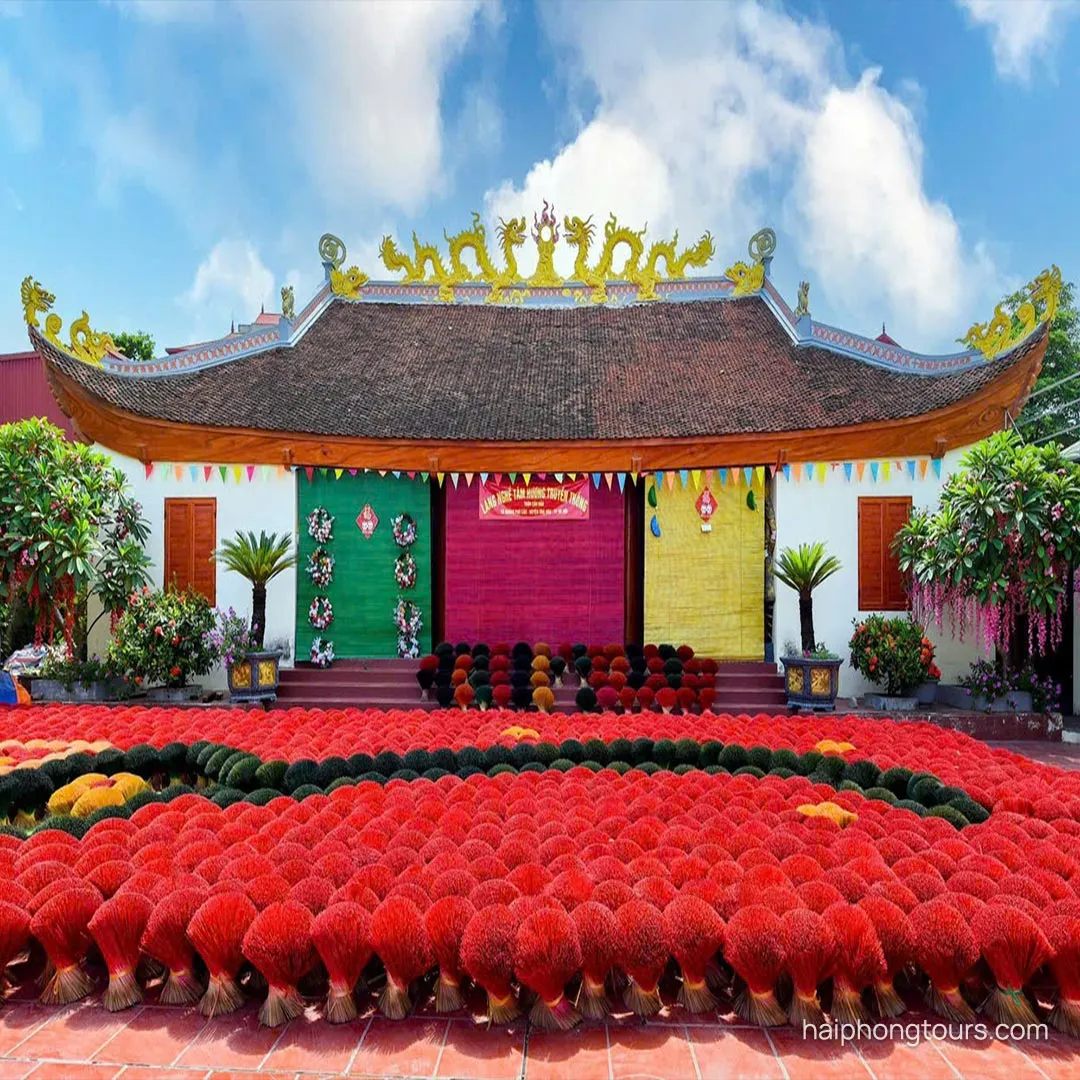

Look at the incense beyond its color
Cao Thon’s makers produce several forms, including ordinary incense sticks, larger sticks and spiral coils. Comparing these is a useful way to begin: the familiar straight stick is only one way of shaping the fragrant material.
Family recipes can combine ingredients such as cinnamon, star anise, cloves and licorice in different proportions. Ask your host to identify a few ingredients and explain their roles. Understanding the texture and preparation of the mixture is more realistic than expecting a family to disclose its complete recipe.
During production, material is prepared and mixed, formed or applied to the sticks, dried and packed. Hand skills and machinery can work together. Ask which stages are happening during your appointment, rather than assuming a short visit will follow one batch through every stage.
A good demonstration gives you something specific to notice: how evenly the coating sits around the core, how the maker handles a fresh piece and how coils keep their shape. Let the host select an object you may handle; fresh incense and a fully dried product need different care.
Book observation, photography or a lesson explicitly
These are different experiences. An observation visit needs a household that is working and willing to explain. A photography visit needs permission for the people, courtyard and arrangement you want to photograph. Trying a production step requires someone to teach and supervise it.
BUTA Trans – Luxury Tours, operating the Hanoi Day Tour website, lists a private Cao Thon outing with a household visit, village walk, English-speaking guide, car and lunch. Ask for the Cao Thon itinerary by name and obtain confirmation for your date.
The listed day continues to Ecopark after lunch. If you want a village-only return or a Pho Hien heritage stop instead, request a revised itinerary and price. A shorter trip, different destination or hands-on lesson is not automatically included in the published program.
- For understanding the craft: request a maker-led explanation with English interpretation and enough time at one household.
- For making something: name the activity you want to try, give the ages of children and confirm supervision, materials and any additional charge.
- For photographs: show the kind of image you have in mind and ask whether it needs a special setup or paid participation.
Have the final quote identify transport, guiding, household arrangements, meals and any photography or activity fees. Confirm what happens if the household cannot receive you or rain prevents the outdoor part. A visit to a production home is more specific than a car booking to the village.
Plan around drying conditions
Choose a dry morning when the host expects to have incense outside. Sunshine helps the drying process, but an early arrival does not guarantee that racks and bundles are already in place. Set the arrival time with the household after explaining whether photographs or the workshop matter most.
If rain is likely, decide whether you still want the indoor explanation and whatever work is available. Confirm covered visitor space rather than assuming an entire workshop can receive a group out of the rain. If the outdoor scene is essential, agree a date change before paying.
Incense demand rises before Tet, Vietnam’s Lunar New Year. Busy production can make the work interesting to observe, but it also leaves the household less time to host. Arrange an appointment, and check holiday dates separately from the weeks of preparation.
Make the household visit comfortable
Wear shoes suitable for village lanes and clothing that can tolerate powder or a dye mark. Keep bags away from work surfaces and leave clear routes between equipment and drying areas. Children need close supervision around machinery, sticks and freshly formed products.
Strong fragrances and fine powder are part of what you should discuss with the host before entering a production room. If either bothers you, request a shorter explanation in an airy space. You do not need incense to be burned beside you to appreciate how it is made.
Ask before taking portraits or filming a process. Do not move bundles, enter a courtyard uninvited or ask someone to stop work repeatedly for a picture. If a posed demonstration is arranged, settle the participation fee through your guide in advance.
For limited mobility, check the route from the vehicle to the chosen household, thresholds, seating and toilet access. A village walk can be shortened, but that does not establish that every workshop is step-free.
Combine Cao Thon with one clear second interest
For a craft-and-history day, combine the village with a selective Pho Hien temple and pagoda route. Choose one or two monuments after lunch, such as Chuong Pagoda or Thien Hau Temple, rather than adding the entire heritage circuit. Agree the household appointment first, then arrange the rest of the day around it.
If another working craft interests you more, compare Thu Sy’s bamboo fish-trap makers. That is a second household visit with its own receiving arrangements and travel leg. Two craft stops work only when both hosts have confirmed and your driver has allowed enough time between them.
Buying incense at the end of the visit
Tell the maker whether you want finished incense for use or a small craft souvenir. Compare the size, form and scent of the actual product, and ask for the producer’s name on its packaging. A brightly colored bundle and a ready-to-burn product are not necessarily the same purchase.
Choose a quantity you can pack without breaking the sticks or coils, and ask how to keep it dry during your onward journey. The strongest reason to visit Cao Thon is the chance to understand the work behind a familiar Vietnamese object; a well-arranged hour with a maker can matter more than collecting photographs at several doorways.
Would you like help fitting this experience into your trip? Contact us with your travel dates, starting point, available time and group size. Tell us about walking limits or special interests so we can suggest a practical itinerary.