
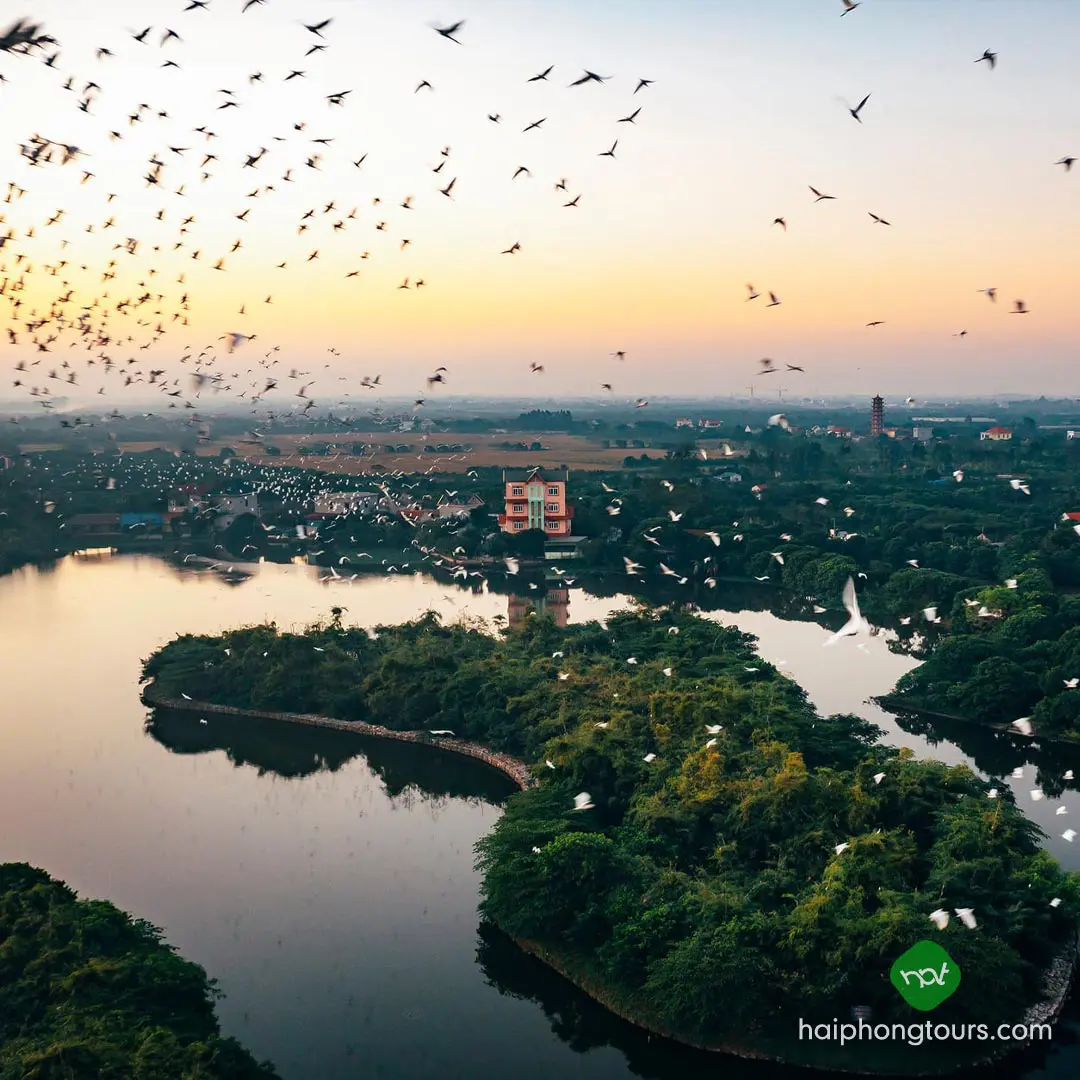
Chi Lang Nam Stork Island, or Dao Co Chi Lang Nam, is a waterbird colony on An Duong Lake in Hai Phong. Visit for birds flying over the lake and gathering in the bamboo-covered islands, with a choice of watching from the shore or taking a boat trip.
Late afternoon can be rewarding as birds return to roost, but arrange your visit around the site’s opening hours and last boat. This is a wild bird colony: the number of birds, their movements and the species you see vary with the season, weather and time of day.
Where is Chi Lang Nam Stork Island?
The site is in An Duong village, Nam Thanh Mien commune, Hai Phong. Older maps and travel information place it in Chi Lang Nam commune, Thanh Mien district, Hai Duong province. Both names refer to the same destination around An Duong Lake.
Use Dao Co Chi Lang Nam and the lake location when arranging transport. It is in the inland countryside, so plan from your actual starting point rather than treating it as a quick stop near central Hai Phong’s waterfront or Cat Ba.
What you can see
The familiar English name is Stork Island, but the colony includes egrets, herons, night-herons and other waterbirds. Watching their movements between the lake, bamboo and surrounding countryside is the main attraction. Binoculars make it easier to observe birds without approaching the nesting areas.
Toward evening, daytime-feeding birds may return while night-herons begin to leave to feed. Allow time to watch from one position rather than expecting the largest flocks as soon as you arrive. The site received national scenic recognition in 2014.
Choose shore viewing or a boat trip
Watching from the shore
Shore viewing suits visitors who want a steady position for binoculars or prefer to avoid a small boat. Ask staff which public viewing areas are open and have a clear view of the colony. A patient stop can reveal birds landing, changing perches and moving between the islands.
If your group includes someone with limited mobility, check the distance and surface between the drop-off point and the viewing area. Do not assume every lakeside path or boat boarding point is accessible.
Going onto An Duong Lake
Boat trips give a different perspective on the islands. Start with the visitor information at the entrance or boat pier, where you can check routes, service prices and visiting rules. Hai Phong Tours recommends choosing from the boats operating that day rather than planning around a particular boat type shown in an old photograph.
- Confirm the trip length, route and whether the fare is per person or per boat.
- Ask about children’s fares, boat capacity and correctly fitting life jackets.
- Check whether entrance, parking and the boat ride are charged separately.
- Confirm the last departure and return time before planning an evening trip.
Keep your distance from the nesting islands and follow staff directions. Taking a boat onto the lake does not mean you can land wherever you choose or approach nests for a closer look.
Planning the timing and journey
Bird activity changes through the year. If seeing a particular species or nesting behavior matters to you, ask the site about recent observations before setting your travel date. Avoid building the trip around a guaranteed migration spectacle.
For afternoon viewing, arrive early enough to check access and boat arrangements in daylight. Dawn can also be an active time for birds, but confirm that visitor access is available before organizing an early departure from your hotel.
Arrange the return journey as well as the outward trip, especially if you hope to stay until late afternoon. Give your driver the exact destination, agree on the waiting arrangement and leave room for rural roads and weather. Bring drinking water, sun or rain protection, insect repellent and shoes with grip.
Watching without disturbing the colony
- Keep voices low and leave music and bird-call recordings off.
- Use binoculars or a zoom lens instead of moving closer to active nests.
- Do not try to make birds take flight for a photograph.
- Stay in permitted visitor areas and keep children close around the water.
- Take litter away and avoid damaging vegetation along the shore.
Add a farm visit at Phong Co Farm
Phong Cò Farm, in nearby Trieu Duong village, Nam Thanh Mien commune, offers a different countryside stop alongside the lake. Its growing areas include seasonal melons and tomatoes in protected houses, fruit trees, flowers and a lotus garden. This is a working agricultural visitor site; the crops and activities available will depend on the growing cycle.
Before adding it to your day, ask your accommodation or the Dao Co visitor-information staff to help confirm farm reception, the exact entrance and any visit charges. If you want to pick or taste produce, arrange that specifically rather than assuming entry includes a harvest activity. Confirm any English guidance you need.
A confirmed farm visit can fit before late-afternoon birdwatching, leaving the lake as the main event. Treat the farm and bird site as separate visits, with separate access arrangements and charges. Plan this as a day outing; book overnight accommodation separately rather than assuming the farm name guarantees an operating farmstay.
If you want to add local culture, ask ahead about visiting Nam Pagoda or Hoi Yen’s rice-paper-making area. A village visit and a hands-on workshop are different arrangements; do not assume demonstrations or production will be available when you arrive.
Chi Lang Nam works well as a focused countryside birdwatching visit. Give the lake enough unhurried time, keep expectations flexible and confirm the day’s access before setting out.
Would you like help fitting this experience into your trip? Contact us with your travel dates, starting point, available time and group size. Tell us about walking limits or special interests so we can suggest a practical itinerary.