
Visit Co Chat if you want to understand how a silkworm cocoon becomes usable thread. In this working village near Nam Dinh, the interesting part is the reeling process: hot water, fine filaments, turning reels and the skill needed to keep the thread running. Nearby Cu Tru adds a different subject, fabric weaving, if you can arrange access to a working loom.

Make a receiving workshop the starting point of your plan. These are household production areas, with work depending on orders, materials and the people available that day. A confirmed explanation of one process is more valuable than arriving unannounced and expecting an entire village of demonstrations.
Where Co Chat and Cu Tru fit into a trip
Both villages are in Ninh Giang commune, Ninh Binh Province, in the former Nam Dinh area beside the Ninh Co River. Older maps and business addresses use Phuong Dinh commune, Truc Ninh district, Nam Dinh. Those older names are useful for finding the village, but a general “Ninh Binh” destination is much too broad for a driver.
Ask the receiving person for the exact workshop pin. Co Chat and Cu Tru are separate villages; do not assume a meeting arranged in one includes the other. From a Nam Dinh base, plan the workshop appointment and your return transport together. From Hanoi, allow a full day for the road journey, the craft visit and a meal.
If you mainly want to compare scarves and buy finished fabric close to Hanoi, Van Phuc Silk Village is the more direct choice. Co Chat makes sense when seeing the production of the thread itself is worth the longer trip.
Follow the thread through Co Chat
Reeling and weaving are different operations. Reeling draws filaments from cocoons and gathers them into thread; weaving interlaces threads to make cloth. Keeping that distinction in mind helps you understand a workshop even before you have a detailed translation.
Begin with the cocoons
Ask to see the material before it reaches the hot-water basin. Compare the cocoons with the finished thread and let the maker explain which ones are suitable for that day’s work. Do not assume the household also grows mulberry leaves or raises the silkworms: producers now obtain cocoons from other regions as well.
This is also the point to establish what you have booked. Watching a maker prepare cocoons is different from handling tools yourself. Keep children beside you around hot water and operating equipment, and follow the worker’s instructions about where to stand.
Watch the hands as well as the reel
At a reeling station, look for how the worker finds the filaments, guides them from the water and maintains a continuous thread. The reel’s motion is easy to photograph; the repeated adjustments are what explain the skill. Ask the guide to translate the maker’s explanation when a thread breaks or a cocoon needs replacing.
Handwork and machinery coexist in Co Chat. Some households use powered equipment for stages such as twisting and winding. Seeing a motor does not mean you have come to the wrong place: it is part of how working families adapt production. Ask which stage is happening rather than judging the whole process from one machine.
Compare thread, drying skeins and finished fabric
Outdoor skeins are a familiar image of Co Chat, but drying depends on the weather and the stage of production. Arrange the visit around a working household rather than a promise of golden thread covering every lane. A wet day may still allow an indoor explanation while offering a very different photographic scene.
When samples are available, compare the thread before and after processing, then look at a finished fabric. Ask which stages this household completes and which happen elsewhere. That gives you a clearer understanding of the craft than assuming one family produces every item from silkworm to garment.
What Cu Tru adds
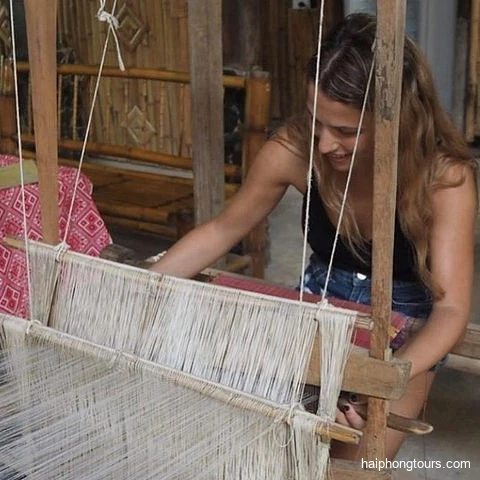
Cu Tru is useful for understanding weaving as a continuing village industry. Its output includes everyday fabrics and textiles such as towels, and motorized looms form part of present-day production. Expect a working environment rather than a room of antique handlooms arranged for visitors.
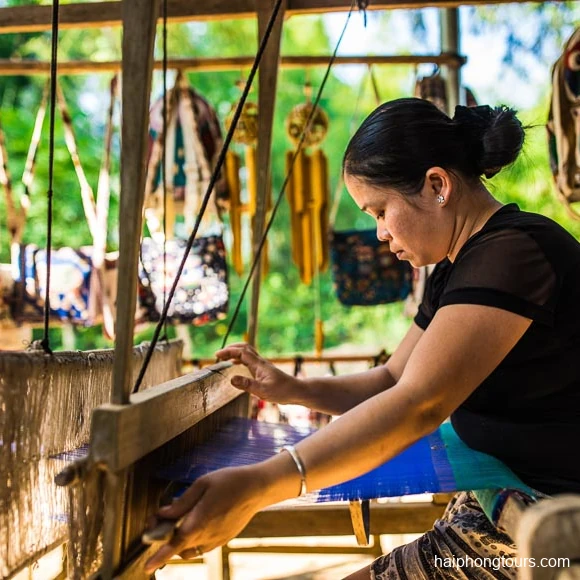
At a receiving workshop, ask to identify the lengthwise warp, the crosswise weft and how the loom changes those threads into cloth. Establish the material being woven: a village’s historic connection with silk does not mean that every current product is pure silk. The sound, repeated movement and practical layout can be as informative as the finished item.
Add Cu Tru when you have a confirmed loom visit or a particular interest in textiles. If only the Co Chat appointment is available, spend the time there instead of searching private doorways for an open workshop. A short lane walk is not a substitute for permission to enter a production room.
Arrange a visit that matches your interest
Chat Silk, the Co Chat Silk Cooperative, lists and for inquiries. Use the contact to explain whether you want to see reeling, discuss fabrics or buy a particular product. Obtain an agreed meeting time and location before traveling; a product inquiry line is not a promise of walk-in factory tours.
For a guided countryside arrangement, Ecohost includes Co Chat in its craft experiences. Specify both village names if you want the paired visit, and ask for the actual receiving workshops and English interpretation in the proposed itinerary.
- Production: identify the operation expected to be running on your date, rather than requesting a general “silk tour.”
- Participation: distinguish watching, an explanation and any supervised activity you may actually try.
- Price: separate the host or demonstration charge, interpretation, transport, lunch and purchases.
- Access: ask about the distance from the vehicle to the workroom, seating and a usable restroom if these affect your visit.
As a planning allowance, give one arranged workshop around an hour to 90 minutes. Reserve a half-day locally if you want two workshops, a village walk and time to choose a purchase. These are itinerary allowances, not advertised tour durations.
Buy something you can connect to the maker
Co Chat is not limited to selling raw thread. The cooperative’s range includes fabric, scarves, bedding and smaller accessories. If you want one of these, ask what will actually be available at the meeting place rather than assuming every online item is stocked in a village showroom.
Before paying, establish who produced the fabric, its fiber composition, its dimensions and its care instructions. For fabric by length, confirm the width as well as the amount you are buying. Keep the receipt and the maker’s contact with the item, especially if you are ordering something to be finished or delivered later.
A workshop purchase can make the production explanation tangible: you leave knowing which stages you saw and how they relate to your textile. Choose an item for that connection and its usefulness, rather than treating a village name alone as proof of every product claim.
Keep the rest of the day manageable
For a first Nam Dinh craft day, build around the confirmed workshop, lunch and one contrasting cultural stop. Co Le Pagoda adds religious architecture without requiring another craft appointment. Let your driver arrange the order around the workshop’s working time.
For a village architecture walk between appointments, consider Dich Diep Ancient Village, also in Ninh Giang. Its old gate, stone bridge and curved household gateways give you a different subject from the textile process. Hai Phong Tours recommends keeping this as a walk unless a house or weaving workshop has separately agreed to receive you.
If you are staying farther toward Hai Hau, place the craft visit into the journey to or from your accommodation. Avoid filling the same day with several churches, a coastal excursion and an unconfirmed second village. Co Chat is most rewarding when there is time to follow the process and hear a maker explain it.
Would you like help fitting this experience into your trip? Contact us with your travel dates, starting point, available time and group size. Tell us about walking limits or special interests so we can suggest a practical itinerary.