
Cua Bac Church holds its regular Sunday English Mass at 10:30 a.m., according to the Archdiocese of Hanoi’s current directory. At 56 Phan Đình Phùng, the church also makes a rewarding architecture stop near Hanoi’s old citadel. Decide whether you are coming for worship or sightseeing: a service time does not establish a visiting session for photographs or an interior tour.
Address, access and the right contact
Give your driver Nhà thờ Cửa Bắc, 56 Phan Đình Phùng, phường Ba Đình, Hà Nội. The church stands near the Nguyễn Biểu junction. Include the street number because “Cửa Bắc” also names the citadel’s North Gate, a separate landmark. Older descriptions use Quán Thánh ward; the current archdiocesan address uses Ba Đình ward.
The parish notice page is Giáo Xứ Cửa Bắc – TGP Hà Nội, with the Facebook handle giaoxucuabac. The Archdiocese links directly to this page from its parish profile. Check its notices for your date, particularly at Christmas, Easter and other important celebrations.
If you need a parish referral, the Archdiocese’s reception number is 024 3825 4424, or +84 24 3825 4424 from overseas. This is the archdiocesan office, not a dedicated sightseeing line at Cửa Bắc. Start with the parish page for a local visit enquiry.
A separate tourist admission tariff and fixed daily sightseeing hours are not published on the official parish profile. Confirm access if entering the building is essential. Allow approximately 30 to 45 minutes for an architecture visit, as a planning estimate, with an exterior-only visit as the fallback when parish activities occupy the church.
Regular Mass times and how to attend
The Archdiocese’s parish profile and city Mass directory agree on this regular timetable. Times are Hanoi local time.
| Day | Mass times | Practical note |
|---|---|---|
| Monday to Friday | 19:00 | Evening worship |
| Saturday | 06:30 and 19:00 | Morning and evening services |
| Sunday | 06:30, 08:30, 10:30 and 19:00 | 08:30 is the children’s Mass; 10:30 is in English |
The directory lists confession at 09:45 before the Sunday English Mass, as well as Thursday and Friday at 19:30 in the regular parish timetable. If you need a particular language, contact the parish beforehand, especially for a weekday appointment.
For the Sunday English Mass, we suggest arriving around 10:10 to 10:15. This gives time to find the entrance and a seat without interrupting the service. Keep your lunch or next activity flexible because an official finishing time is not published.
If you are unfamiliar with Catholic worship, follow the ushers’ directions and observe quietly from your seat. Ask a parish volunteer beforehand if you are unsure about participation in Communion. Silence your phone, avoid flash and leave architectural photography until an appropriate moment outside the service. A tour guide should also pause commentary while worship is taking place.
Read the architecture in three stages
Start with the tower and overall shape
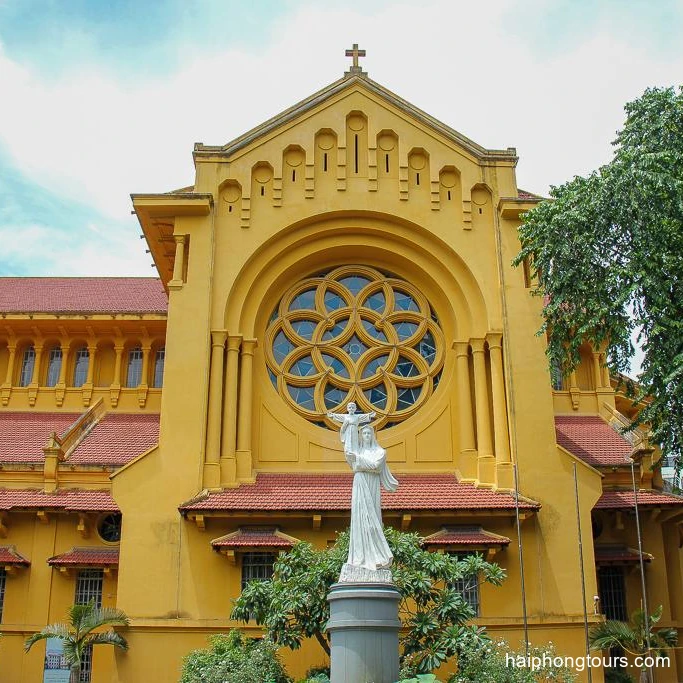
Stand where you can take in the whole church before concentrating on details. Its tall bell tower sits to one side of the main entrance, while a dome marks the central part of the building. The composition is deliberately uneven in its large volumes. Following the tower, dome and connecting roofs with your eye makes this easier to appreciate than taking only a close-up of the facade.
Look for the selected Asian details
A study in the Vietnam Association of Architects’ journal identifies the small tiered roof above the bell-tower entrance and the octagonal decoration on the transept facade as specific East Asian elements. The transept is the section crossing the church’s main body. These are useful details to locate when a general description such as “Indochinese architecture” feels too broad.
The study emphasizes that the overall form remains recognizably that of a Western church. Try comparing one wide photograph of the composition with a closer photograph of a roof detail. This records how the different architectural elements work together. For a wider route, our North Vietnam architecture guide places Hanoi’s religious buildings alongside civic architecture and trading streets.
Read the interior from an appropriate visitor position
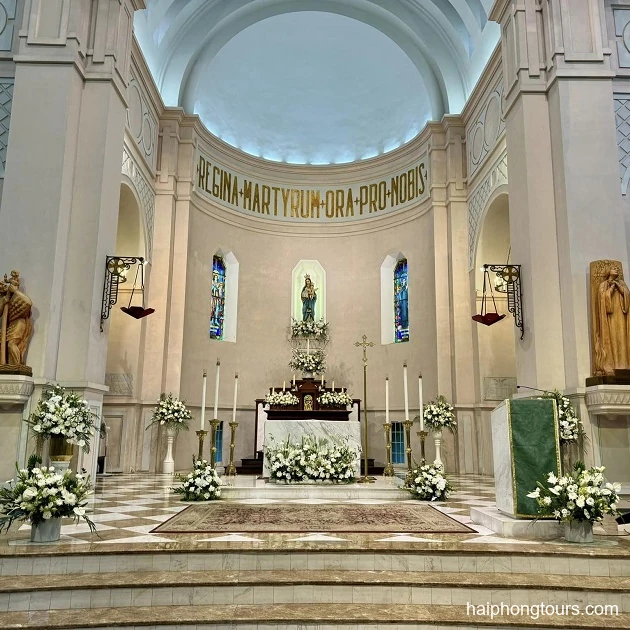
When entry is permitted, notice the long main space, the parallel rows of columns and the transition beneath the dome toward the sanctuary. The parish’s description identifies the sacristy, or nhà áo, on the left. It is a working religious space, so remain within the area indicated for visitors rather than treating side rooms as exhibition galleries.
Look along the main axis before taking photographs. If people are praying, remain behind them and keep doorways and seats accessible. An open door may be for service preparations or a private ceremony; let parish staff indicate whether a short visit is appropriate.
The church’s name and historical milestones
The National Archives Centre I traces the project through correspondence between Father Dronet and architect Ernest Hébrard. Its account records a request in 1923, the laying of the foundation stone on 4 December 1927 and the formal inauguration on 1 February 1931. The church’s position beside the northern side of the old citadel explains the familiar name Cửa Bắc, meaning “North Gate.”
The current parish dedication is Đức Mẹ Hà Nội, or Our Lady of Hanoi. You may also encounter the earlier title Queen of Martyrs. A further important date is 4 November 2014, when the restored church was dedicated after a 19-month restoration. This ceremony belongs to the building’s modern history, rather than its original opening.
Two practical ways to arrange the morning
Architecture and history: after confirming parish access, allow a 09:00 to 09:45 church stop, then take time to see the separate North Gate from the street. Continue to the visitor entrance of Thăng Long Imperial Citadel at 19C Hoàng Diệu. Allow the rest of the morning for the citadel and arrange its admission separately. These are suggested itinerary times, not church opening hours.

Sunday worship: have breakfast first, arrive early for the 10:30 English Mass, then take a relaxed lunch. Put a museum or citadel visit in the afternoon if you want another substantial stop. Avoid inserting an interior photography tour between Sunday services without parish agreement.
For a mixed group, agree whether everyone will attend Mass. Anyone choosing another activity should have a clear meeting place and flexible collection arrangement. If the church interior is unavailable, the surrounding streets and the citadel can still support a useful morning without waiting indefinitely at the door.
Clothing, photography and access needs
Wear clothing that covers shoulders and knees, remove hats inside and keep voices low. Ask before photographing individuals or using a tripod. Leave food and drinks packed away in the worship space. The religious-site etiquette guide gives further advice for combining different places of worship in one trip.
Travellers needing step-free access should establish which entrance is usable and whether assistance is available before setting out. Confirm vehicle drop-off and any toilet needs at the same time. For groups, send the date, proposed arrival time, number of people and purpose of the visit together; an English Mass does not imply that an English architectural guide is available.
Fit Cửa Bắc into a Hanoi morning. Contact Hai Phong Tours with your dates, hotel, group size and preferred focus: English Mass, architecture or a nearby heritage route. Tell us about access needs and fixed onward bookings so the proposed plan leaves enough time.