
Visit Cuc Phuong’s Carnivore and Pangolin Conservation Education Center for a closer understanding of rescued wildlife and the reasons some animals remain in long-term care. Arrange the visit through the national park and ask specifically for this center. A general reservation for the “rescue centers” can leave the actual stops unclear.
A confirmed late-afternoon session is a useful choice when animal activity matters to you. Give the visit its own space in the day, with interpretation and return transport arranged. It is a managed education experience, not a forest search for wild pangolins or an opportunity to handle them.
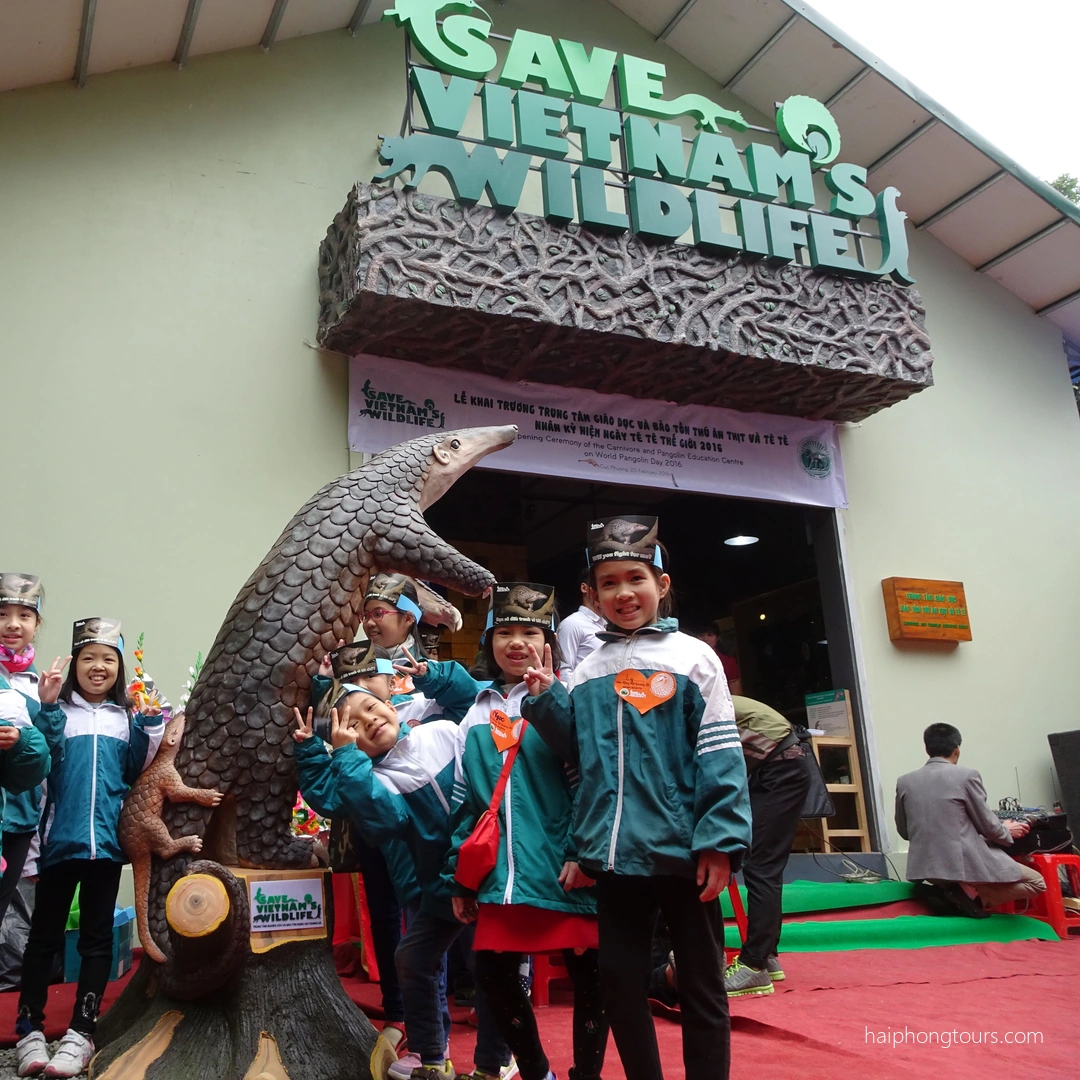 Visitors at the education center’s opening in 2016.
What you will learn at the center
Save Vietnam’s Wildlife’s education program uses interactive exhibits to introduce carnivores, pangolins and the pressures of hunting and wildlife trade. The animal residents used for education are rescued individuals that cannot return to the wild.
Keep the exhibition and animal-viewing parts of the visit equally important. A quiet enclosure need not be the end of the conversation: ask about the resident’s background, its natural behavior and the care it needs. The guide’s explanation may be more revealing than a brief glimpse.
The public program includes pangolins, otters, civets and a wild cat among its educational animals. This is not a checklist of animals you will definitely see. Accept the route and viewing arrangements offered on your date; a ticket does not give access to treatment or other restricted areas.
A pangolin is a mammal, despite its scales
Pangolins have overlapping keratin scales, made from the same material as human nails. They feed mainly on ants and termites, using a long, sticky tongue, and are predominantly nocturnal. Curling into a ball is a defensive response, not a pose to request for a photograph.
Those details make useful observation prompts. Look at the outline of the body and the arrangement of the scales, or ask how its diet shapes daily care. If the animal is resting out of view, use the displays and explanation instead of trying to attract it.
Illegal hunting and trade in meat and scales are major threats to pangolins. Do not buy wildlife products or pay for a handling photograph elsewhere on your trip. A conservation visit is most useful when what you learn changes choices beyond the center.
Arrange the correct admission and interpretation
For a tourist visit, contact the park’s Center for Environmental Education and Services. Name the Carnivore and Pangolin Education Center, also associated with the abbreviation CPCP, rather than asking only for a Cuc Phuong ticket.
Send the date, number of visitors, children’s ages and the language you need. Ask for the meeting pin, session length, available interpretation and total cost. Confirm whether the selected admission includes both the park and this center, and whether an interpreter or internal transport costs extra.
For a research or educational group visit, contact Save Vietnam’s Wildlife in advance. Its education inquiry service is different from the park booking office and the wildlife-rescue hotline.
Do not treat an English website or a guide included in a broader package as confirmation of English interpretation for your session. If discussion is the main reason for coming, settle that detail before booking the car.
Choose an afternoon session or an authorized evening program
Many of the center’s animals are more active later in the day. Ask about a visit from around 3 p.m., leaving time to look, listen and depart without rushing. Confirm reception on your date rather than arriving during the midday break.
Ordinary daytime activities in the park must finish before 7 p.m.; later activities require authorization. An evening visit therefore needs a confirmed park program. Overnight guests also cannot independently enter the deep forest at night.
The park’s Dau Chan Tien Su & Ky Quan Rung Gia program offers a daytime conservation circuit and a separate overnight option with an evening carnivore-and-pangolin stop. Ask which version includes the experience you want. Meals appearing in an itinerary are not necessarily included in its quoted package price.
If combining this with a night outing, use the Cuc Phuong evening-program guide to plan the return or overnight stay. Firefly viewing is seasonal; it should not be the condition on which a conservation visit is worthwhile.
Keep the rest of the itinerary manageable
Choose one other main activity rather than trying to collect every conservation stop. The Endangered Primate Rescue Center is a separate visit focused on langurs, gibbons and other primates. Confirm both sessions before assuming they fit together.
For a Ninh Binh or Tam Coc day trip, arrange a waiting driver or an agreed return collection. Give the driver the confirmed meeting point and finish time, including any evening extension. The Cuc Phuong from Tam Coc guide explains the wider road journey and transport inside the park.

Bring shoes suitable for outdoor paths, drinking water and a rain layer. Ask about the complete visitor route if steps, standing or uneven ground are difficult. Explain to children beforehand that quiet observation is the activity: follow staff directions about distance, lighting and photographs, and never offer food or reach toward an animal.
Leave with an answer to one specific question, such as why an animal needs permanent care or how its feeding behavior differs from an animal you already know. That gives the visit a clearer purpose than counting sightings.
Would you like help fitting this experience into your trip? Contact us with your travel dates, starting point, available time and group size. Tell us about walking limits or special interests so we can suggest a practical itinerary.