
For three travelers, a triple cabin is usually the simplest starting point. For four, compare one family cabin with two cabins joined by an internal door. Families of five or six normally need a confirmed connecting arrangement or several cabins; the phrase “family room” does not prove that every guest has an approved bed.
Choose by the exact mix of adults and children, who can share a bed, and how much privacy you need. Ask for the vessel, cabin names, bed layout, bathroom count and total price in writing before paying. These are overnight cruise arrangements; a private room on a day cruise is a different product.
Quick choice for families of 3, 4, 5 or 6
- Three people: request a triple cabin with either three singles or one double plus one single. A child sharing the parents’ bed is a fare arrangement, not a third bed.
- Four people: compare one family cabin with a verified four-person layout against two internally connecting cabins. Check whether you get one or two bathrooms.
- Five people: look for a connecting unit approved for five, or compare a triple cabin plus a double or twin. Identify a sleeping place for every guest.
- Six people: two approved triples or three double/twin cabins are often easier to verify than a loosely described family suite. A cabin advertised for four adults and two children is not automatically suitable for six adults.
For three adults, confirm how the third bed is supplied
A cabin approved for three guests may have three single beds, one double plus one single, or a standard layout with an approved extra bed. The word “triple” confirms occupancy only when the operator accepts all three travelers; it does not guarantee three permanent beds or three separate sleeping surfaces.
Three friends or colleagues should request three separate beds in writing. If the third place is a rollaway or sofa bed, confirm its sleeping dimensions, additional charge and position when opened. Ask whether luggage can still be stored without narrowing the route to the bathroom or cabin exit.
Shared family cabin or connecting rooms?
One shared family cabin
A single cabin keeps parents close to younger children and can be easier at night. It also means that lights, conversations and early bedtimes affect everyone. Check the floor plan: a large advertised area does not guarantee separate sleeping zones or more than one bathroom.
Ask whether the stated beds are permanent, rollaway beds or converted sofas. If a cot or extra bed is added, confirm where it goes and whether luggage can still be stored without blocking the bathroom or exit.
Two cabins with an internal connecting door
Connecting cabins suit families who want separate sleeping areas while retaining direct access between rooms. Confirm that the booking includes both cabins and a usable internal door. The words “adjacent,” “nearby” and “same deck” usually mean access through a public corridor.
Check the beds and bathroom in each room. A connecting pair may provide two bathrooms, but the room name alone does not guarantee that. Ask whether the internal door can remain unlocked from both sides in the arrangement assigned to your family.
Several separate cabins
Separate cabins can work for adults, teenagers or a multigenerational group that values privacy. They are less suitable when young children would be alone across a public corridor. Confirm the operator’s rules on how adults and children may be allocated before choosing this plan.
Current cabin examples worth comparing
Renea: triple and connecting cabins in Bai Tu Long Bay
Renea lists an 18-square-meter Deluxe Triple with either one double plus one single or three single beds. Its 30-square-meter Family Connecting Cabin combines two interconnecting rooms and is presented for up to five guests, with the bed arrangement depending on the requested configuration.
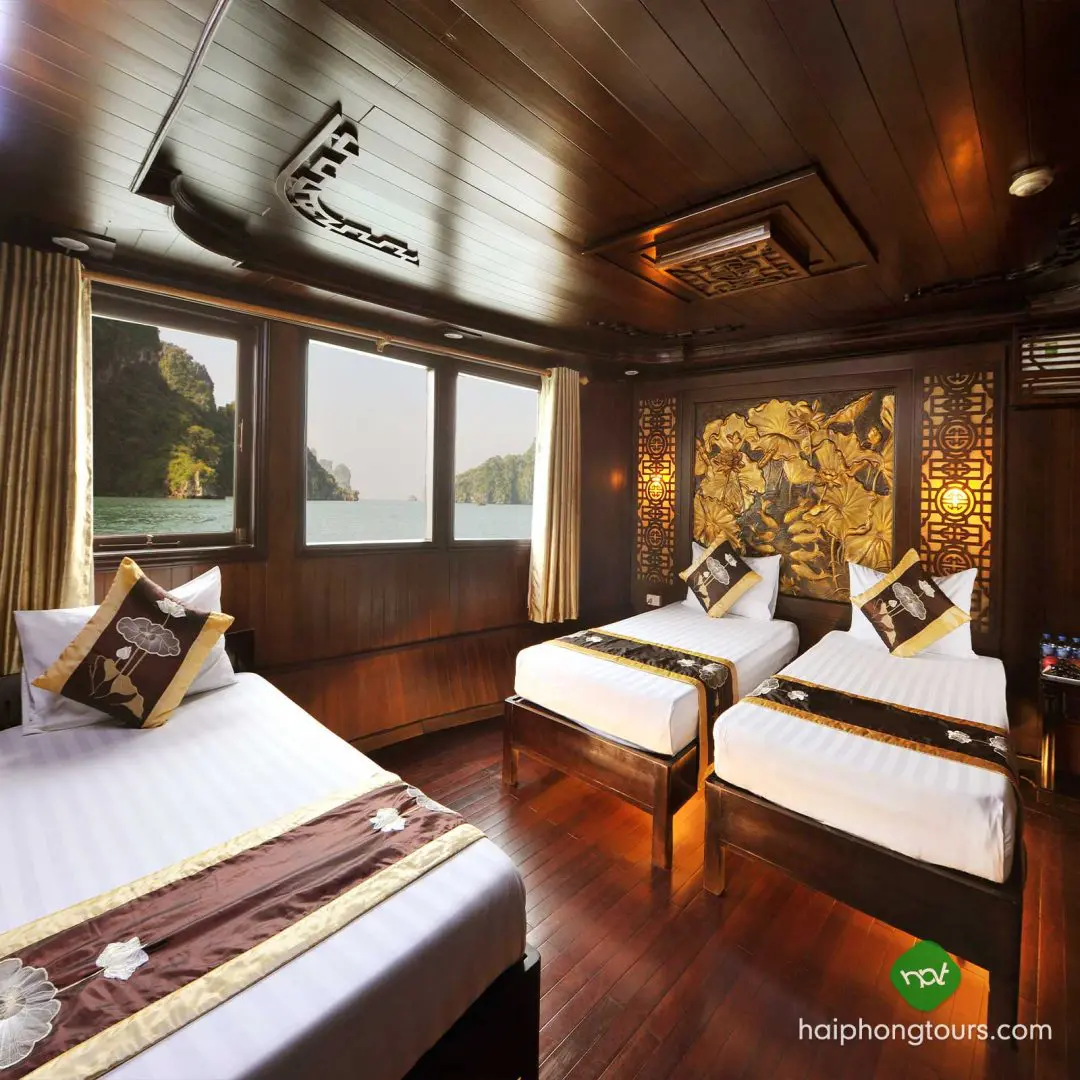
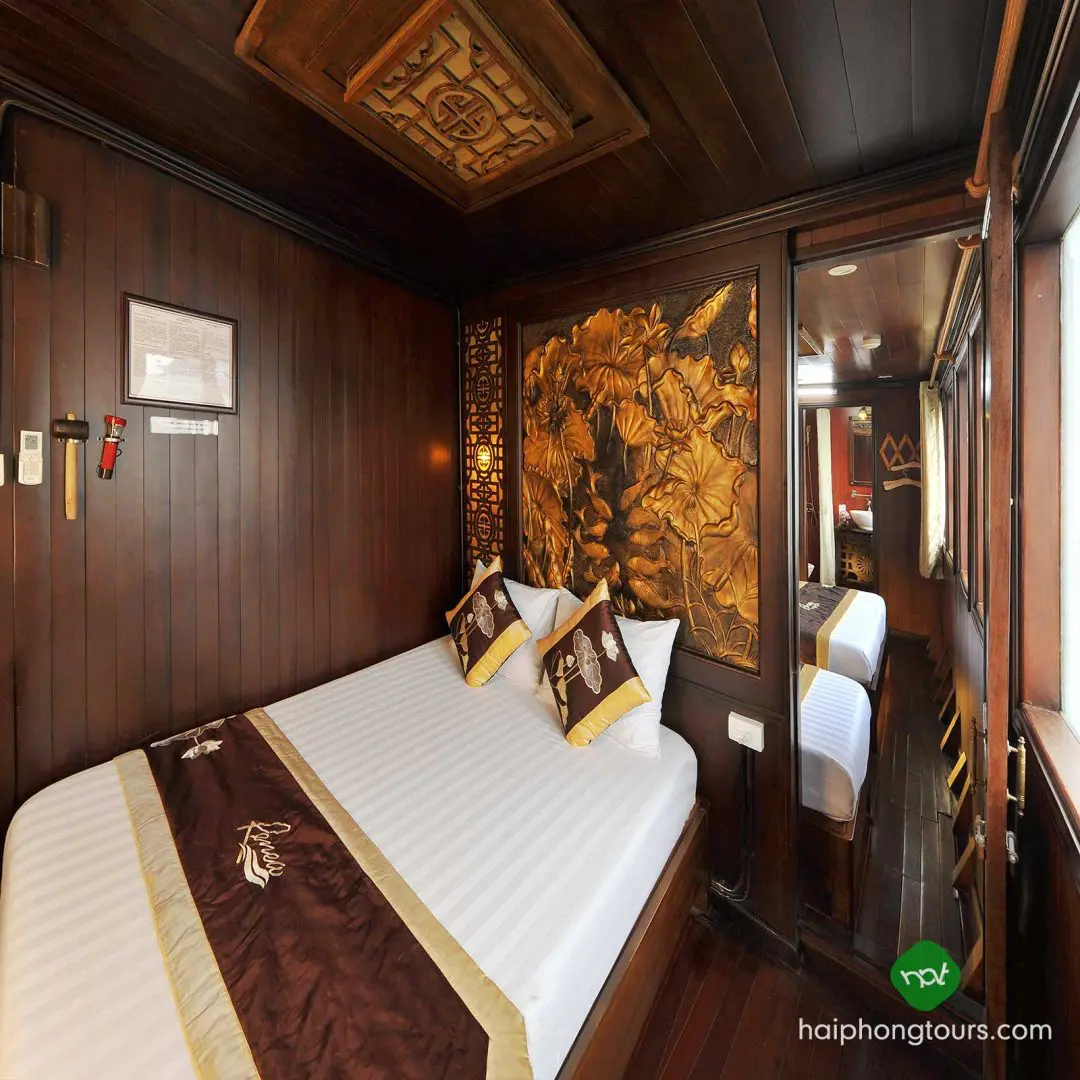
A Deluxe Triple and Deluxe Family cabin aboard Renea Cruise.

The Renea two-day Bai Tu Long Bay cruise follows a quieter overnight route through Cap La and Thien Canh Son Cave. Give every child’s birth year and your required beds when requesting availability. Hai Phong Tours does not offer a Bai Tu Long day cruise because the route is too far for its one-day program; plan at least two days and one night for this bay.
Mon Chéri: one family cabin or a connecting pair
Mon Chéri distinguishes its 70-square-meter Elegance Family Balcony from its 80-square-meter Elegance Connecting Door category. The published bed plan for each includes one double and two singles, while the connecting category uses an internal door between rooms.
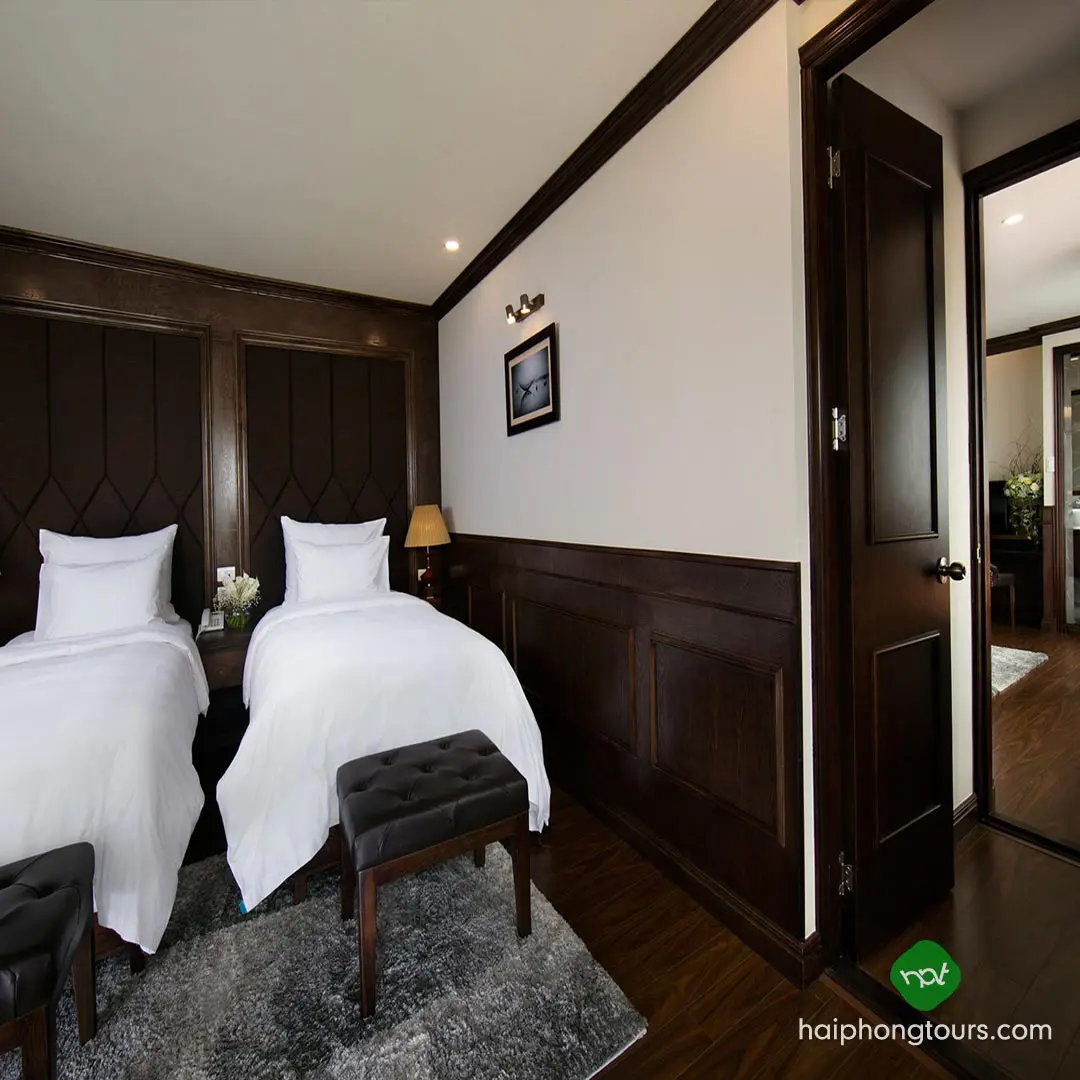
The cruise’s published capacity can also include extra-bed places for children. Treat that as a maximum to verify, not a promise that six adults or six separate beds will fit. Ask for the exact cabin category, passenger mix and additional-bed placement on your sailing.
Signature: check bed sharing before choosing a family suite
Signature presents its Elite Family Suite as two connected rooms with two double beds. That layout can suit two couples or a family comfortable with shared beds; it does not give four separate beds. The published maximum includes children, so confirm the accepted ages and sleeping plan rather than applying the headline capacity to every group.
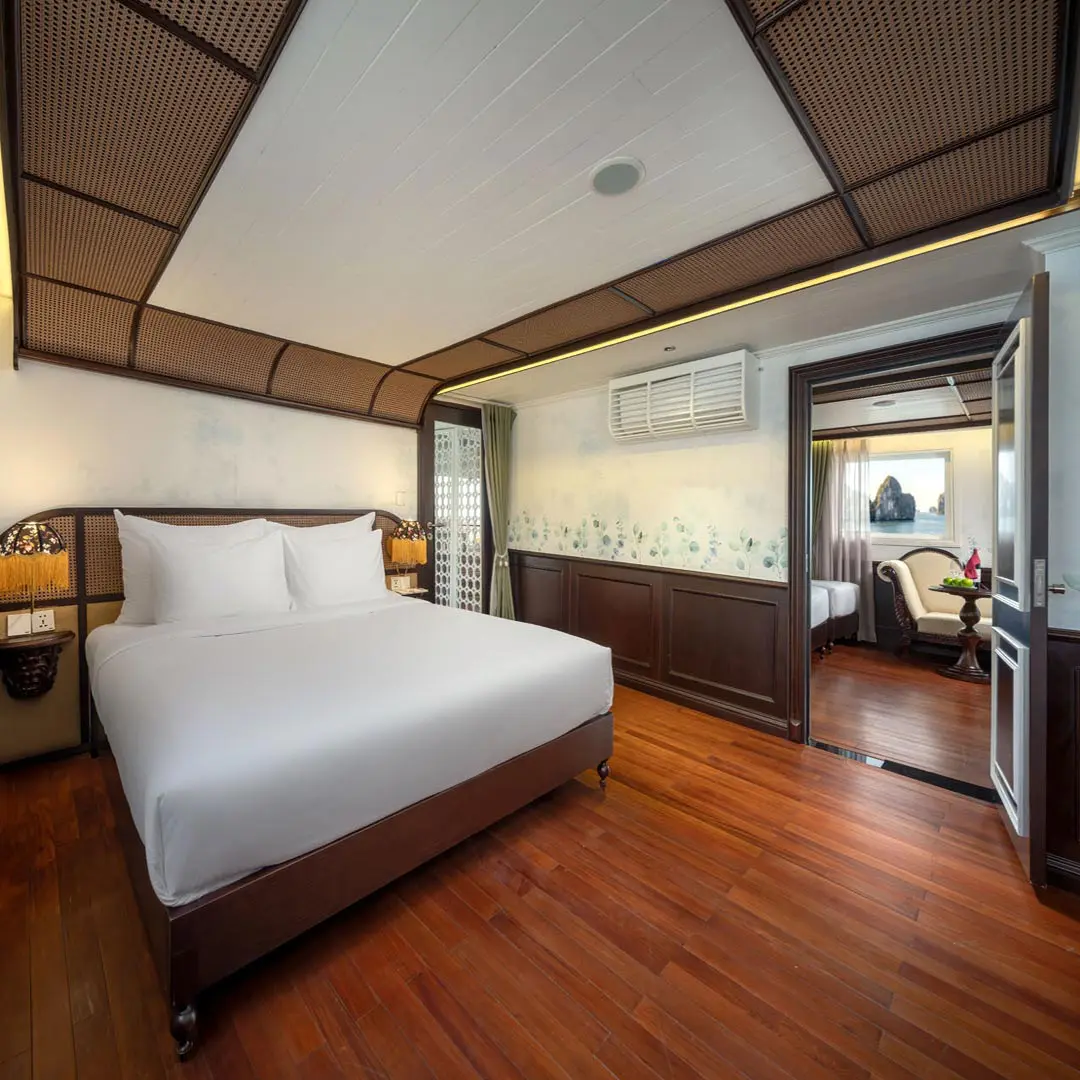
The Signature two-day Bai Tu Long Bay cruise is another overnight option. Make sure you are quoted the named Signature vessel and family suite, since similarly named cruises and cabin categories are not interchangeable.

Catherine: a larger ship on the main Halong route
Families who prefer the main Halong Bay route can compare the Catherine two-day cruise. Its current itinerary includes Sung Sot Cave, Titov Island and Luon Cave, and the ship lists family-oriented facilities such as an elevator and a children’s corner.


Request the exact triple or connecting category and its bed plan for your date. Choose Catherine because both its route and onboard setup suit the family; a cabin layout alone should not decide the cruise.
Match the cabin to your family’s routine
With young children, consider night waking, bathroom trips and where an adult will sleep. Ask how balcony doors lock, and supervise children around balconies, corridors, stairs and open decks.
With teenagers or grandparents, separate sleeping areas and an additional bathroom may matter more than keeping everyone in one room. Check deck position, stairs and lift coverage instead of assuming that a larger suite is easy to access.
With a cot or extra bed, ask for its dimensions and placement. Added furniture reduces usable floor area even when the cabin’s advertised size sounds generous.
Compare the total family price
Send the same passenger details to every cruise you compare: travel date, number of nights, number of adults, each child’s birth year and every separate-bed requirement. Child fares and age bands vary by operator, and a reduced fare may require sharing an existing bed.
Compare one complete total for the named vessel, cabins, meals, activities, transfers and supplements. Two connecting cabins may cost differently from one family cabin; a single-occupancy charge can also apply when one traveler uses a separate room. Avoid comparing a per-person starting price with a full family quotation.
What to confirm before payment
- The exact vessel, departure date and itinerary.
- Every cabin name and the number of rooms included in the quotation.
- The number and type of beds, who shares each bed, and any cot or extra bed.
- An internal connecting door if direct room-to-room access is essential.
- The number of bathrooms and the cabin’s deck position.
- Occupancy approval for all adults and children, using the operator’s age calculation.
- The total price, transfers, inclusions, supplements and cancellation terms.
A useful confirmation names the rooms and sleeping arrangement instead of saying only “family room.” If the required setup is unavailable, compare a different cabin combination, vessel or sailing date before making a nonrefundable payment.
Useful guides for your trip
Need help choosing the cruise or coordinating the shore transfer? Contact us with your date, preferred route, group size and starting point. Tell us about any dietary, mobility or onward-connection needs before booking.