
Apply the right licence-recognition pathway
The self-drive checklist needs one qualification: a Vienna-format international driving permit with the matching national licence is one recognised pathway, rather than the only pathway for every nationality. Vietnamese law also recognises qualifying licences under applicable treaties or mutual-recognition agreements. Establish which pathway covers your issuing country and actual motorcycle class; a rental company handing over keys does not establish that entitlement.
A private car is usually a car with a driver
When a Ha Giang operator advertises a private car or Jeep tour, establish who controls the vehicle. A chauffeur-driven booking does not imply that the company will rent the same car for you to drive. These are different contracts, with different licensing, security, insurance and recovery responsibilities.

QT, for example, advertises private Jeep and enclosed-car journeys with local drivers. QT is based at Lam Dong, Phuong Thien, Ha Giang. This is a third-party tour enquiry. It is not evidence of foreign-visitor self-drive car availability, and it is not a Hai Phong Tours Loop product.
Separate four lines in a multi-day car quote
| Line | What to establish |
|---|---|
| Vehicle and driver | Exclusive use, usable seats, luggage space and driver overnight costs |
| Daily road programme | Named overnight towns, included stops and the last day’s final destination |
| Rooms and activities | Which items are reserved and which are paid separately |
| Changes | How a shorter route, extra night or different finish is priced |
A driver and a guide also have different roles. If cultural interpretation or English conversation matters, establish the service actually included instead of assuming every locally experienced driver is an English-speaking guide.
Check the product, not just the easy-rider label
QT publishes a standard shared-group limit of eight motorcycle guests, combining self-riders and easy-rider passengers. That is one provider’s stated arrangement, not a regional standard. Use the same level of specificity when comparing another seller: actual guest count, staff roles and whether a private group can be combined with others.
For any mode, have the contract identify who handles a complaint while you are still travelling. QT publishes for its own bookings and asks for the reference and relevant evidence. Keep equivalent details for the provider you choose, so an unsuitable rider, missing room or changed vehicle can be addressed before the trip ends.
Choose self-drive only when you are legally licensed for the motorcycle, insured for the activity and already experienced on steep mountain roads. Choose an easy rider when you want the open-air motorcycle experience without controlling the bike. Choose a private car when weather protection, seat belts, luggage space or easier access matters more than riding.

All three modes can show you the main Ha Giang Loop landscape. The best decision is not the one that looks most adventurous in a video. It is the one whose legal, physical and safety demands match you for three or four consecutive mountain days.
Quick comparison
Self-drive motorcycle
- Main advantage: direct control over the vehicle and stops.
- Main limitation: you carry all responsibility for licensing, insurance, navigation, road judgment and fatigue.
- Best for: properly licensed riders with substantial recent mountain experience.
- Poor fit for: first-time riders, travelers relying on a rental lesson or anyone whose documents do not cover the motorcycle class.
Easy-rider passenger
- Main advantage: open views and motorcycle access while an experienced rider controls the bike.
- Main limitation: long sitting, weather exposure and dependence on the rider’s decisions.
- Best for: travelers comfortable as passengers who carefully verify the operator and rider.
- Poor fit for: people with serious back, hip or balance problems, strong anxiety as a passenger or low tolerance for cold and rain.
Private car
- Main advantage: weather protection, seat belts, easier luggage storage and the ability to rest between stops.
- Main limitation: less open-air immersion and fewer safe stopping options on small roadside shoulders.
- Best for: families, small private groups, older travelers and anyone who does not want to ride.
- Poor fit for: travelers whose only goal is the physical sensation of motorcycling.
Start with the complete Ha Giang Loop planning guide if you also need the route, overnight towns, weather and luggage strategy.
The route does not require a motorcycle
The main circuit between Ha Giang, Quan Ba, Yen Minh, Dong Van, Ma Pi Leng and Meo Vac uses roads traveled by cars as well as motorcycles. A car may skip a narrow side track, use a different parking place or take longer to turn around, but it can deliver the central landscape and town experience.
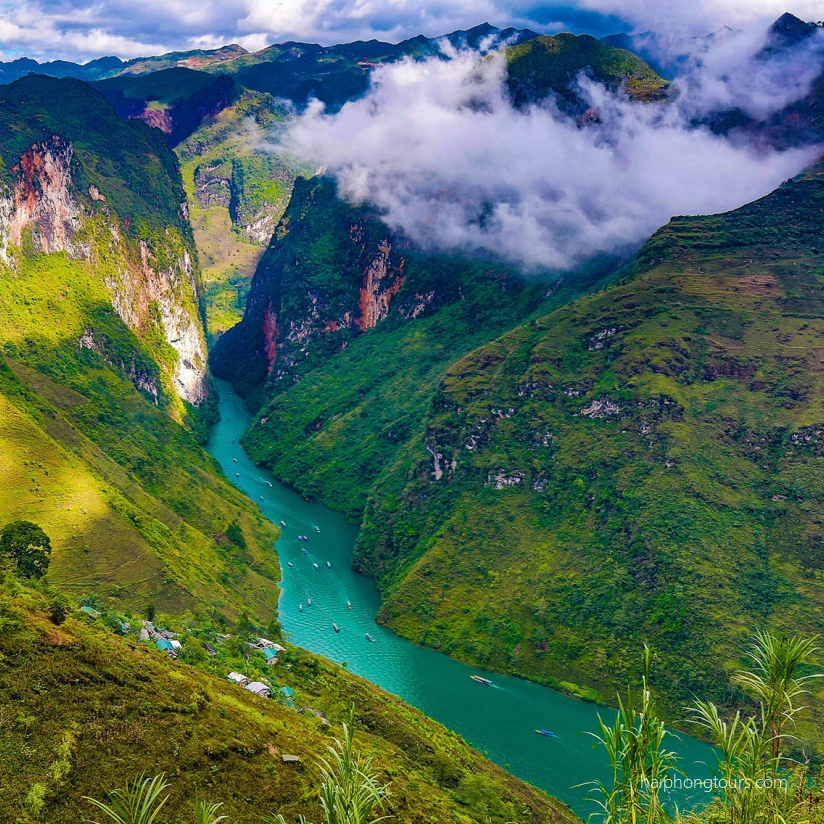
Motorcycles make it easier to stop in small spaces and create a stronger sense of the surrounding air, temperature and gradient. That advantage also means direct exposure to rain, cold, dust, road spray and every movement of the vehicle. Do not confuse exposure with completeness.
A traveler in a car can still walk through a village, visit a market, cross Ma Pi Leng and stay in the same overnight areas. The route should be built around meaningful stops rather than around proving a transport choice.
When self-driving is a responsible choice
Self-drive is appropriate when all of these conditions are met:
- Your national licence covers the motorcycle class you will ride.
- You hold an international driving permit recognized in Vietnam and carry it with the national licence.
- Your travel insurance covers that engine class and lawful recreational riding.
- You have recent experience with steep descents, tight bends, wet surfaces and mixed traffic.
- You can inspect the motorcycle and reject an unsuitable vehicle.
- You are prepared to shorten the route for fatigue, fog, rain or a closure.
Vietnam recognizes international driving permits issued under the 1968 Vienna Convention when used with the matching national licence. The permit must contain the correct vehicle category. An online card sold as an “international licence,” a car-only entitlement or a rental shop’s willingness to hand over keys does not establish that you may legally ride.
Travel insurance can impose its own engine-size, licence, helmet and activity conditions. Read the policy wording or ask the insurer in writing. A policy that covers medical treatment generally may still exclude an unlawfully operated motorcycle.
Why ordinary scooter experience may not be enough
Ha Giang adds long gradients, blind corners, heavy vehicles, animals, broken edges, construction and rapidly changing visibility. A rider must control speed before the bend, hold a stable line, leave braking distance and manage the motorcycle when luggage or a passenger changes its balance.
City riding experience can help with traffic awareness, but it does not automatically teach safe mountain descending. A few circles in a rental yard cannot test judgment in fog, braking on a wet slope or choosing whether a road should be abandoned.
If your recent experience is limited to flat roads, small automatic scooters or occasional holiday rentals, an experienced rider or car is the stronger decision. You still see Ha Giang without using the public road as a training course.
What an easy rider changes
“Easy rider” usually means you travel as the passenger while a local rider controls the motorcycle. It removes your need to steer and normally removes the foreign-licence problem for operating that motorcycle. It does not make the trip passive or risk-free.
You remain exposed to the weather and must sit behind another person for long periods. Your safety depends on the actual rider, motorcycle, helmet, group system and daily decisions. A strong operator should be able to explain how riders are selected, licensed and supervised without relying on a vague claim of experience.
Check the actual rider
- Ask whether the named rider is an employee or a last-minute subcontractor.
- Confirm the rider holds the required Vietnamese licence for the motorcycle.
- Ask how the rider communicates with an English-speaking passenger.
- Confirm the rider does not drink alcohol before or during the road day.
- Ask what happens if you are uncomfortable with speed or riding behavior.
Meeting the rider before full payment or departure is useful. Discuss hand signals or simple phrases for stopping, slowing down, toilet breaks and pain. You should be able to request a safe stop without waiting for the next scheduled attraction.
Check passenger comfort
Sit on the motorcycle with the planned luggage attached. Confirm that both feet rest securely on passenger pegs, the exhaust cannot burn your leg, the seat leaves space between you and the rider, and your helmet does not move when you shake your head.
A large backpack on your shoulders shifts weight and increases fatigue. Use a small day bag for water and essentials, and secure the main loop bag to the vehicle without loose straps near the wheel, chain or exhaust.
What a private car changes
A private car reduces weather exposure and makes layers, camera equipment, medicine and luggage easier to manage. It gives each passenger a stable seat, and a traveler who feels tired can rest while the driver continues. This makes the mode valuable for mixed-age families and people who are unsure about several days on a motorcycle.
Cars still share narrow mountain roads with buses, trucks, motorcycles and local traffic. Confirm a driver who regularly works in the region, working seat belts for every occupied seat and a vehicle size suitable for the route. Do not accept extra passengers who prevent seat-belt use.
A car cannot stop safely at every viewpoint. Agree that the driver will use established pull-offs and parking areas, even if that means walking back or skipping an unsafe photograph. A door should never be opened into traffic without checking behind.
Comfort over consecutive days
Motorcycle rider
The rider uses hands, shoulders, core and legs throughout the day while maintaining attention. Rain gear, gloves and a helmet add heat or restriction. Four moderate days may be easier than three compressed days even when the total road distance is similar.
Motorcycle passenger
A passenger can develop knee, hip, lower-back or neck discomfort from a fixed position. Ask for regular breaks before pain becomes severe. Mount and dismount only after the rider confirms the motorcycle is stable.
Car passenger
A car seat is easier for many travelers, but repeated bends can cause motion sickness. Sit where you can see forward, avoid reading on a phone and request fresh-air stops. The middle or rear position and vehicle suspension affect comfort, so describe previous motion problems before the route begins.
Weather changes the value of each mode
Rain and low cloud reduce visibility for every vehicle. On a motorcycle they also reduce warmth, grip and rider comfort. An easy-rider passenger may have little control over when the group decides to continue, so agree in advance that the route can pause or change.
A car offers protection but does not make a landslide, flood or official closure safe. The driver should follow current local and official road advice. A rigid promise to complete every stop regardless of weather is a warning sign in any transport mode.
Pack waterproof inner bags even in a car because luggage may be moved in rain. On a motorcycle, use full rain protection that does not hang near moving parts. Umbrellas are for stopped visits, never for a moving passenger.
Vehicle inspection for self-drivers
Inspect the motorcycle in daylight before your luggage is attached. Record its condition with the rental representative present. At minimum, check:
- front and rear brakes operate smoothly;
- tires have sound tread and no obvious damage;
- headlight, brake light, indicators and horn work;
- mirrors stay in position and give a useful rear view;
- steering moves normally and the suspension is not visibly leaking;
- the chain, controls and stand appear properly maintained;
- the fuel procedure, repair support and emergency contact are clear;
- luggage can be secured without affecting steering, lights or wheels.
A quick visual check cannot certify mechanical safety. If the motorcycle behaves differently under braking, steering or load, stop and contact the provider rather than adapting your riding to a suspected defect.
Equipment for riders and passengers
Use a properly fitted motorcycle helmet from a reputable manufacturer. The chin strap should hold it securely, the shell should show no major damage and the visor or eye protection should allow clear vision. A loose decorative helmet is not adequate for a mountain route.
Closed footwear, long trousers, gloves and abrasion-resistant outer layers offer more practical protection than sandals and thin rain ponchos. Bright or reflective details improve visibility. Ask what protective equipment is included and inspect its condition before accepting the booking.
Car passengers should use seat belts throughout the road sections, including short transfers. Families must verify the current child-restraint arrangement and vehicle fit before paying rather than assuming a suitable seat will appear at departure.
Group size and pace
A larger motorcycle group can create more waiting, dust, overtaking pressure and separation at junctions. Ask how many guests travel with each leader, whether there is a rear guide and what the group does when a rider or passenger needs to stop.
Do not ride tightly to prevent another vehicle entering the group. Each motorcycle needs its own following and braking distance. A good leader regroups at safe places instead of using speed to keep everyone visually connected.
A private car gives your party more control over pace, but only if the itinerary is private in practice. Confirm whether the vehicle, driver and stops are exclusive to your booking.
Cost comparison without misleading headline prices
Compare the complete package rather than a price per day. An easy-rider or car rate may include the driver, fuel, rooms, meals or selected admissions, while a self-drive rental may leave those items separate. Ask for inclusions and exclusions in writing.
For self-drive, include the motorcycle deposit, protective equipment, fuel, repair responsibility, parking, accommodation and any fee for returning the vehicle late. For an easy rider, check room occupancy, rider accommodation, luggage transfer and whether tips are expected. For a car, confirm vehicle size, tolls, driver meals and overnight expenses.
The cheapest package is poor value when it hides shared sleeping arrangements, an unlicensed rider, worn equipment or a route that relies on night travel.
Which mode fits common traveler types?
Solo traveler with strong motorcycle experience
Self-drive can fit after licence and insurance verification. Joining a small responsible group may add route support, but keep independent control over your speed and decision to stop.
Solo traveler without the correct motorcycle licence
Use an easy rider or join a private or shared car arrangement. Do not rely on the claim that police checks are the only consequence; legal status can also affect insurance and responsibility after a collision.
Couple with different comfort levels
A private car often avoids forcing one person onto a motorcycle. Two easy riders can also work if both travelers accept passenger exposure and each rider is verified. Do not place an inexperienced partner behind a newly trained self-driver.
Family or older travelers
A private car is usually the practical starting point. Confirm seat belts, child restraints where required, frequent stops, accessible rooms and walking demands at attractions. The car can skip a climb without losing the core road landscape.
Photographer with equipment
A car protects equipment and allows safer packing. A motorcycle offers easier small stops but exposes gear to vibration and weather. In either mode, use designated stopping space and never film from the driver’s hand.
Red flags before departure
- The provider says no licence is needed because the roads are rural.
- The booking cannot name the actual motorcycle class, vehicle or rider.
- A helmet is visibly damaged, loose or purely decorative.
- The group expects alcohol at lunch before riding continues.
- The route has no answer for fog, heavy rain, closure or illness.
- The schedule depends on riding after dark to reach a fixed hotel.
- Passengers cannot request slower travel or additional stops.
- The vehicle condition and existing damage cannot be documented.
Resolve these issues before leaving Ha Giang. Once the group is on a remote road, your practical alternatives become smaller.
Questions to send the operator
- Which exact vehicle and transport mode will my booking use?
- Who will drive or ride, and how is the required licence verified?
- What insurance applies to the vehicle, driver, rider and passenger?
- Which helmet and protective items are included?
- How many travelers are in the group?
- How are luggage and valuables carried?
- Can the pace and route change for pain, fatigue or weather?
- What support is available after a breakdown or incident?
- Which rooms, meals and fees are included?
- What is the cancellation or route-change policy?
After choosing the mode, compare the three-day and four-day Ha Giang Loop plans. Transport and duration should be decided together: a passenger who needs frequent breaks may gain more from an extra day than a confident car traveler.
Final recommendation
Use self-drive only when the documents, insurance and experience are already in place. An easy rider is the closest alternative for the open-air experience, provided you verify the person, equipment and pace. A private car is a complete way to see the main loop and is often the strongest option for comfort, weather protection and mixed-ability groups.
No mode removes mountain-road risk. Choose the arrangement that gives you a clear right to slow down, stop and change the route. Ha Giang remains valuable when the traveler who arrives safely is not the person holding the handlebars.
Would you like help fitting this experience into your trip? Contact us with your travel dates, starting point, available time and group size. Tell us about walking limits or special interests so we can suggest a practical itinerary.