
Ha Thai is a useful half-day trip from Hanoi if you want to understand Vietnamese lacquer art, visit a working studio or try a short decorative technique yourself. Arrange the particular studio and activity first. The village includes production businesses as well as places that receive visitors, and a showroom visit is different from a taught workshop.
The most important expectation concerns time: a short class can use a prepared base for eggshell inlay or decoration, but it cannot reproduce every stage of a professionally finished, multilayer lacquer object. Choose the visit for the technique you will learn and the work you will see, with the take-home arrangements agreed before you start.
Find Ha Thai, south of central Hanoi
Use the name Làng nghề sơn mài Hạ Thái, in Hong Van commune, Hanoi. Older addresses place the village in Duyen Thai commune, Thuong Tin district. Both labels may still appear in workshop directions.
Obtain your host’s exact entrance pin. A village marker, a production address in the craft industrial area and an artist’s studio are not necessarily the same drop-off point. Confirm whether your car can reach the entrance and where it should wait.

Plan a half-day for one substantial studio visit and the return journey from Hanoi. Treat driving times as dependent on your hotel, route and traffic, particularly if you have another reservation later in the day. A confirmed pickup and return arrangement is more useful than relying on an optimistic village-to-city estimate.
Choose the experience you actually want
Join a beginner workshop
Dung Di Art Studio, associated with artist Tran Cong Dung, is a named starting point for a visitor workshop in Ha Thai. Its visitor format includes decorative work with eggshell on prepared bases. Ask your organizer to confirm the studio, instructor, materials and current session rather than treating the village name as a complete booking.
Eggshell inlay involves arranging small fragments to form an image or surface pattern. A prepared base lets a beginner concentrate on that part of the craft within a short visit. The studio’s team may assist with finishing; ask which steps you will do yourself and which have already been completed.
A painting activity may use different materials and produce a different result. If working with traditional lacquer is the reason for your trip, state that clearly and ask what coating or paint the session uses. Do not choose solely from a photograph of the finished sample.
Watch production and talk with a maker
An observation visit can reveal more of the professional process than a beginner activity. Ask to see examples at several stages, such as a prepared support, a piece being decorated and a finished object. Production depends on the workshop’s orders, so no single visit is guaranteed to show every stage in progress.
This format suits a traveler interested in materials, design or collecting. Agree on an explanation in a language you understand, and establish whether the visit is a paid demonstration, a studio appointment or a shopping stop. An export factory’s business hours do not establish public visitor access.
Buy a finished piece
Ha Thai’s work includes decorative panels and practical objects such as boxes, trays and vases. Buying after seeing the process can help you understand why apparently similar items have different prices. You do not have to join a class to appreciate the work, and a class need not include a purchase.
Understand what the layers are doing
Vietnamese sơn mài combines applied layers with sanding and polishing. The finished appearance comes from how those stages interact, rather than simply from brushing a glossy coating onto an object.
The support underneath can vary. Ask whether a piece uses wood, bamboo, ceramic or another material, then look at how the surface has been prepared. A maker can explain the relationship between that base, the ground layers and the final decoration more clearly with an unfinished sample in hand.
Eggshell can create pale, textured patterns; mother-of-pearl provides a different reflective effect. Neither material belongs in every piece. Look for how the maker incorporates the decoration into the surface, and ask permission before touching a sample to feel the finish.
For a trip focused on shaped shell, the Chuon Ngo mother-of-pearl inlay village guide explains an arranged maker visit, a beginner activity and commissioning a custom piece. Agree on the actual workshop and finishing time before building the day around it.
Professional work involves repeated stages and waiting between them. The overall time changes with the materials, design and finish and may extend over weeks or months. A long production process and a short visitor workshop can both be real, because the workshop starts with work that has already been prepared.
Ha Thai workshops use different production methods, including traditional lacquer and modern coatings. A high shine or a village label alone does not tell you which material was used. Ask about the actual piece rather than assuming all products in the village follow one recipe.
Settle the take-home details before the class
- The object: What size and type of base are included, and can you choose the design?
- The materials: Is the activity eggshell inlay, painting, sanding or a combination? What tools and coatings will you handle?
- The supervision: Who teaches, in what language, and how much individual assistance is available?
- The cost: Does the quote include the base, decoration, finishing, packing and the object itself, or are any of these extra?
- The timing: Can your particular object travel that day, or does it need further finishing, collection or delivery?
- The packaging: How should it be carried without damaging the surface, and what care instructions come with it?
If you fly out of Hanoi soon afterward, explain that before choosing a session. A same-day souvenir must be suitable for the time you have; a promise attached to one workshop format should not be applied to a larger or more elaborate custom piece.
How to assess a piece you might buy
Begin with the maker, the base material and the intended use. A decorative bowl should not automatically be treated as a food bowl, and a tray designed for serving cups is not necessarily suitable for direct contact with hot food. Ask the seller for the care and use instructions for that specific product.
With permission, examine edges, the underside, the fit of a lid and the finish around an inlaid area. Look at the piece from more than one angle. Do not scratch, heat or apply liquid to an object as a supposed authenticity test.
For a larger purchase, record the dimensions, maker and agreed price on the receipt. If delivery is involved, settle the packing method, shipping charge, dispatch date and responsibility for damage before paying. Allow enough time to inspect the actual object instead of buying solely from a display sample.
A focused visit or a longer craft day
For a workshop-led trip, keep Ha Thai as the main activity. Reserve roughly two to three hours on site as a planning allowance for an introduction, a short class and time to look at finished work. Confirm the real session length with the host; an observation-only visit may be shorter, while a more involved class may need longer.
If you have a full day, Quang Phu Cau incense village offers a contrasting craft south of Hanoi, with bamboo-stick production and outdoor drying displays. Check the weather and the exact courtyard or workshop, then arrange the whole driving route and lunch. Ha Thai’s studio session and an incense photography stop have different timing needs.
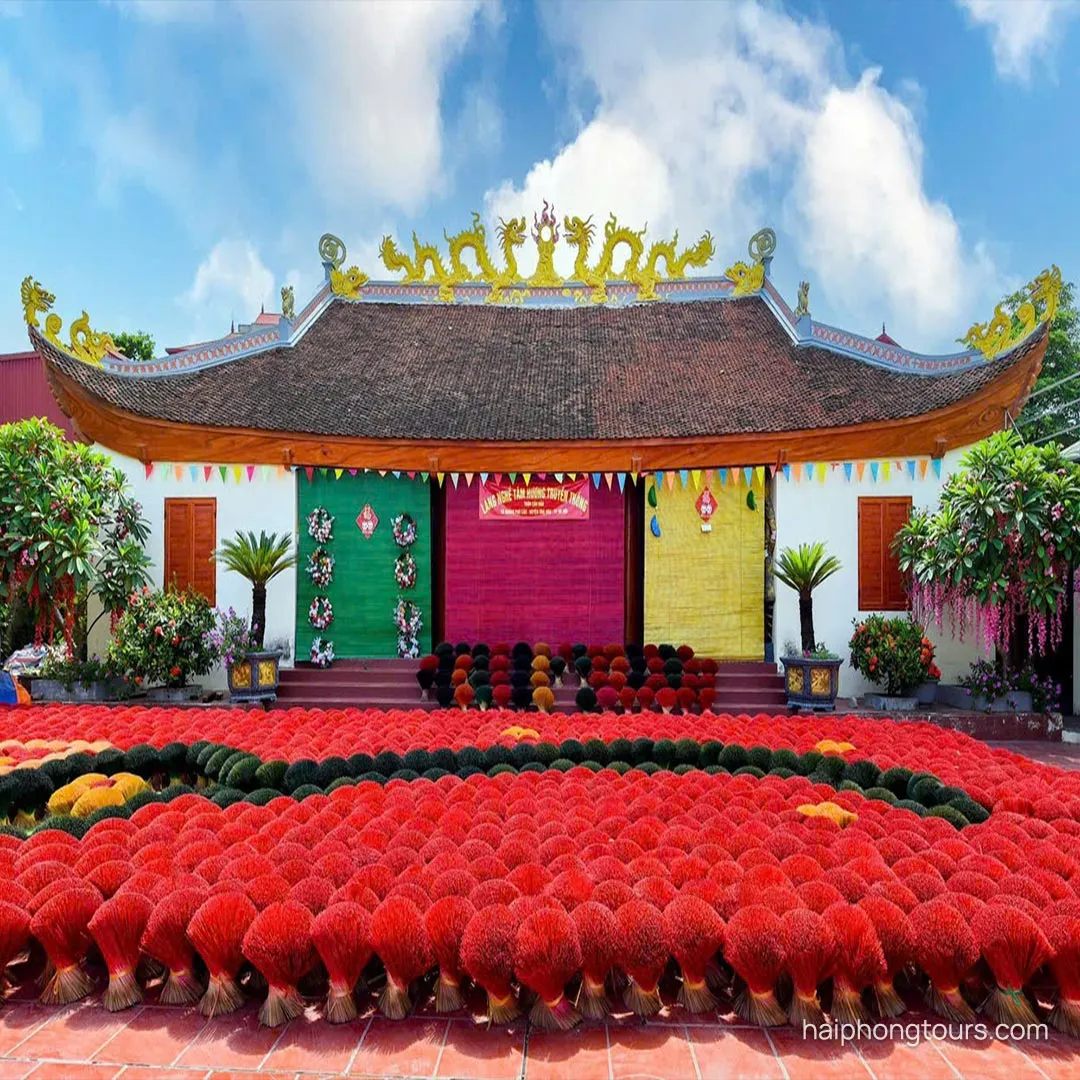
A multi-village tour may give you only a brief lacquer activity. Read the actual itinerary and ask how much time is spent making, observing and shopping. The North Vietnam craft workshop guide helps compare lacquer with pottery, textiles and printing when you have room for only one craft outing.
Be comfortable in a working studio
Wear clothing you do not mind marking, tie back loose hair and follow the host’s instructions around tools and unfinished objects. Ask before photographing people, designs or production areas. Pieces set aside to cure or dry are work in progress, even when nobody appears to be using them.

For children, confirm a suitable activity and the level of adult supervision. For anyone sensitive to strong odors, ask about the materials used and whether the session takes place in a separate, well-ventilated visitor area. The right workshop is one where you can participate comfortably and understand what you are handling.
Before setting off, keep the studio’s name, meeting pin, agreed activity and return transport together. Those details turn Ha Thai from a general craft-village stop into a visit with a clear purpose and a realistic result.
Would you like help fitting this experience into your trip? Contact us with your travel dates, starting point, available time and group size. Tell us about walking limits or special interests so we can suggest a practical itinerary.