
Being pregnant does not automatically rule out a Ha Long Bay cruise, but two separate approvals matter: your prenatal clinician must consider the specific trip appropriate, and the exact cruise operator must accept you for the gestational age you will be on every sailing day. Get both answers before making a nonrefundable payment; a general assurance from an agent is not enough.

A day cruise or a hotel-based visit usually offers a simpler return to land than an overnight sailing. An overnight cruise may still be reasonable for some travelers with an uncomplicated pregnancy, but only after the operator confirms the vessel, boarding method, activity opt-outs, documents and emergency plan in writing. Operator permission is not medical clearance.
Make the booking decision in this order
- Ask your prenatal clinician about the actual itinerary. Include the travel dates, weeks of pregnancy, road-transfer time, hours or nights on the boat, planned activities and expected distance from obstetric care.
- Identify the operating company and vessel. A brand, reseller or itinerary name may not identify the boat that will carry you.
- Send your gestational age in weeks and days. Give the age at embarkation and at the end of the cruise, not only a due date or trimester.
- Obtain written acceptance. Ask the operator to state whether you may board, what certificate is required and whether any activity or cabin restriction applies.
- Verify medical and evacuation cover. Pregnancy complications, delivery, neonatal care, boat evacuation and trip cancellation can fall under different policy clauses.
- Pay only after the answers are consistent. Save the operator’s reply, insurer assistance number and prenatal summary offline.
Ha Long Bay operators do not use one pregnancy rule
Do not apply a familiar 24-week ocean-cruise cutoff to every Ha Long Bay boat. Current public wording differs among local operators, and the wording itself matters.
- Bhaya Cruises: says it refuses guests who have entered their 36th week by the beginning of the cruise. It asks for the pregnancy in weeks, confirmation of good health and non-high-risk status, advance notice and an insurance review.
- Mon Chéri Cruises: says a guest is welcome only if she has not entered the 35th week at the beginning of the cruise. It also asks for gestational age, health and risk status, advance notice and an insurance review.
- Dragon Legend Cruise: asks pregnant guests to notify the company and strongly recommends physician advice and certification of fitness to sail. Its FAQ tells travelers who have entered the 24th week to consider the cruise duration and their health carefully; it does not state that sentence as a universal boarding ban.
- Athena Cruise: states in its current Vietnamese booking policy that guests from the sixth month onward must inform the advisory team for a safety assessment before the reservation is confirmed. The operator should translate “sixth month” into a clear answer for your exact week and sailing.
- Paradise Vietnam: does not state a gestational cutoff or certificate rule in the pregnancy section of its public FAQ. Ask for an individual written answer instead of treating the absence of a published cutoff as automatic acceptance.
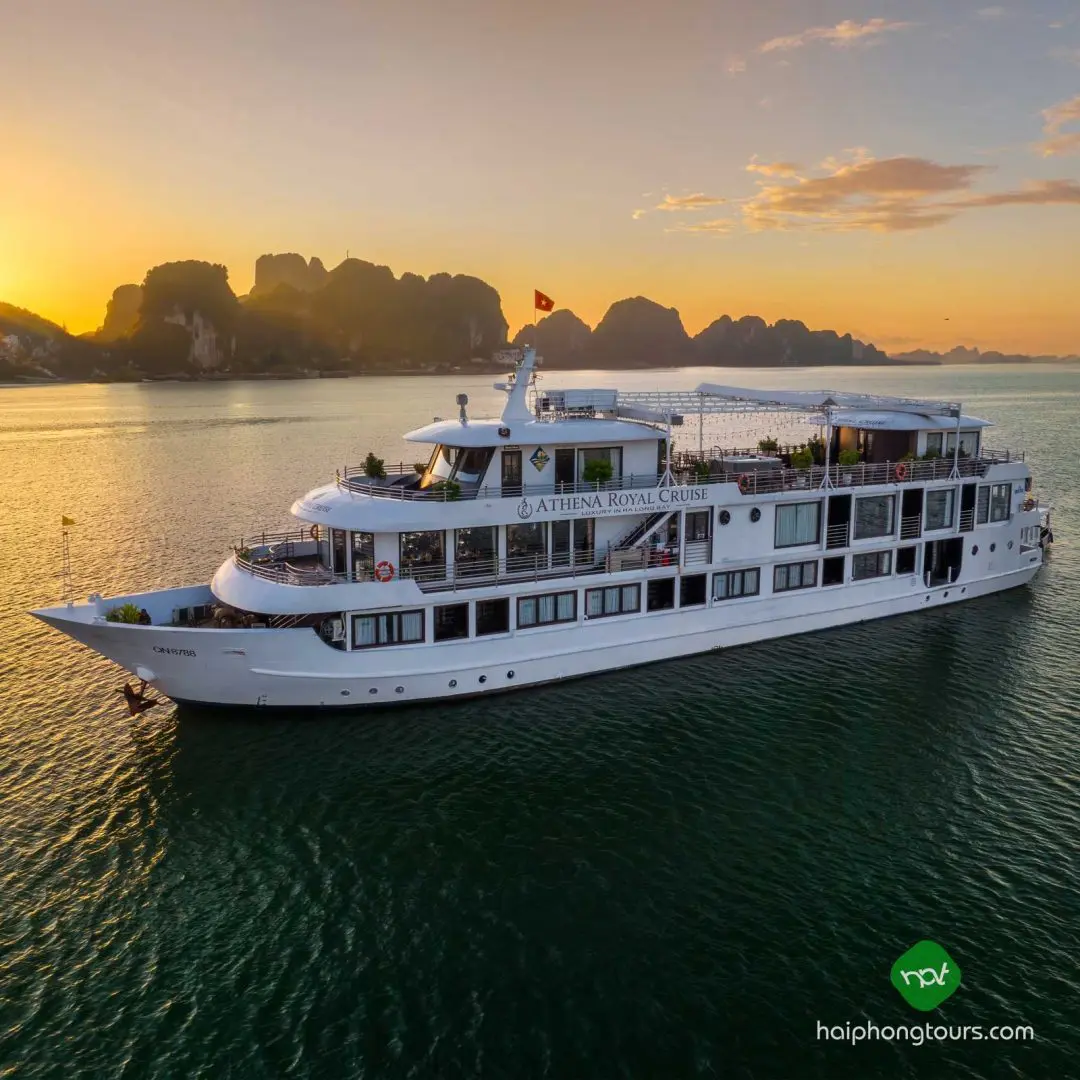



These examples apply only to the named operators. A replacement vessel, charter, partner boat or revised policy can change the answer. Reconfirm shortly before departure even when you obtained approval at booking.
Send a precise request to the operator
A short question such as “Is pregnancy allowed?” leaves too much room for a vague reply. Send the facts needed for a boarding decision and request a direct answer from the operating company.
Please confirm in writing whether [full name] may board [exact vessel] on [date]. She will be [weeks + days] pregnant at embarkation and [weeks + days] at disembarkation, with an estimated due date of [date]. Her prenatal clinician has [approved / not yet approved] this itinerary, and the pregnancy is [uncomplicated / describe only the relevant condition]. Please state the required medical letter, how recent it must be, its exact wording, the submission deadline, any activity or cabin restrictions, and the cancellation terms if boarding is later refused.
Ask the operator to include the vessel name and sailing date in the reply. If a reseller answers, request confirmation from the operator rather than relying only on a sales representative’s summary.
Clarify the medical letter
Even when a website does not mention a certificate, ask whether one is required at check-in. Confirm whether it must include your due date, gestational age on the sailing date, fitness to travel, whether the pregnancy is considered high risk, the clinician’s contact details, an issue date and a signature. Ask whether a digital copy is enough or whether you must bring the original.
Clarify what happens if the situation changes
Pregnancy progresses between booking and sailing. Ask what happens if you cross the operator’s threshold, develop a complication, receive medical advice not to travel or are denied boarding because the document wording is incomplete. Obtain the refund, date-change and no-show terms in writing before paying.
Check the physical route, not just the cabin photos
Embarkation and tender transfers
Ask whether you board directly by gangway or transfer by tender or small boat. Confirm the number and height of steps, whether there are handrails, whether the surfaces can be wet, and whether staff will carry your luggage. If a transfer requires stepping between moving boats, ask how the crew assists and whether boarding can be avoided in rough conditions.
Request a cabin that minimizes repeated stair use and gives practical access to a restroom and the main indoor area. Do not assume that an elevator shown for one vessel exists on a replacement boat.
Caves, islands, kayaking and swimming
Your clinician, not the activity label, should decide what is appropriate for you. Cave visits and island viewpoints can involve long stairways, uneven or wet paths, heat and limited shade. Kayaking adds a low entry, twisting movement and the possibility of getting wet; swimming conditions and access points vary.
Ask whether each excursion is optional and where you will wait if you skip it. On some itineraries, guests transfer to a day boat or tender while the main vessel follows another schedule. “You can skip kayaking” does not necessarily mean you can remain alone in your cabin throughout the stop.
Day cruise, overnight cruise or hotel stay
If rapid access to land, flexible meals, a larger bathroom or control over your schedule matters, a hotel stay with a short day cruise may be the more practical format. It is not automatically medically suitable, but it reduces the time committed to an overnight route. If your clinician says you need frequent monitoring or ready access to obstetric care, postpone the cruise rather than trying to solve that need with a more luxurious cabin.
Prepare for motion, food and heat
Motion sickness
Discuss motion-sickness prevention with your prenatal clinician before travel. Do not assume a tablet offered by another traveler or carried in the boat’s basic medicine supply is appropriate during pregnancy. If you are prone to nausea, ask the operator about the route and request a cabin away from the bow when possible.
Looking at the horizon, avoiding reading or prolonged phone use, limiting unnecessary head movement, getting fresh air and lying down can help some travelers. Vomiting can lead to dehydration; tell the crew early if you cannot keep fluids down.
Meals and drinking water
Send pregnancy-related food requests in advance. Ask for meat, fish, shellfish and eggs to be fully cooked and served hot, and avoid unpasteurized dairy products. At a buffet, choose freshly replenished hot dishes instead of food that has been sitting at room temperature.
Use sealed or otherwise reliably safe drinking water and keep a supply within reach. If you develop repeated vomiting or diarrhea and cannot stay hydrated, seek medical advice promptly rather than treating it as a minor inconvenience.
Heat, decks and balance
Open decks, cave entrances and island paths can become hot, humid or slippery. Wear shoes with grip, use handrails, keep both hands free during transfers, pace yourself, rest in an air-conditioned or shaded area and drink regularly. Avoid an unfamiliar strenuous activity simply because it is included in the fare.
Medical access from the bay is not immediate
There is no bay-wide promise of an onboard doctor or a fixed evacuation time. Bhaya, for example, says its crew does not include a doctor and publishes a one-hour tender estimate to the pier for an urgent case. Mon Chéri says it has a doctor on call and standard first-aid equipment, while Paradise says crew can summon a speedboat. These statements describe different arrangements and do not guarantee immediate obstetric or neonatal care.
Questions the operator should answer
- Who provides first aid on the exact vessel, and is any doctor physically onboard or only available by phone?
- How would a pregnant guest leave the vessel during the day and overnight?
- Is a tender or speedboat available throughout the route, including at the farthest point?
- What response time does the operator plan for that route, and what can delay it?
- Which pier and hospital would normally be used for an obstetric emergency?
- Who contacts the ambulance and insurer, and who pays the boat and road-transfer charges initially?
- Can a companion leave with the patient, and how is luggage recovered?
Current onshore reference points
Vinmec Ha Long Hospital in Hong Gai lists emergency and intensive care plus obstetrics and gynecology. Its current address is 10A Le Thanh Tong Street, Hong Gai Ward, Ha Long.
Quang Ninh Obstetrics and Pediatrics Hospital is the provincial specialist facility for obstetric and pediatric care. Its current official contact page lists Tuan Chau Ward, Quang Ninh; emergency; and the maternity unit.
These are planning references, not a promise that your operator or insurer will choose either facility. Call before a non-emergency visit to confirm the department, clinician, language assistance and payment arrangement. For a medical emergency ashore, Vietnam’s medical contact the relevant service. On the water, tell the cruise manager immediately because the crew controls the vessel response.
Check insurance clause by clause
Travel cancellation insurance, overseas medical insurance and medical evacuation insurance are different. A policy card or credit-card benefit does not prove that pregnancy-related care is covered.
Ask the insurer to confirm in writing:
- coverage for unexpected complications of pregnancy at your gestational age;
- coverage for preterm and full-term delivery, cesarean delivery and neonatal intensive care;
- whether pregnancy is treated as a preexisting condition and what must be declared;
- medical transport from a boat to shore, road ambulance and transfer to a higher-level hospital;
- coverage for kayaking, swimming or other activities you may join;
- trip cancellation if your clinician advises against travel or the operator later refuses boarding;
- whether the insurer chooses the hospital and evacuation destination;
- whether you must pay first and claim later; and
- the 24-hour assistance number and preauthorization process.
Carry a prenatal summary, estimated due date, medication and allergy list, clinician contact, insurance details and relevant test results. Store copies on your phone and with your companion, and keep the documents available offline.
Do not board with urgent warning signs
Seek medical care immediately rather than boarding if you have vaginal bleeding or fluid leakage, severe or persistent abdominal pain or contractions, chest pain, trouble breathing, fainting, a severe headache that will not go away, vision changes, fever, or a clear reduction in fetal movement when movement is normally expected.
If a warning sign begins onboard, tell the crew immediately and state clearly that you are pregnant and how many weeks pregnant you are. Do not wait for the next scheduled activity or attempt to transfer between boats without crew coordination. Your companion should bring your records, medications, passport and insurance details and contact the insurer’s emergency-assistance team.
Final checklist before you leave the hotel
- The prenatal clinician has reviewed the actual cruise plan.
- The exact operator and vessel have accepted you in writing.
- Your weeks and days of pregnancy are correct for embarkation and disembarkation.
- The medical letter meets the operator’s wording, date and original-copy rules.
- The boarding method, tenders, stairs, luggage help and cabin location are confirmed.
- You know which excursions you will skip and where you may wait.
- Motion-sickness medication, if any, has been approved for you by your clinician.
- The operator has acknowledged your food request.
- Your insurer has confirmed pregnancy, evacuation, cancellation and newborn clauses.
- Your records, operator contacts, hospital contacts and insurer number are saved offline.
The safest booking is not the cruise with the most reassuring marketing. It is the one where your clinician’s advice, the named operator’s written rule, the exact vessel’s physical setup and the emergency plan all support the same decision. If one of those pieces is missing, change the format or postpone the cruise.
Useful guides for your trip
- Ha Long, Lan Ha and Bai Tu Long Cruise Itineraries
- Halong Attractions: Bay Cruises, Museum, Beaches and Parks
Need help choosing the cruise or coordinating the shore transfer? Contact us with your date, preferred route, group size and starting point. Tell us about any dietary, mobility or onward-connection needs before booking.