
Hanoi has several intercity bus stations, and choosing the nearest one can send you to the wrong departure point. Use the exact pickup address on your booking: your coach might leave from My Dinh, Giap Bat, Nuoc Ngam, Gia Lam or Yen Nghia, but a shared limousine may collect passengers at an operator office instead.
Confirm the departure point before arranging your taxi or leaving your hotel. “Hanoi pickup” does not automatically mean the Old Quarter, Noi Bai Airport or a main bus terminal. Your arrival point at the other end matters just as much, especially for places such as Tam Coc, mountain homestays and resorts outside town.
Read these three details before choosing a station
- The operator and departure time: several companies can serve the same destination from different parts of Hanoi.
- The boarding address: ask for a map pin, building or gate, and a photograph of the meeting point if the address is unclear.
- The actual destination stop: a town bus station, roadside junction and hotel drop-off are different services.
Useful Vietnamese terms are bến xe for a bus station, văn phòng for an office and điểm đón for a pickup point. A xe buýt is generally a city or regional public bus; a xe khách is a passenger coach. “Limousine” usually describes a shared upgraded van or minibus, so do not assume it means a private vehicle.
Which Hanoi bus station is on your ticket?
My Dinh: Pham Hung Road, western Hanoi
Address: 20 Pham Hung. My Dinh is an important departure point for northern and northwestern journeys. It can be relevant for trips such as Moc Chau, but an operator serving that destination may also use its own office or other pickup locations.

Do not book a taxi to My Dinh simply because a search result mentions the station. Check whether your ticket says the terminal itself, a nearby address or another collection point. With an overnight coach, also check the arrival time: reaching a mountain town before dawn requires a separate accommodation plan.
Giap Bat: Giai Phong Road, southern Hanoi
Address: Km 6, Giai Phong Road. Giap Bat is a major terminal on the southern side of the city and can be relevant for journeys toward Ninh Binh and neighboring destinations. Routes are not divided neatly by compass direction, so the operator’s actual booking details remain the deciding factor.
 Giap Bat is on Giai Phong Road; use the station printed on your ticket.
For Ninh Binh, ask whether your bus ends in the urban area or continues to Tam Coc, Trang An or your accommodation. A cheaper terminal-to-terminal ticket may still require a local taxi. Giap Bat and Nuoc Ngam are separate terminals; do not treat their names as interchangeable.
Nuoc Ngam: Ngoc Hoi Road, southern Hanoi
Address: 1 Ngoc Hoi. Nuoc Ngam is another formal coach terminal south of central Hanoi. Use the full name Bến xe Nước Ngầm when showing the destination to your driver.
If a ticket specifies Nuoc Ngam, a bus from Giap Bat or an operator office elsewhere is not automatically an alternative departure for that booking. Allow time to find the correct counter and boarding area after you reach the terminal. The word “Ngam” in this station’s name does not indicate an underground metro station.
Gia Lam: Ngo Gia Kham Street, across the Red River
Address: 9 Ngo Gia Kham. Gia Lam bus station is on the eastern side of the Red River. This is a different place from Gia Lam railway station, so enter Bến xe Gia Lâm, not just “Gia Lam,” when arranging transport.
A trip from the Old Quarter includes a river crossing. Leave room for city traffic rather than judging the journey from straight-line distance. If you are staying on the eastern side of Hanoi, this terminal may be convenient, but only when it is the actual departure point for your service.
Yen Nghia: the Quang Trung–National Highway 6 corridor
Yen Nghia bus station is on Hanoi’s southwestern side, along the corridor toward Hoa Binh. It is also the name of the western terminus of the Cat Linh–Ha Dong metro line.
The metro can help with part of the journey, but arriving at Yen Nghia metro station is not the same as being beside your departing coach. Include the transfer between the rail station and the correct bus boarding area. From the Old Quarter, you first need to reach the metro; there is no direct Old Quarter metro boarding point.
An operator office can be the correct departure point
Many tourist-facing services use an office, hotel collection area or roadside meeting point. That arrangement can be easier than crossing the city to a large terminal, provided you understand exactly what is included.
Ask whether the address is where the main coach leaves or where a smaller feeder vehicle collects you first. If there is a vehicle change, clarify how luggage moves between vehicles and whether the published journey time starts at your pickup or at the main coach departure.
For a hotel pickup, send the full hotel address and confirm that the vehicle can reach its entrance. An Old Quarter pedestrian restriction or narrow lane may require a nearby meeting point. Keep the operator’s contact details available and check messages before leaving the lobby.
Getting to the terminal with luggage
A taxi or booked car is usually the simplest arrangement when you have large bags, children or an early departure. Give the driver the exact terminal or office address, then keep your operator’s instructions available for the final approach.
Public transport can work when your accommodation and departure point align with a useful route. Count the walk to the stop, waiting, any interchange and the final walk with luggage. Our guide to getting around Hanoi without a motorbike explains where buses, metro and taxis fit different journeys.
Cityline connections at My Dinh, Giap Bat and Gia Lam
These three terminals have a Cityline passenger connection service for travel between the station and addresses in Hanoi. At the terminal, ask station staff where to arrange the connection or find its pickup area.
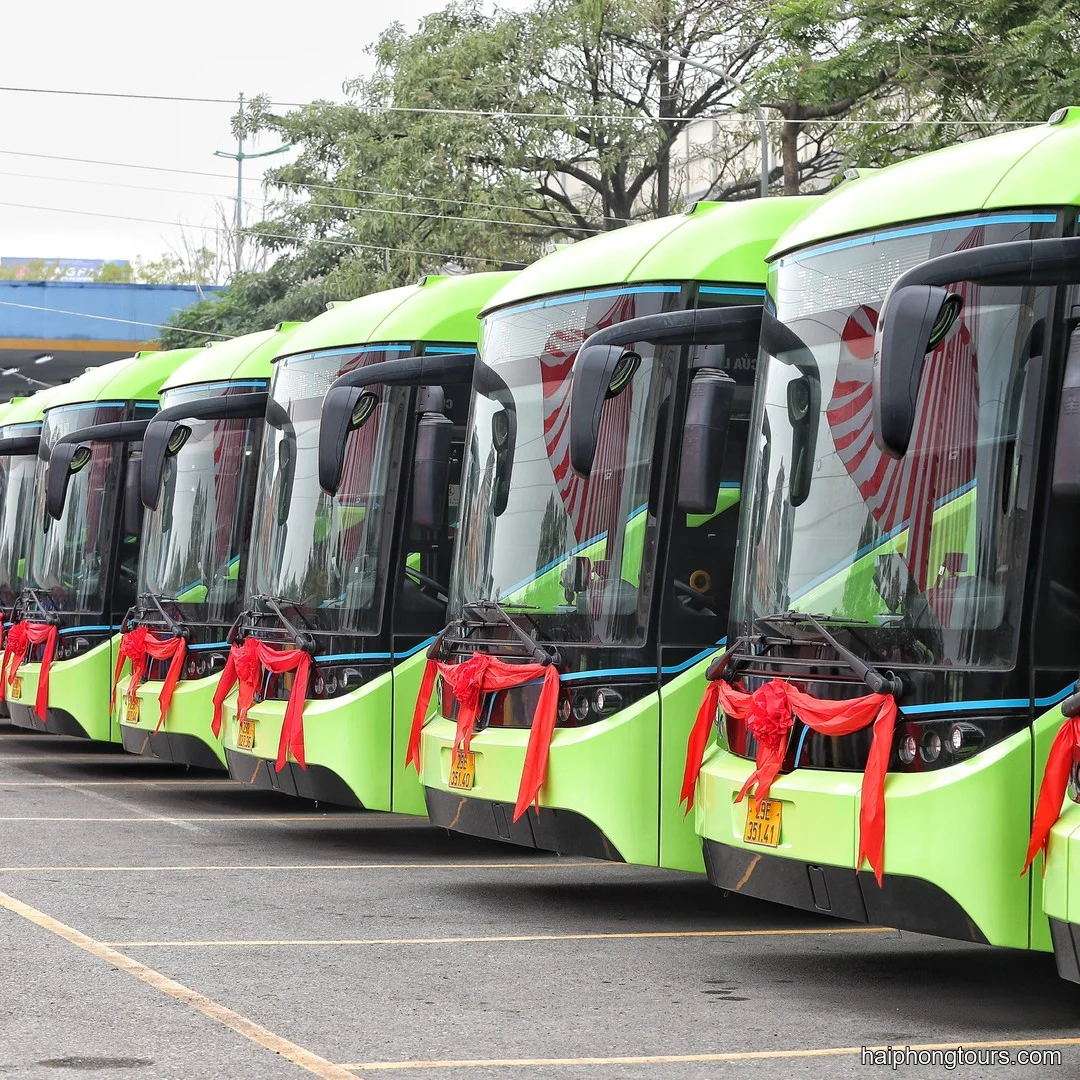
Treat this as a separately priced connection. Before booking, confirm whether the quote is per passenger or for the vehicle, the destination coverage, luggage allowance and pickup time. Do not assume it is included in your intercity coach ticket or that an immediate departure is guaranteed.
Coming straight from Noi Bai Airport
Noi Bai is outside central Hanoi, and “airport pickup” is a separate booking detail. A coach departing from Hanoi does not necessarily stop at the airport. Confirm the correct terminal, the meeting point after baggage collection and what happens if the flight arrives late.
For a separate airport-to-city transfer followed by a coach, include immigration where applicable, baggage collection, the drive to the departure point and the operator’s boarding deadline. A scheduled landing time is not your road departure time.
Avoid a connection that only works if every stage runs exactly on time. See our Hanoi airport transfer guide before choosing between a direct onward service and a city transfer.
Make boarding straightforward
- Reconfirm the meeting point the day before. Keep the Vietnamese station or office name, map pin, departure time and contact number together.
- Plan to reach a large terminal about 30–45 minutes before departure. This is a practical allowance, not a replacement for the operator’s own check-in requirement. Allow more if you still need to buy a ticket.
- Match the operator and destination before loading bags. Ask the ticket counter or your booked operator to identify the boarding bay and vehicle.
- Keep valuables and journey essentials with you. Make your checked luggage recognizable and confirm how to retrieve it at your actual stop.
- Check the final drop-off before the coach leaves. Save the hotel address separately if a local transfer is still needed.
If you are running late, contact the operator immediately. A later bus, changed ticket or refund depends on that booking’s conditions; going to another station does not automatically solve a missed departure.
When a direct car is worth comparing
Compare the whole journey rather than just the coach fare: transport to the terminal, tickets for everyone, luggage charges if applicable and the final transfer to your hotel. A direct car becomes more attractive when your group has several bags, your destination is outside town or two connecting transfers would consume much of the day.
Hai Phong Tours recommends fixing the exact pickup and hotel drop-off before comparing quotes. For routes currently available, the transfer directory lets you check the relevant journey. A station transfer, a direct intercity car and a car retained for sightseeing are different bookings; confirm which one the quote covers.
The useful decision is not which Hanoi bus station is “best.” It is whether the departure point, arrival point and connection arrangements on a particular service work for your trip.
Useful guides for your trip
- How to pay for Hanoi buses: Cash, QR tickets and passes
- Best Places to Visit in Hanoi: A First-Time 2-Day Plan
Would a private transfer make this journey easier? Contact us with your travel date, exact pickup and drop-off, number of travelers and bags. Include any flight, train or cruise deadline so we can assess a suitable plan and quotation.