
You can use Hanoi Metro with a suitcase if each bag stays within the operator’s luggage limit: no more than 56 cm × 36 cm × 23 cm and no more than 18 kg. A bag that exceeds either the size threshold or the weight threshold may be refused, so check the complete case, including wheels, handles and bulging pockets, before leaving your hotel.
The metro is most practical when your origin and destination are close to stations, you can control the bag without blocking other passengers, and you are not making a tight airport or train connection. If your suitcase is over the limit, you have several large cases, or a working lift is essential to the trip, use a taxi or prearranged car instead.
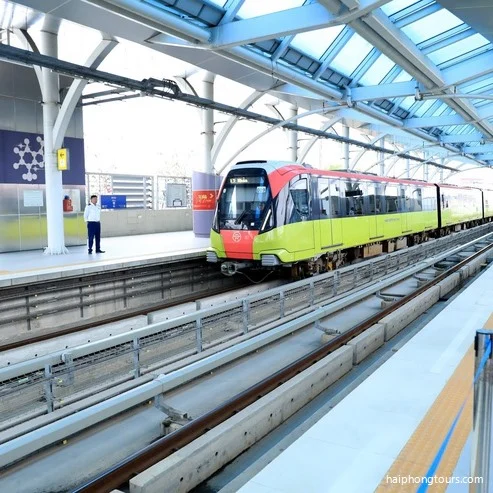
Check your suitcase against the official limit
The luggage rule uses two separate tests. Your bag should not exceed 56 cm in length, 36 cm in width or 23 cm in depth, and it should not weigh more than 18 kg. A light bag can still be too large, and a compact bag can still be too heavy.
- Measure the widest external points, including wheels, fixed handles and packed side pockets.
- Weigh the bag after adding the items you will carry on travel day.
- Keep straps secured so they cannot catch in a gate or train door.
- Do not split an oversized load at the station and assume it will be accepted; staff instructions apply.
Weapons, flammable or explosive materials, illegal goods, strong-smelling fresh food, dirty substances, remains and live animals are prohibited. If an unusual item could create a safety or cleanliness problem, ask station staff before entering the paid area.
Choose the line that actually serves your trip
Hanoi currently has two separate operating metro sections. Line 2A runs between Cat Linh and Yen Nghia through 12 elevated stations. It is useful for trips along the southwest corridor, including connections toward Ha Dong, but it does not serve the Old Quarter, Hanoi Railway Station or Noi Bai Airport directly.
Line 3 currently operates only on its elevated Nhon-Cau Giay section. The underground extension toward Hanoi Railway Station remains under construction, so do not plan a direct metro ride to the main railway station. A map may show the full future line even though only the elevated section is open to passengers.
Check both ends of the journey on a current map before choosing the metro. The rail ride can be easy while the walk, stairs, traffic crossings or final taxi from the station makes the complete trip awkward with luggage. For a broader comparison of city options, see the Hanoi without a motorbike guide.
Use a simple station-to-platform routine
- Confirm the exact entrance. Large roads and elevated structures can separate station entrances. Approach from the side that avoids an unnecessary road crossing when possible.
- Ask for the lift before entering. Tell a uniformed staff member your direction of travel and that you have luggage. Staff can point you to the suitable gate and lift.
- Buy the ticket you can use immediately. Keep your suitcase beside you while paying and do not place it across another gate.
- Pass through one person at a time. Move yourself and the bag through the gate together without letting it trail far behind.
- Check the terminal direction. Platform signs usually identify the direction by the last station on the line, not by your intermediate stop.
- Leave time at the destination. Finding the lift and the correct street exit can take longer than leaving by the nearest stairs.
Buy the easiest ticket for your visit
For an occasional trip, a single-journey paper QR ticket from the station counter is usually the simplest choice for an international visitor. It does not require a Vietnamese citizen ID. Tell the clerk your destination, keep the ticket accessible, and use it as directed at both ends of the journey.
Foreign visitors can also register for the Hanoi Metro app with a passport and portrait, but approval can take about three days. That makes registration more suitable for a planned multi-day stay than an immediate station purchase.
A supported Visa contactless card can be convenient, but one card is for one passenger at a time. Tap in and tap out with the same payment method. A missed tap may result in the highest fare or require help from staff, so do not rush through the exit while managing a suitcase.
Avoid the busiest periods with a large bag
Current published weekday peak periods are 6:30-9:00 in the morning and 16:30-19:30 in the afternoon. Trains are more frequent then, but platforms, lifts and carriages can be crowded. If your schedule is flexible, travel outside those windows and confirm the same-day timetable before setting out.
Services are generally published for a daily operating window of 5:30-22:00, with frequency varying by line, day and time. Do not treat the last listed departure as a safe connection for a flight or an intercity train; allow for the walk, station access and final transfer as well.
Keep the bag controlled on the platform and train
- Stand away from the platform edge and keep the suitcase upright beside you.
- Let passengers leave before you board.
- Do not board when the doors are closing.
- Move away from the doorway once inside and keep aisles clear.
- Hold a rolling case throughout the ride so it cannot move during acceleration or braking.
- Prepare to leave before your stop without crowding the door early.
With a stroller, wheelchair or mobility limitation, ask station staff for assistance rather than searching for an accessible route while carrying bags. A lift may be farther from the entrance you first see, and temporary availability can change. Keep a road-transport fallback when stairs are not possible.
Do not use the metro as an airport train
Hanoi Metro does not reach Noi Bai Airport. Any metro plan for the airport still needs a bus, taxi or car for the remaining distance. That transfer may save money, but it adds another boarding step and more time handling the suitcase.
For a fixed flight, very early departure or several large cases, Hai Phong Tours recommends choosing a direct road transfer that leaves a realistic traffic buffer instead of building a tight metro-and-bus connection. The same principle applies when your hotel is far from a station or when rain makes the walking section difficult.

Use the North Vietnam luggage logistics guide to compare carrying, storing and transferring bags across a longer itinerary.
What to do if you leave a bag behind
Tell station staff immediately. Give the line, travel direction, boarding and exit stations, approximate time, carriage position if known, and a precise description of the item. Do not re-enter through a gate or board another train without staff direction.
Hanoi Metro lists the customer hotline as. Keep your ticket or payment record because it helps establish when and where you traveled. For passports, cash or other important property, also follow the appropriate police or consular procedure.
When a taxi or car is the better choice
Choose road transport when any of these conditions applies:
- One bag exceeds 56 cm × 36 cm × 23 cm or 18 kg.
- You cannot move all your luggage safely without blocking other passengers.
- You need step-free access but cannot confirm a usable lift.
- Your flight or intercity train leaves too soon for a missed connection.
- Your destination requires a long walk or another difficult transfer from the station.
- You are traveling at the busiest time with children, a stroller or several cases.
Final metro-with-luggage checklist
- Measure and weigh every bag.
- Confirm that the operating line serves both useful ends of the trip.
- Check the same-day service window and allow extra connection time.
- Use a paper QR ticket if you need the simplest immediate purchase.
- Ask staff for the suitable gate and lift.
- Keep the suitcase controlled and clear of doors and aisles.
- Save and keep your ticket or payment record.
- Use a taxi or car if the bag, access route or deadline makes the metro fragile.
Useful guides for your trip
Would you like help fitting this experience into your trip? Contact us with your travel dates, starting point, available time and group size. Tell us about walking limits or special interests so we can suggest a practical itinerary.