
For travel from Hanoi to Lai Chau city, compare a direct sleeper bus with a private car for the full road journey. Direct coaches typically schedule around seven to eight hours, with both daytime and overnight departures to consider. A car is more useful when you need a particular hotel, a mountain homestay or planned stops along the way.
Choose the exact destination before choosing the vehicle. “Lai Chau” can mean the provincial center or a much wider region: Than Uyen, Sin Ho and Sin Suoi Ho are separate destinations. A cheap ticket appearing in a province-wide search may leave you far from the accommodation you intended to reach.
Which journey should you book?
- To a hotel in Lai Chau city: a direct bus plus a confirmed local pickup is a straightforward option.
- To Sin Suoi Ho village: compare a bus to Lai Chau followed by host-arranged transport with a car quoted to the actual homestay.
- To Sin Ho town: ask specifically for Sìn Hồ. Check a through service for your date or arrange the onward mountain journey from Lai Chau.
- To Than Uyen or Pa Khom: search for Than Uyen and arrange the lake or accommodation connection separately.
- To visit Sapa first: give Sapa its own stay, then arrange the mountain-road leg west to Lai Chau.
For a first visit, arriving at a city hotel before exploring farther afield can simplify the trip. Going straight to a village works better when the host and transport provider have agreed on the final approach, arrival time and where someone will meet you.
Direct buses from Hanoi to Lai Chau city
Operators to check include Ngan Ha, The Anh and Phuc An. Compare their departures to Lai Chau Bus Station or a clearly identified city office. Do not select a service ending in Than Uyen or Muong Te simply because it appears under the same regional search.
The available vehicle can be a conventional sleeper or a smaller-capacity cabin-style bus. Read the layout for the actual departure: “limousine” does not necessarily mean an upright reclining seat. Ask about berth dimensions if you are tall, access to an upper berth if climbing is difficult, and the luggage allowance before paying.

Use the arrival time as a planning estimate. A late-evening departure can reach Lai Chau before dawn, while an afternoon departure may reach it after dark. Neither automatically includes a room, hotel transfer or permission to remain on the vehicle until morning.
Board at the place named on the ticket
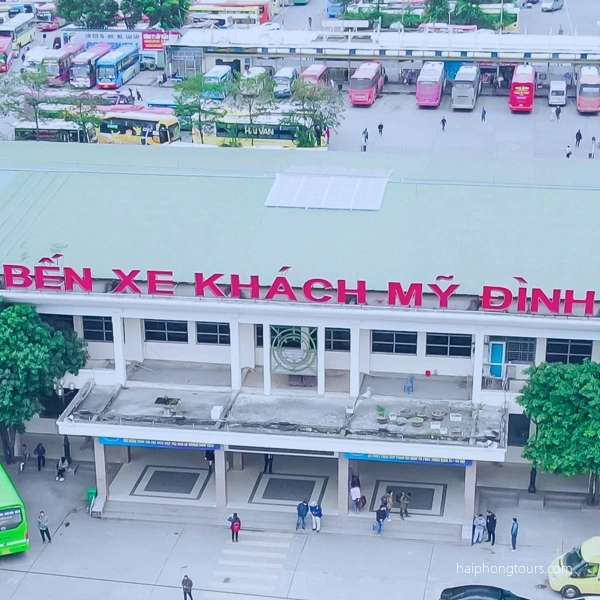 My Dinh is a departure point for direct coaches to Lai Chau.
My Dinh Bus Station, 20 Pham Hung, is a useful starting point for this route. It is outside the Old Quarter. Allow for the cross-city journey and the time needed to locate the operator’s counter or boarding bay; the station arrival and coach departure are separate deadlines.
The Hanoi bus-station guide helps distinguish My Dinh from other terminals and company offices. If your booking uses a different office or transfer vehicle, get its map pin and collection instructions rather than heading to My Dinh automatically.
Day bus or overnight bus?
Choose daytime travel for an easier arrival
A morning departure can make it easier to reach your accommodation during its normal receiving hours. You give up much of a sightseeing day, but you can see your surroundings on arrival, eat and settle in before deciding on the following day’s activities.
Check the arrival clock rather than the “day bus” label. A midday departure may still end in the evening. If you want to continue to a mountain village, ask whether there is enough daylight for the additional drive or spend the first night in Lai Chau.
Choose overnight travel only with a receiving plan
An overnight bus can suit travelers who sleep comfortably in a moving vehicle and have arranged what happens at the other end. Send the hotel the expected arrival time and ask whether a room will be ready. A reservation starting that calendar day does not by itself establish access at 4 or 5 a.m.
If you need a bed immediately, ask which night to reserve and confirm that staff will receive you. For a village stay, agree on a city meeting point and collection time with the host. Avoid making the first morning depend on an immediate trek, a market connection or a long motorcycle ride after poor sleep.
A private car: direct arrival or a longer northwest itinerary
The approach via the Hanoi–Lao Cai expressway and Highway 4D is a substantial road journey. Treat it as a full travel day; around eight hours is a useful starting allowance, with the exact hotel, breaks, traffic and mountain conditions affecting the total. Ask the driver to confirm the route and timing for your booking.

A direct transfer and a scenic journey through Nghia Lo and Mu Cang Chai are different plans. The latter deserves overnight stops if you want time among the terraces and villages. Adding those places to a direct-car request without changing the schedule produces a very long day with little useful sightseeing.
For a car quote, list the full journey rather than requesting only “Hanoi to Lai Chau”:
- Give the Hanoi pickup pin or explicitly request Noi Bai Airport pickup.
- Name the final city hotel or village accommodation, including the host’s meeting point.
- Specify planned stops and whether the driver should remain with you on later days.
- Describe passengers, bags and any child-seat or mobility requirement.
- Confirm tolls, parking, waiting, extra-distance charges and the driver’s overnight arrangements for a multiday hire.
A larger vehicle is not automatically better for a narrow homestay approach. Ask the host what vehicle can reach the entrance and whether you will need to walk or change vehicles for the last section. Agree who carries the luggage and where the main vehicle waits if access is restricted.
Should you stop in Sapa first?
A Sapa stop makes sense when you want to visit Sapa, rest there or divide the journey into separate days. It adds another booking and a change of base, so it is less attractive when Lai Chau is your only destination and a suitable direct coach is available.
For a planned Sapa stay, the Hanoi-to-Sapa transfer covers that first leg, with an Old Quarter hotel pickup and Sapa drop-off; other Hanoi pickups may carry a surcharge. The onward journey to Lai Chau or a village needs a separate arrangement. Confirm the accommodation pin on each leg.
Hai Phong Tours recommends making Sapa a genuine stopover rather than a rushed interchange. An overnight stay lets you set off rested for the O Quy Ho mountain approach, while a tightly timed same-day connection can leave little flexibility for traffic or poor visibility.
Plan the final leg beyond Lai Chau
Sin Suoi Ho: a village pickup, not a city drop-off
Sin Suoi Ho lies roughly 30–35 km from central Lai Chau on a winding approach. Send bản Sin Suối Hồ and your host’s pin, not just the commune name. Arrange the transfer before the long-distance bus arrives and confirm the return or onward pickup as well.
The Sin Suoi Ho village guide covers homestay access, the waterfall walk and how to give the stay enough time. A vehicle reaching the village does not establish step-free access to your room.
Sin Ho: a separate mountain destination
Sìn Hồ is not Sin Suối Hồ. Sin Ho is around 60 km from central Lai Chau, with its own plateau-town accommodation and onward road journey. Ask for a current through-service option before assuming you must change in the city; if changing, have the local connection confirmed first.
Use the Sin Ho overnight and market guide to decide where to sleep. For a market-focused trip, arriving the previous day is more forgiving than attaching the mountain leg to an overnight coach’s estimated arrival.
Than Uyen and Pa Khom: book the correct part of the province
A Than Uyen ticket can be appropriate for the rice valley or Pa Khom area, but it is not a substitute for a ticket to Lai Chau city. The Than Uyen and Pa Khom guide explains the distinction between the town, lakeside accommodation and boat landing. Arrange that last local journey around your actual arrival.
Airport arrivals, weather and the return to Hanoi
For a Noi Bai arrival, ask whether the provider collects inside your passenger terminal or at an off-airport meeting point. Include time for arrival formalities, bags and the ride to any external pickup. A route passing near the airport does not by itself include terminal collection.
Heavy rain can disrupt mountain roads and village approaches. Ask the operator and host about the current route before departure, follow closures and let them change or postpone the journey when necessary. Do not treat a bus still appearing in a booking search as confirmation that every local road is open.
For the return, reserve both the ride out of your village and the onward coach or car. Keep a buffer between them, and avoid pairing the shortest advertised road time with a flight you cannot miss. The useful booking is the complete journey from your actual bed in Lai Chau to your next confirmed destination.
Useful guides for your trip
Would a private transfer make this journey easier? Contact us with your travel date, exact pickup and drop-off, number of travelers and bags. Include any flight, train or cruise deadline so we can assess a suitable plan and quotation.