
Hoa Lo Prison is one of Hanoi’s most substantial short history visits. The preserved prison and exhibitions cover French colonial imprisonment and the later captivity of American airmen. Allow 90 minutes for a considered daytime visit, or longer if you follow extensive audio commentary. The separately booked Đêm thiêng liêng programme adds guided storytelling and dramatized scenes after the daytime galleries close.
Address, daytime hours and useful contacts
- Entrance: 1 Hỏa Lò Street, Cửa Nam Ward, Hanoi. Look for the historic gateway bearing the name Maison Centrale.
- Daytime hours: 08:00–17:00 every day, without a lunch closure, including public holidays and Tết.
- Standard daytime admission: 50,000 VND per person, bought directly at the main gate.
- Visitor enquiries: 0822 446 116 or 0825 112 668. From overseas, replace the first 0 with +84.
- Landline and email: 024 3934 2253; contact@hoalo.vn.
An 08:30 arrival works well for a morning plan. For an afternoon visit, aim for around 15:00 if you want a full 90 minutes and time to return any hired equipment. These are suggested arrival times, not published last-admission deadlines. Hỏa Lò is a specific historic attraction; ask your driver for “Di tích Nhà tù Hỏa Lò” and the entrance on Hỏa Lò Street.

Day tickets and concession eligibility
| Visitor | Daytime admission | What matters |
|---|---|---|
| Standard visitor | 50,000 VND | Applies to domestic and international visitors outside concession categories. |
| Child under 16 | Free | Bring evidence of age if it may be unclear. |
| Eligible student aged 16 or over | 25,000 VND | A student card from an institution within Vietnam’s national education system is required. |
| Vietnamese citizen aged 60 or over | 25,000 VND | Bring age and citizenship documentation. |
The site also provides disability and other statutory concessions. Show the relevant documentation at the counter before purchasing. An overseas student card or being an international visitor over 60 does not establish eligibility for the categories above. Daytime exemptions do not automatically determine the price of a separate evening programme.
Understand the two historical periods
The French began building the prison in 1896. Much of the visitor route concerns Vietnamese political prisoners held under colonial rule, including the conditions of confinement, punishment, political organisation and escape. A later section covers American airmen imprisoned here during 1964–1973. Keep these periods separate as you move between rooms.
Only a portion of the former prison survives as the heritage site. Following the decision to redevelop the larger complex in 1993, the southeastern section was retained and restored. Start with the site plan or introductory model so you understand the relationship between the original prison and the area you can explore today.
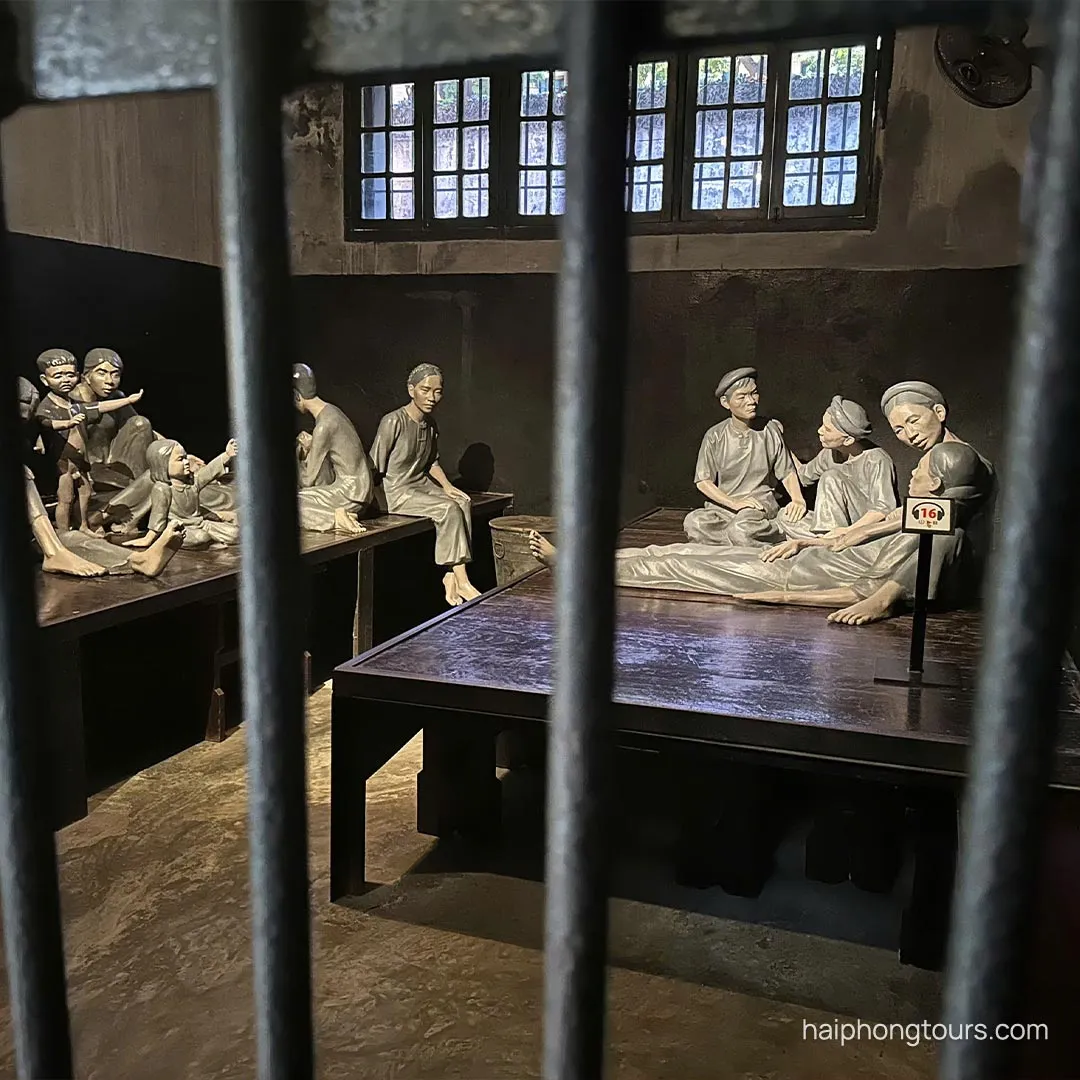
A cell, a reconstructed prisoner scene and an original object are different kinds of evidence. Read the label before deciding what you are looking at. This is particularly helpful when a display combines a surviving architectural space with figures installed to explain how it was used.
A useful route through the exhibitions
The entrance and colonial prison spaces
The original main gateway is itself an important surviving feature. After the introductory displays, follow the marked route through the detention spaces and punishment exhibits. Notice how the physical arrangement controls movement and observation. Choose a named prisoner’s story to follow alongside the architecture, rather than treating every room as an interchangeable scene of confinement.
The guillotine is one of the collection’s most confronting objects. Give the accompanying explanation time, and distinguish its documented use from the surrounding reconstruction. Visitors with children can pause before this section and decide whether to continue together or skip it.
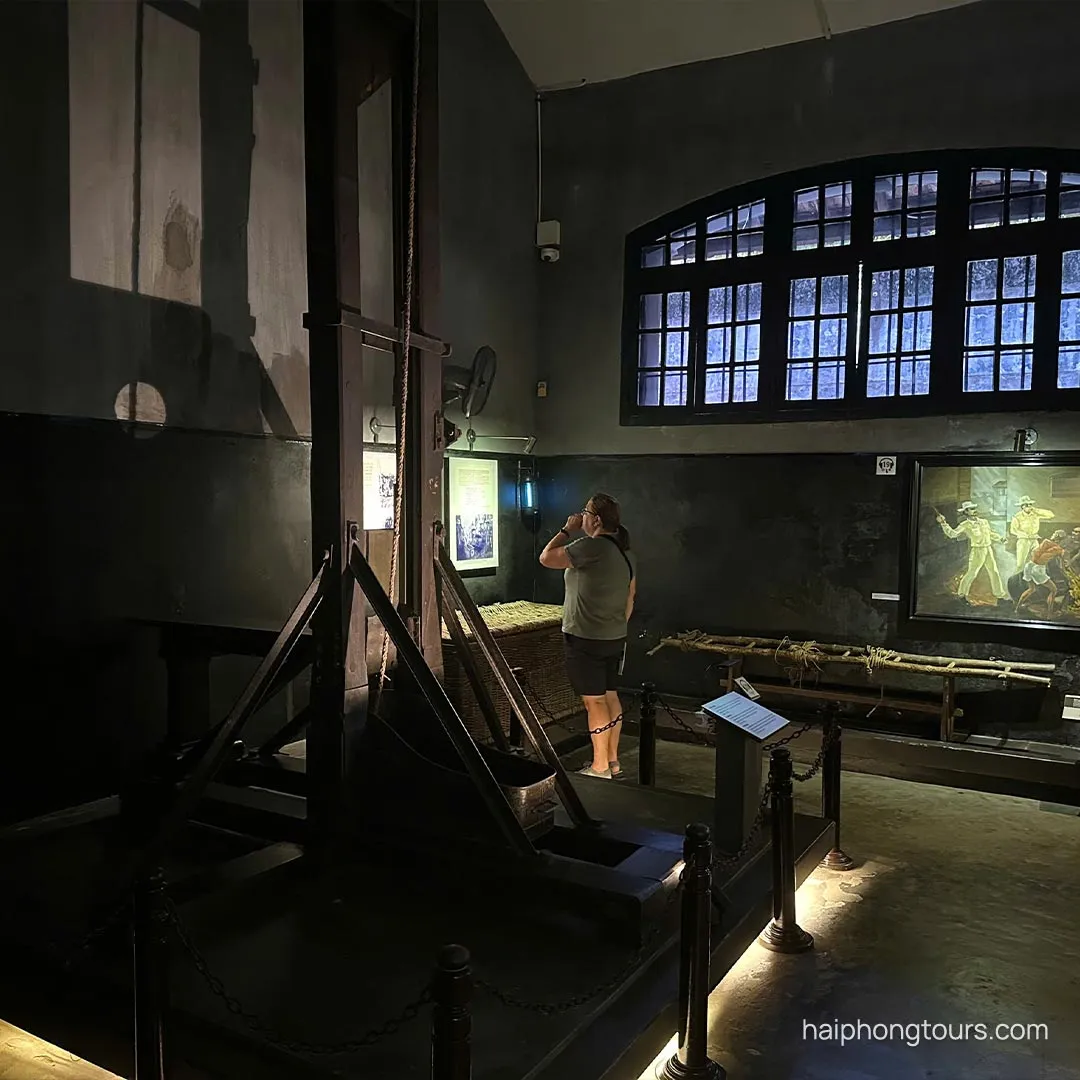
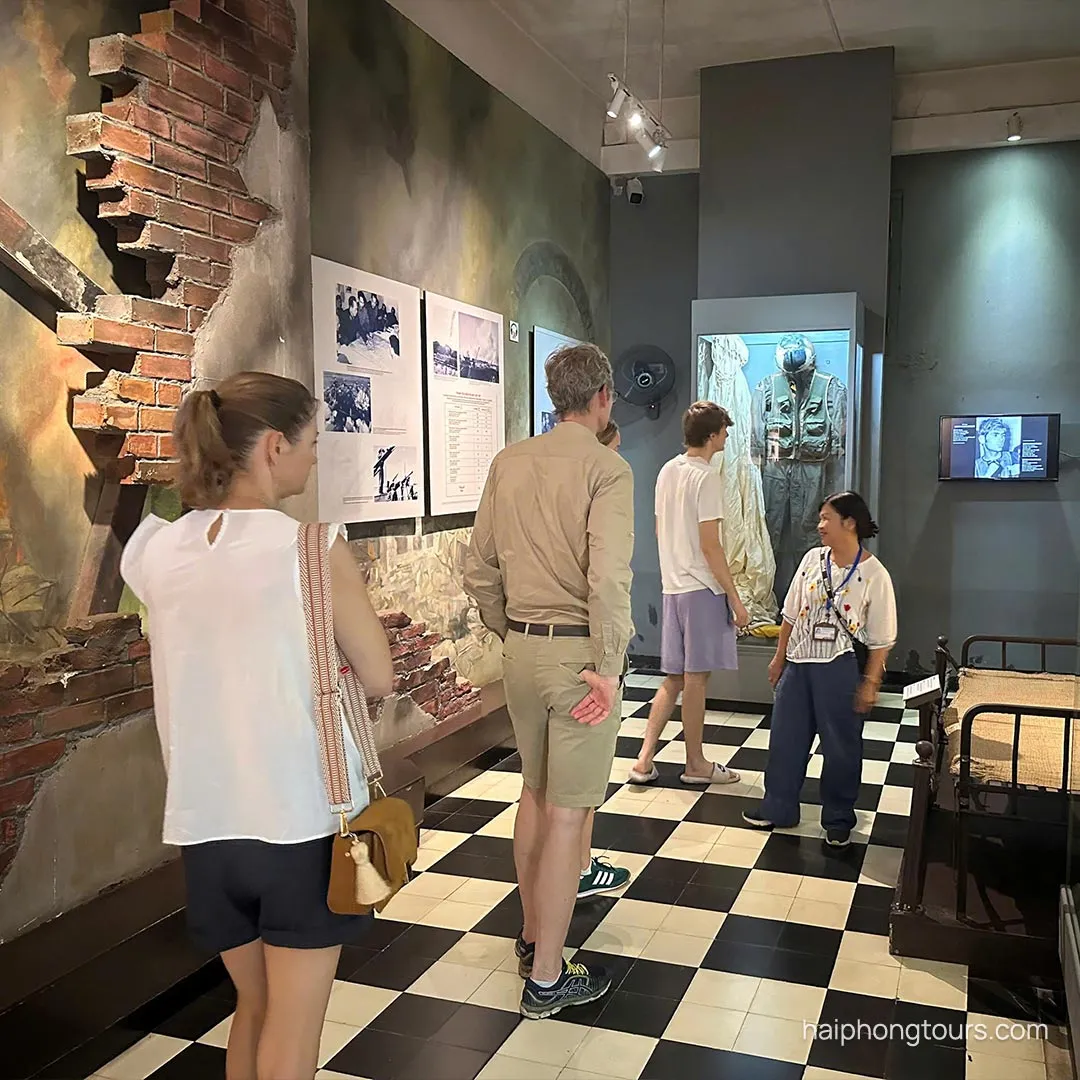
The guillotine and historical displays at Hoa Lo Prison.
The escape stories
Look for the preserved drain entrances associated with escapes in 1945 and 1951. The site’s online exhibition explains the Christmas Eve 1951 attempt: sixteen prisoners entered the drainage system, five escaped and eleven were recaptured. That specific story makes the small architectural opening more meaningful than a general account of prisoners seeking freedom.
Use the dates to distinguish the attempts. If a guide describes an escape, ask which opening and which year the account concerns. The objects are worth examining slowly, but follow the barriers and instructions rather than attempting to recreate a prisoner’s movements.
American prisoners and the memorial
American prisoners called Hỏa Lò the “Hanoi Hilton.” The nickname should not suggest comfortable detention. American POW testimony and the National Museum of the United States Air Force document torture, coercive interrogation, poor nutrition and inadequate medical treatment in the prison system. Prisoners moved between camps, and conditions changed over time.
Read this section alongside prisoner testimony and pay attention to the date, location and purpose of each photograph. An image of recreation or a staged activity cannot describe an entire captivity. The site presents history through a Vietnamese commemorative perspective; understanding that context helps you assess the displays without overlooking the experiences of individual prisoners.
Leave a few quiet minutes for the memorial. It changes the pace of the visit from reading and examining objects to remembrance. Avoid playful poses around punishment displays or the commemorative area.
Audio commentary or a guide
Ask the ticket desk for English audio commentary and the current rental charge. The site’s published audio system includes Vietnamese, English and French, with numbered stops that you select on the device. This suits visitors who want to pause, replay an explanation or spend longer in a particular room.
Check the device before leaving the counter and allow time to return it. If you prefer questions and discussion, arrange a guide through management or your tour operator. Tell them whether your priority is colonial imprisonment, escape stories or American POW history. A guided overview and a complete audio circuit require different amounts of time.
Booking the separate night experience
Hanoi’s culture department’s 2026 visitor information lists night programmes from 19:00 on Friday, Saturday and Sunday. Its November 2026 tourism information continues to promote Đêm thiêng liêng 2: Sống như những đóa hoa and Đêm thiêng liêng 3: Lửa thanh xuân. The programmes combine storytelling, lighting, sound and staged scenes; their emphasis differs from a self-paced daytime circuit.
Contact 0825 112 668 for the date and programme you want. Obtain the total price, language, expected finish and cancellation conditions before paying. The 50,000 VND daytime ticket does not buy this experience, and the availability of daytime English audio does not establish English narration at night.
Explain any difficulty with dark or confined spaces when booking, and ask about the format’s age recommendation. Plan dinner before the confirmed reporting time and leave the return journey flexible until you know the finish. Follow the evening’s photography instructions, which can differ from ordinary daytime rules.
Practical rules and fitting Hỏa Lò into your day
The published rules require luggage to be left in the designated place, prohibit smoking and moving objects, and restrict incense and flowers to the memorial area. Follow staff directions about bags, photography and permitted routes. If wheelchair access or large-bag storage determines whether you can visit, contact management beforehand about the actual gallery route and storage arrangements.
For an independent morning, visit around 08:30–10:00, then take a café break before continuing towards Hoàn Kiếm Lake. This leaves room to process the subject and avoids immediately following one intense exhibition with another. Our Hanoi museum comparison can help you choose a different subject for later.
The Hanoi City Group Tour includes Hỏa Lò in its Afternoon and Full Day options, with an English-speaking guide and Old Quarter pickup. Its published afternoon sequence visits Hỏa Lò at 12:30 and continues to the Temple of Literature at 13:30. Choose that for a broad city introduction; choose an independent visit if you want substantially longer inside the prison exhibitions.

Need help choosing the right format? Contact Hai Phong Tours with your travel date, hotel, group size and main historical interest. Include children’s ages, language needs and walking limits so the proposed visit fits your group.