
Hua Ma Cave makes a rewarding land excursion during a Ba Be Lake stay: a wooded climb, a broad valley view and spacious chambers filled with limestone formations. The useful distinction is access. You reach Hua Mạ by road and steps, so add it to your land itinerary rather than expecting a lake boat to deliver you to the entrance.
Where Hua Ma Cave is now
The current location is Bản Pjan hamlet, Đồng Phúc commune, Thái Nguyên province, on the side of Cô Đơn mountain. VOV’s May 2026 report places it approximately 8 km from the Ba Be National Park centre. That distance uses the park centre as its starting point; your homestay or boat pier may be elsewhere around the lake.
Older maps describe the area as Quảng Khê commune, Ba Bể district, Bắc Kạn province. Save Động Hua Mạ as the destination, with the cave entrance marked separately from your accommodation. This helps a driver identify the attraction despite the administrative name changes.
The climb and a realistic visiting plan
Allow 1–2 hours at the cave, plus road travel. This is our planning allowance for the ascent, interior and descent, not an official admission session. Public sources reviewed for this guide did not establish a reliable daily opening timetable or last-entry time. Arrange a daylight visit through your accommodation or tour provider before setting out.
The approach follows roughly 300 metres of stone steps through woodland. This figure describes the length of the uphill approach, not a 300-metre vertical climb or a verified step count. At the entrance, look back towards the Chợ Lèng River and the fields and village below before going into the mountain.
Build the stop around the slowest walker. A comfortable outline is 20–30 minutes for the approach and pauses, 40–60 minutes inside, then time for the descent. These are flexible allowances, not measured walking records. The return staircase can demand more concentration than the climb, especially if surfaces are wet.
Wear shoes with a firm grip and keep both hands available on the steps. A small backpack is easier than carrying shopping bags. Bring drinking water, and finish snacks outside the chambers. Travellers who cannot manage repeated steps should choose a lakeside activity instead; this route should not be sold as access without stairs. For young children, an adult needs to stay close on both the ascent and descent.
How to look at the formations
A provincial survey visit in May 2026 described a cave more than 700 metres long, covering approximately one hectare, with the highest ceilings reaching about 50 metres. These dimensions explain the spacious impression inside. They describe the cave as a whole, rather than promising that every metre is open to visitors.
Local reporting compares individual formations with Quan Âm, a heavenly gateway, a brush tower and a stone musical instrument. Treat those names as imaginative ways to read natural shapes. They are not carved statues or a fixed museum collection. A guide can point out the locally named features; you can also enjoy their silhouettes without trying to match every formation to a label.
Start with the entire chamber, then look for three different scales: the high ceiling, the larger columns or curtains, and smaller clusters beside the visitor route. Hanging stalactites and formations rising from the floor become easier to distinguish when you change your viewing angle. Stay on the permitted path, keep fingers off the stone and never tap a formation to test its sound.
VTV’s April 2026 photographs show installed coloured lighting. Expect an illuminated visitor experience, with colours that can alter how the rock appears in photographs. For clearer pictures, hold the phone still and expose for the lit stone rather than brightening the entire chamber. Avoid blocking the path while taking repeated photographs, and follow staff directions if a section is closed or lighting is being serviced.
Why the cave is called “horse head”
The national tourism database translates Hua Mạ as “horse head” and records a local legend involving a ruler whose horse would not cross a stream. Villagers told him that cries came from the spirits of people killed in the cave; a Buddhist sanctuary was established to bring them peace. Other retellings differ. This is oral tradition explaining the cave’s name and spiritual associations, rather than a dated account of how the limestone formed.
Admission: understand the fee and the reported price
Thái Nguyên Resolution 32/2025/NQ-HĐND, effective from 1 January 2026, sets the following sightseeing fees:
| Attraction | Listed fee per person, per visit |
|---|---|
| Hua Ma Cave | 40,000 VND |
| Ba Be Lake | 60,000 VND |
The regulation exempts children under 16 and certain other eligible categories. Bring evidence of age if claiming a child’s exemption. For two adults without an exemption, the listed sightseeing fees total 80,000 VND for the cave, or 200,000 VND for both attractions. Transport, boat hire and other services are separate costs.
There is a discrepancy in public reporting: VTV’s 27 April 2026 article quotes 45,000 VND for adults and 25,000 VND for children, without explaining age bands or additional charges. Use the regulation as the fee reference, and request an itemised total and receipt at booking or admission. We cannot verify what accounts for that difference.
A published cave-and-lake tour you can enquire about
Sai Gon–Ba Be Resort lists a Hua Ma Cave–Ba Be Lake morning tour. Its published outline has breakfast at 06:30, hotel pickup at 07:15, a transfer to the boat pier at 09:00 and the end of the boat outing at 10:30, followed by the transfer back to the hotel.
The listed inclusions are entrance fees, private car transport, a local guide and one 500 ml bottle of water per person. Breakfast and a boat journey appear in the itinerary but are not separately specified in that inclusion list. Have the written quote cover both, the guide’s language and the final hotel-return time.
The page is dated November 2019 and still displays a contact-for-price offer. It is a useful programme to request, not a confirmed daily departure or a fixed 2026 tariff.
Contact the resort on +84 209 387 6699, +84 889 173 555 or +84 961 917 666, or email booking@saigonbaberesort.com. Its address is the Ba Be National Park administrative area, Ba Bể commune, Thái Nguyên. These are hotel and tour-booking contacts, rather than a cave ticket-office number.
Fit Hua Ma into a Ba Be stay
For an independent day, visit the cave after breakfast, return for lunch, then use the afternoon for a lake outing or time around your village accommodation. This gives the climb its own unhurried slot. If a longer boat route is the priority, put Hua Ma on another morning rather than compressing every attraction into a single boat booking.
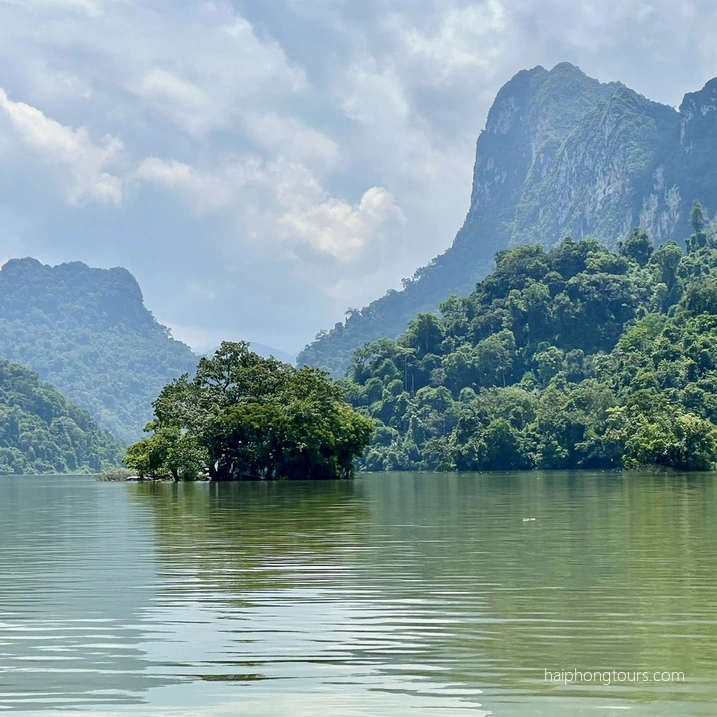
Use our Ba Be Lake planning guide to choose the wider stay. If you are comparing cave experiences, read the Tham Phay expedition guide before choosing; the equipment and activity expectations require their own planning.
For help combining accommodation, road transport and a suitable lake programme, send Haiphong Tours your travel date, overnight location, group size and any difficulty with stairs. That gives us the information needed to build a workable route and an itemised quote.