
Huong Canh is a worthwhile pottery visit if you want to understand dark, unglazed Vietnamese stoneware and meet a working maker. Its small group of family workshops offers a different experience from a large ceramics market. Arrange a specific studio visit or clay session, then add one of the village’s carved wooden communal houses if cultural context interests you.
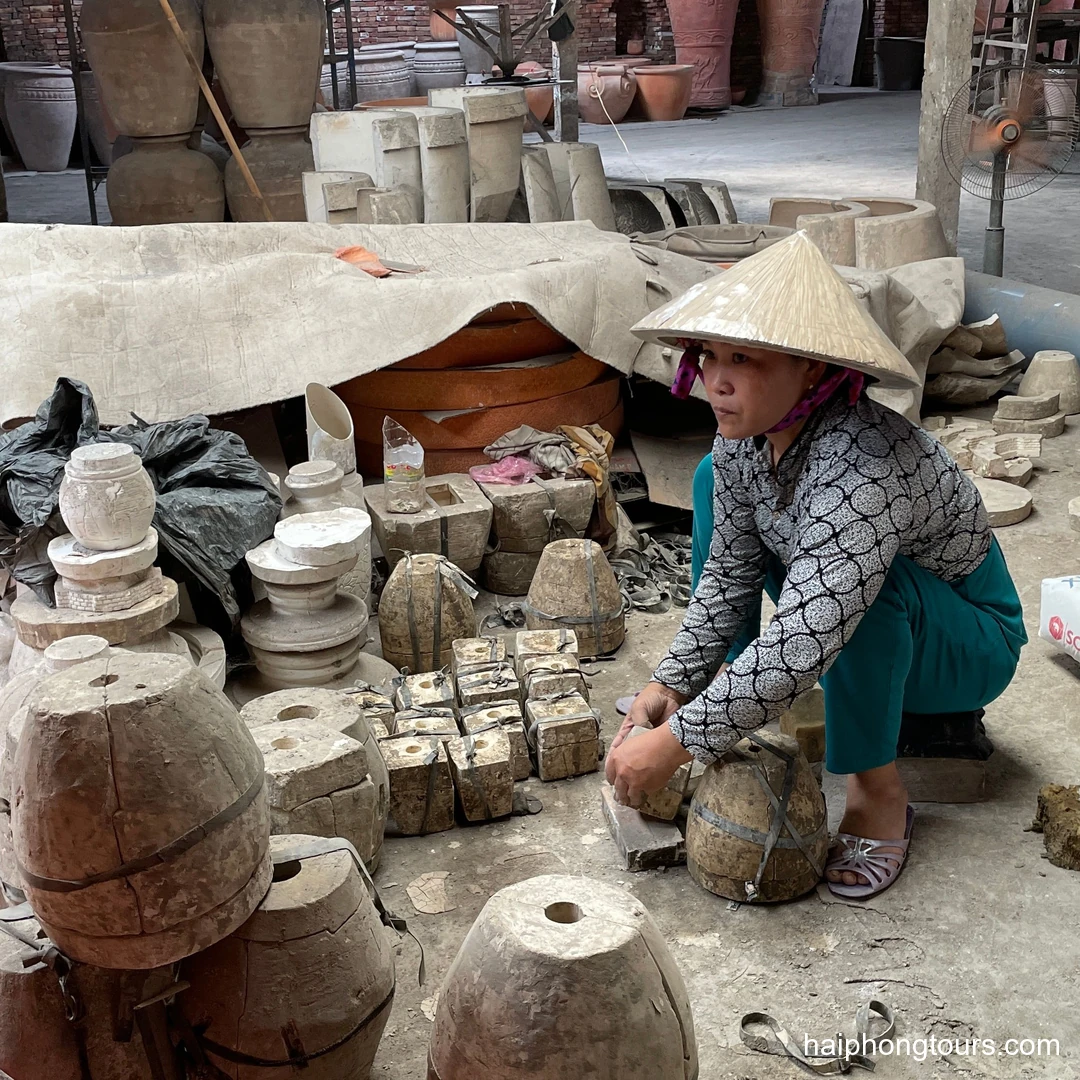
The pottery area is at Lo Cang, Huong Canh, now in Binh Nguyen commune, Phu Tho. Older addresses use Huong Canh town, Binh Xuyen district, Vinh Phuc. Keep the maker’s name and exact workshop pin with the address; the village name alone does not identify your appointment.
What makes Huong Canh pottery different
The local tradition is gốm sành, or stoneware, associated with substantial jars and other household vessels. Its characteristic earthy brown surface comes from the clay and firing rather than a layer of colored glaze. Look at the form, surface and carving instead of expecting painted souvenir plates.
Contemporary makers also produce sculptural vases, relief panels and decorative objects. An art piece and a storage jar can therefore share a material tradition while serving very different purposes. Ask the maker to put two contrasting examples side by side; it is a useful way to see how the craft has developed.
Only a small number of families continue production. You may see shaping or finishing without a kiln being fired that day. A visit is more rewarding when built around a conversation and a planned activity than a search for streets lined with busy furnaces.
Choose the workshop before choosing the rest of the day
Quang Duc: contemporary work and a clay experience
The family workshop of artisan Nguyen Hong Quang, known as Quang Duc, makes artistic and functional ceramics and maintains a visitor experience area. Activities have included preparing clay, using a pottery wheel and forming a piece with family members’ guidance. It is a sensible place to investigate when making something is the purpose of your trip.
Have your local guide or host arrange the named workshop and confirm the session before you travel. Specify whether you want hands-on making or an explanation of production. A family studio’s ability to receive a group does not mean an English class runs every hour or that an individual can arrive without an appointment.
Thanh Nhan: a direct contact for the working kiln and finished pottery
Thanh Nhan pottery lists a Lo Cang address. Contact kiln owner Giang Anh to arrange a visit. Its range includes household and display ceramics.
Use that contact to arrange a production or buying visit and ask what can be shown on your date. Do not assume the number is a village-wide booking office or the contact for Quang Duc’s clay session. Request the precise meeting point and arrange interpretation if you want a detailed technical discussion.
Decide what happens to the piece you make
The most useful distinction is between taking home a clay model and receiving a finished, fired ceramic. Shaping a pot is one stage. Drying and firing require a separate process, so a short activity does not automatically produce a durable vessel ready for your suitcase.
Before starting, agree whether the studio will fire your piece, when it can be collected and whether delivery is possible to your remaining address in Vietnam. Ask about the total cost, including firing and packing. If you leave the country soon, buying a finished small piece may be more practical than arranging an uncertain later shipment.
For a beginner, a simple bowl or small hand-shaped object offers more time to learn than an ambitious large vase. With children, choose the activity with the instructor and keep the group within the supervised visitor area. Working kilns and drying shelves are production spaces.
Add the communal houses for another kind of craftsmanship
Huong Canh’s heritage includes three communal houses: Huong Canh, Ngoc Canh and Tien Canh, also called Tien Huong. They belong to the local worship and community tradition, with architecture and carving associated with the seventeenth and eighteenth centuries. They are separate buildings, not galleries inside the pottery workshop.
The carvings give each a different focus:
- Huong Canh: scenes of communal activity, including wrestling, boat racing and hunting.
- Ngoc Canh: work and everyday recreation, including raising a mast, drinking and chess.
- Tien Huong: dragons, lotus and other symbolic natural or sacred motifs.
A visit to one open hall can be enough to appreciate the contrast between clay work and woodcarving. Arrange access if interior detail is important, and follow the caretaker’s instructions around altars. The exterior and courtyard alone will not reveal all the carved scenes described here.
Make a realistic route from Hanoi or Tam Dao
Huong Canh lies northwest of Hanoi, roughly 12 km from the Vinh Yen area, along the National Highway 2 corridor. It can work as the main purpose of a half-day outing, or as a planned stop before continuing toward Tam Dao. The hill town still requires its own onward drive and mountain ascent.
For a day focused on ceramics, pair the workshop with Vinh Phuc Museum, now Hung Vuong Museum Site 2, on Ly Bon Street. Its glazed Tro Pagoda tower provides a useful contrast to Huong Canh stoneware. Confirm the museum session and workshop appointment before setting the route.
For a culture-focused outing, start with the confirmed studio appointment, have lunch locally and visit one accessible communal house before returning. As a planning estimate, leave two to three hours in the village if your chosen lesson fits within that period. A technical studio visit or several halls will need longer.
For a Tam Dao stay, use Huong Canh on the arrival or departure day rather than leaving the hill town for a rushed pottery errand. Agree on the workshop stop and waiting time with the driver. A vehicle booked simply to Tam Dao will not necessarily include a village visit.

If you only want an easy first pottery class from central Hanoi, compare Bat Trang’s workshops, market and museums. Choose Huong Canh because its particular stoneware and working-family setting interest you, especially when the northwest route already suits your itinerary.
Buy a piece that suits the journey home
Large jars express the tradition well, but their weight makes them awkward travel purchases. A small vase or sculptural piece can be easier to carry. Check the actual object for damage, look at the base and rim, and ask the maker about its intended use.
A decorative ceramic is not automatically suitable for food storage, hot liquids or cooking. Ask for care instructions rather than judging function by its resemblance to a traditional jar. Keep the maker’s name with the receipt if provenance matters to you.
Have fragile pieces wrapped separately, with protection around protruding details. For anything too large for your luggage, settle packing, shipping and responsibility for breakage before paying. Buying directly can support the workshop, but a purchase should match your practical needs.

Huong Canh works best as one thoughtful craft appointment with time to understand the material. Confirm the maker, the activity and the fate of your clay piece first; use the remaining time for the village’s wooden heritage rather than trying to fit every workshop into one day.
Would you like help fitting this experience into your trip? Contact us with your travel dates, starting point, available time and group size. Tell us about walking limits or special interests so we can suggest a practical itinerary.