
Tuyet Tinh Coc is not worth a special journey for most visitors to Hai Phong. The quarry landscape may interest photographers, but the blue water in old pictures is not a reliable attraction, and current public sightseeing access has not been established. Choose a managed heritage site for a planned outing; consider this lake only as a brief view from an explicitly permitted place if you are already nearby.
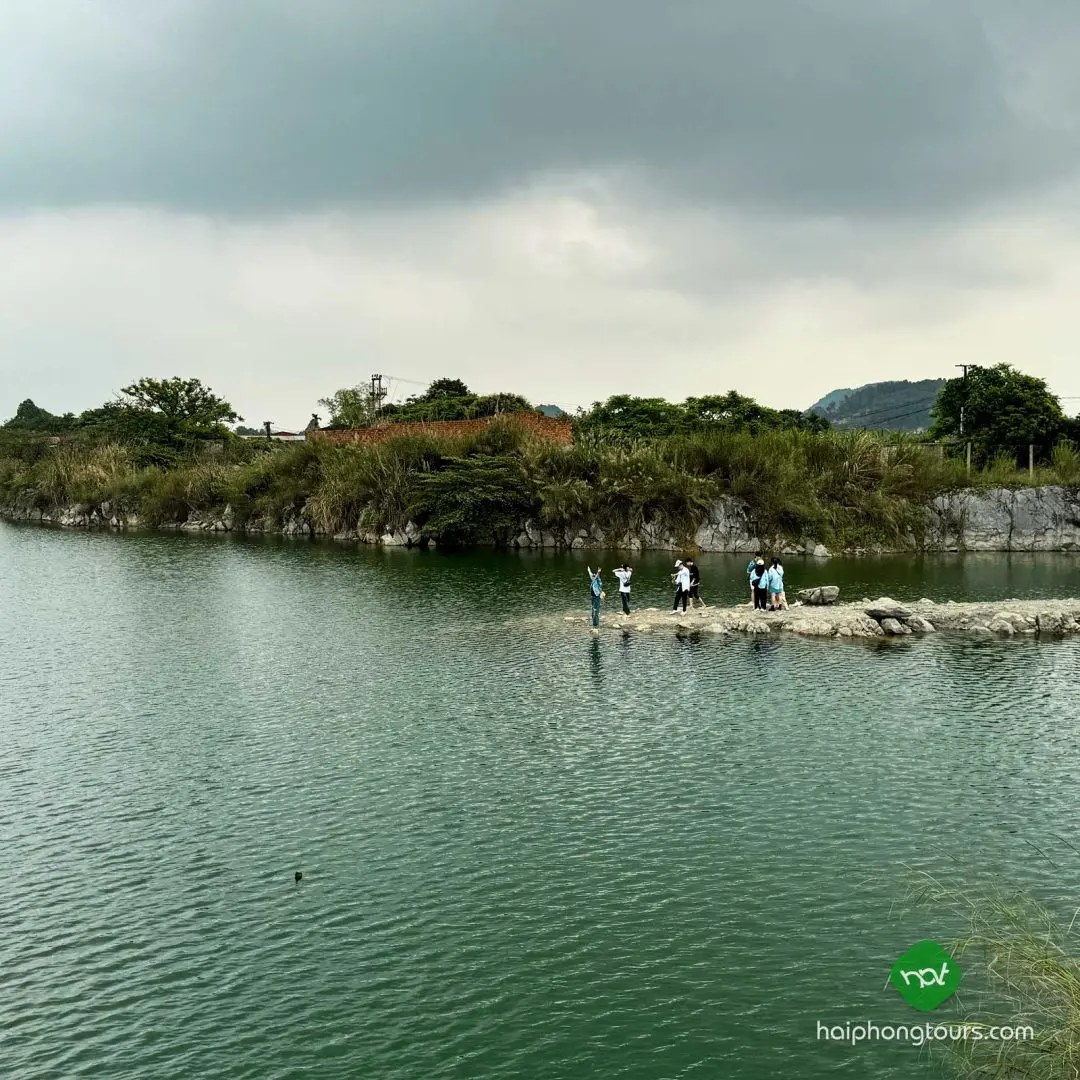
This assessment was updated on 15 November 2026. The strongest recent official evidence concerns drowning prevention, rather than a new visitor entrance, ticket office or recreational service.
Find the Hai Phong lake, not its namesake
The local authority identifies Hồ Tuyệt Tình Cốc in thôn Trại Sơn, xã Việt Khê, Hải Phòng. Older directions use An Son Commune and Thuy Nguyen District. Keep both the current village name and the older area name in your message to a driver; a search for the nickname alone can lead to a different destination.
In particular, this is separate from the place commonly called Tuyet Tinh Coc in Ninh Binh. A booking describing temples, a landscaped walking circuit or that province should not be assumed to cover the Hai Phong quarry lake.
The setting is an excavated limestone quarry. Treat the water, rock faces and industrial access ground as the subject of a landscape photograph, not evidence of a developed lakeside park.
What the access evidence actually says
On 28 May 2026, Viet Khe reported installing warning signs at five locations with drowning risks, including this lake. The campaign warned of deep water and prohibited informal swimming. That is a reason to keep out of the water; it is not an announcement that sightseeing facilities have opened.
A much older report, reproduced by the city portal in March 2017, recorded instructions to fence the lake and prohibit activities there because of quarry hazards. It explains why historical visitor photographs are a poor guide to permission. It does not, by itself, establish the exact boundary or operating arrangements in 2026.
We have not verified a current public opening notice, authorized viewpoint, admission tariff or operator-run lake excursion. Follow present barriers and instructions. If the only approach involves entering controlled quarry ground, leave the stop out of your itinerary.
The relevant local contact
Viet Khe’s published government contact is 0986 700 812, or +84 986 700 812 from abroad. The commune portal also lists ubndxavietkhe@haiphong.gov.vn. The government office is in thôn Phù Lưu, xã Việt Khê; that address is not the lake entrance.
The phone is an official channel for local feedback and enquiries, not a sightseeing reservation desk or a promise of English assistance. A Vietnamese-speaking host can use it to identify the appropriate authority for an access question.
A useful message is: “Hồ Tuyệt Tình Cốc ở thôn Trại Sơn hiện có điểm tham quan được phép không?” This asks whether the lake currently has a permitted sightseeing point. Obtain the exact location if one is identified. A general answer that people visit the area does not identify an authorized entrance.
Set realistic expectations for the photograph
Hai Phong Tours’ original report of its March 2024 visit described ordinary-looking water, a dusty approach and limited facilities. This is a dated observation, not a November 2026 inspection. It is nevertheless useful context for travelers expecting the intensely blue lake promoted in older images.
A photograph cannot prove water quality, depth, or safe footing. This guide does not assign a chemical explanation to the color or repeat an unverified depth measurement. Those details would require evidence beyond appearance.
If a permitted viewpoint is available, a wider composition showing the limestone walls and quarry setting is a more realistic aim than reproducing one particular shade of blue. Stay on the authorized ground. Moving down a bank or climbing a rock face to remove a fence from the frame is not a worthwhile trade for a travel photograph.
Transport, parking and the real cost of a detour
Plan from your hotel and onward destination, not from a generic “Hai Phong” map label. Send the full lake name and Trại Sơn location before accepting a car quote. Include waiting and the return journey if the driver is to remain with you.
There is no verified admission or parking tariff to quote here. An informal parking payment, if offered, is a separate transaction and does not establish permission to enter the quarry. Obtain the amount and parking location before handing over a vehicle.
The sensible comparison is the total extra car time and cost against a short landscape stop. If the visit requires a dedicated return journey from the city, that expense is difficult to justify without a confirmed viewing place. Do not arrange a one-way drop that leaves you depending on finding another car at the lake.
Use normal city stops for refreshments and toilets before the detour. This research did not establish staffed visitor facilities, equipment hire or a campsite at the lake.
Who should leave this stop out?
Skip it if the purpose is swimming, paddling, an overnight camp or a children’s lakeside play session. Those activities need appropriate access and facilities that have not been verified here. Clear-looking water and evidence of previous visitors are not substitutes.
For travelers who need level paths or dependable vehicle-to-viewpoint access, an unconfirmed quarry approach also makes a poor plan. A car can solve the road journey while leaving the final ground conditions unresolved. If a companion cannot comfortably turn back without seeing the lake, choose a different outing from the start.
A more dependable way to spend the time
Bach Dang Giang offers a clearer basis for a heritage outing. Its own visitor information currently publishes 07:00–19:00 daily and a no-service-fee policy. It lists temples, riverfront memorial spaces and other interpreted features. Vegetarian meal service is marked temporarily suspended, so do not build lunch around receiving a meal there.
Our comparison of Hai Phong’s Bach Dang sites helps distinguish the main complex from separate archaeological and worship locations. Choose one main destination before arranging the road route.
If you have only a few hours in the city, use the Hai Phong sightseeing guide to combine a walk with food and a cultural stop instead. You will have a more coherent outing than a journey built around uncertain quarry access.
Planning a Hai Phong countryside visit? Send us your starting point, date, group size and available time. We can discuss a suitable route and a transport quotation based on the places you can actually visit.