
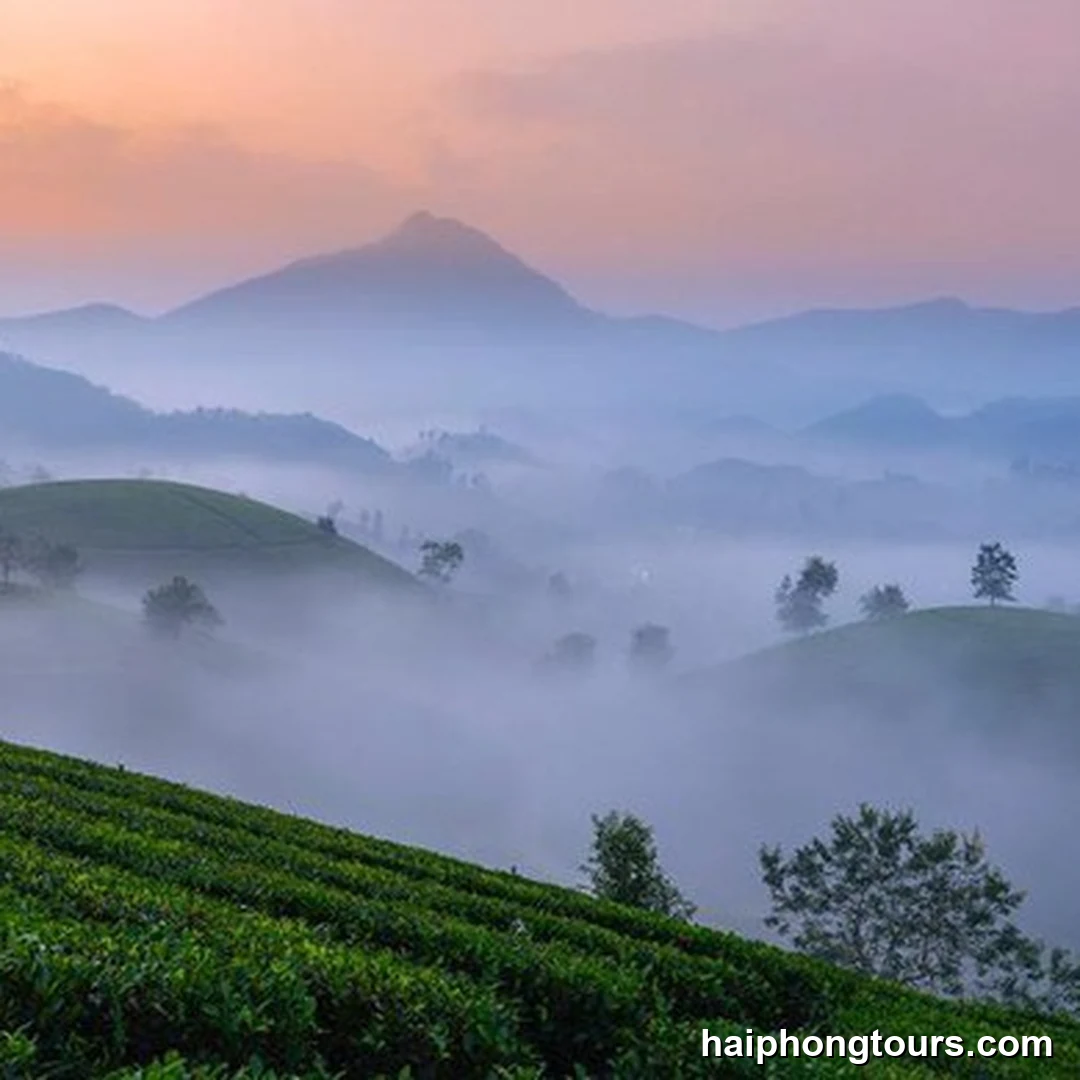
Long Coc tea plantation is a landscape of rounded, tea-covered hills in Phu Tho, roughly 120–125 km from Hanoi. You can visit on a day trip, but staying one night nearby is the more practical choice if your main reason for coming is to photograph the hills around sunrise.
Expect working tea fields, village roads and locally run accommodation. The appeal is the changing light across the hills and the chance to learn about tea growing and Muong culture. Mist can make the landscape especially striking, but it is a weather-dependent bonus rather than something any booking can guarantee.
Where Long Coc is and how much time to allow
The tea hills are in Long Coc commune, Phu Tho province. Older addresses place them in Tan Son district. Use the exact accommodation or agreed viewpoint as your destination, since a general pin for the tea plantation may lead to a different access road.
For travel from Hanoi, allow approximately three to four hours each way as a planning estimate, with extra time for traffic, stops and the final village approach. The distance is manageable for a day trip, but most of that day will be spent traveling if you also try to add several other attractions.
- One day: a daylight visit to the tea hills, a local lunch and a short walk.
- Two days, one night: afternoon arrival, a sunset outing and another chance to photograph the hills at sunrise.
- A longer countryside trip: combine Long Coc with Xuan Son National Park, giving the forest and village visit its own time.
When to visit the tea hills
October to early December is a useful period to consider for cool mornings and misty scenery. The most important conditions are those on your actual travel dates: a valley can be clear, lightly misted or completely obscured on successive mornings.
A green hillside visit can also be worthwhile outside the autumn mist season. Ask your host about the condition of the tea fields before traveling specifically for photographs, since harvesting and pruning affect their appearance. After heavy rain, reconsider steep or muddy access paths.
For sunrise, agree on the departure time with a local host the evening before. Aim to reach a suitable viewpoint before first light, allowing for the walk or local transfer. A fixed year-round arrival time is less useful than checking sunrise for your date and the route you will actually use.
Stay after the sun appears if visibility allows. The view can change as light reaches different slopes and patches of mist move through the valleys. Late afternoon offers another opportunity, particularly if you prefer to explore in daylight before returning to your accommodation.
Getting from Hanoi to Long Coc
By car with a driver
A car gives you flexibility over arrival time and stops, especially with luggage or photography equipment. One common approach follows Highway 32 toward Thanh Son, then continues toward the Long Coc and Xuan Son area. Confirm the final route with your accommodation rather than relying on an old sequence of turns.
For an overnight booking, establish whether the driver stays locally, whether the dawn outing is included and where the car can safely park. A transfer to your homestay does not automatically include repeated trips between viewpoints.
By bus and local transfer
If you want to use a regional bus, arrange the last section first. Ask your host which current service and stop work for your arrival; Minh Dai is a name you may encounter in route information, but it is not the tea-hill viewpoint itself.
Confirm both the outward service and the return pickup before committing. Give the bus operator your intended stop, then agree on a local pickup with the host. Do not build a sunrise plan around finding a taxi or motorcycle ride after an unconfirmed late arrival.
By motorcycle
The final hill roads require more care than the main approach. Keep the ride within your experience, use daylight to identify the route and avoid pushing on along muddy tracks just to reach a photograph location. If you are unfamiliar with the area, ask for a local guide or transfer to the viewpoint.
What to do at Long Coc tea plantation
Photograph the rounded hills
The repeated shapes of the hills are Long Coc’s distinctive feature. In mist, their rounded tops can look like islands; in clear weather, the rows of tea and paths between them become more visible.
Names used for photo areas include Doi Bong and Mong Ngua, while older directions also refer to Doi 3 and Doi 5, or Teams 3 and 5. Ask a local host which access point currently suits the light, road conditions and your walking ability. These names are more useful as starting points for a conversation than as instructions to enter any field you find.
Use established paths and leave room for workers and other visitors. A longer view from a suitable edge can show the layers of hills without stepping across the tea bushes. Ask permission before making people the subject of close photographs.
Learn about growing and making tea
Arrange a tea visit through a host or producer if you want more than a landscape stop. Depending on farm work and the season, this may include seeing how leaves are picked, watching processing or tasting locally made tea.
Ask what is actually included, how long it takes and whether someone can explain the process in English. Pick leaves only when invited and shown how. When buying tea, compare the aroma and taste, then check the producer’s label and sealed packaging rather than selecting solely by a scenic photograph on the packet.
Share a meal and learn about local life
Long Coc’s community tourism is closely connected with local Muong households. A meal at your accommodation can be a useful part of the visit, particularly after an early start. Dishes to ask about include chicken, stream fish, bamboo shoots and com lam, rice cooked in bamboo.
Order ahead so the host knows your group size and any food restrictions. If you would like music, dancing or a cultural activity, arrange it explicitly; these are activities people prepare, not performances that necessarily happen every evening.
Where to stay near the tea hills
Long Coc Ecolodge
Location: Bong 1 area, Long Coc. Phone: 0984 418 819.
Long Coc Ecolodge offers private rooms and shared group accommodation, with a restaurant and outdoor pool. It suits travelers who want to stay close to the tea landscape with meals and facilities on site.
Choose the specific room category carefully: a communal room and a private room offer different levels of privacy. Confirm the view, bathroom arrangement, breakfast time and any early-morning transfer you need. Request a quote for your dates rather than assuming every room or package has the same inclusions.
Homestay Tony Luan
Location: Bong 1 area, Long Coc. Phone: 0337 405 013.
Homestay Tony Luan has Muong-style stilt-house accommodation and is associated with local tea-hill photography and guiding. It is an option to discuss if you want help choosing a viewpoint and arranging a dawn outing.
Ask which private or shared sleeping arrangement is available, whether a local guide or ride is included, and when meals can be served. The same village address does not make this property interchangeable with Long Coc Ecolodge; use the full property name when arranging pickup.
A practical two-day itinerary
Day one: arrive in daylight and explore slowly
Leave Hanoi with enough time for a relaxed afternoon arrival. Check in, have a meal if arranged and ask your host about a short tea-hill walk or producer visit. Establish the next morning’s meeting point while it is still light.
Use late afternoon for a nearby viewpoint, then return for dinner. Keep the evening flexible and prepare the small bag you need for sunrise: a light jacket, shoes with grip, a torch, drinking water and your camera or phone.
Day two: sunrise, breakfast and the return journey
Visit the agreed viewpoint before sunrise if conditions are suitable. Afterward, return for breakfast and allow time to rest, buy tea or take a final short walk before leaving for Hanoi.
If the morning is too wet or visibility is poor, choose a tea tasting or a relaxed breakfast instead of repeatedly moving between slippery viewpoints. An overnight stay gives you more flexibility; it does not make mist or sunshine certain.
Combining Long Coc with Xuan Son National Park
Long Coc and Xuan Son make sense together for travelers interested in tea hills, village life and forest scenery. Plan the park visit as a separate part of the journey, with your accommodation helping confirm the current entry point, available routes and local guiding.
For a substantial walk or village stay, add another night rather than treating the park as a quick stop between sunrise at Long Coc and an early return to Hanoi. Choose activities according to weather and access conditions, and arrange any group gathering with the host rather than lighting a fire in the fields or forest.
For a different countryside combination, consider Suoi Chieu Lake and Ban Mai Retreat for a boat outing and hot-pool stay. Keep a night near Long Coc if sunrise photography is your priority; the lakeside accommodation is a separate base.
Before leaving, settle the practical costs: accommodation, meals, local guiding or transport, and any charge for entering a managed viewpoint or private property. Long Coc is a working landscape with several hosts and access points, so your chosen route and activities determine the visit.