
Mai Chau is worth visiting when you want a quiet rural stay, easy cycling and community-based experiences within a manageable road trip from Hanoi. One night is enough for a first look at the central valley; two nights are better if you want an unhurried ride, a guided walk or time outside the main villages.
Base yourself near Lac Village or Pom Coong for the easiest first visit. Choose Pu Luong instead when trekking and terraced hillsides matter more than flat cycling, or choose a property outside central Mai Chau when the accommodation itself is the main reason for your stay.
Mai Chau at a glance
- Best for: couples, families and independent travelers who want countryside, cycling, White Thai culture and a slower pace.
- Less suitable for: travelers seeking demanding mountain treks, a busy restaurant scene or major attractions from morning to night.
- Useful stay: one night for the central valley; two nights for a fuller trip.
- From Hanoi: approximately 140 km and about 3.5 hours by private vehicle under normal planning conditions.
- Getting around: walking and bicycles work well in the central valley; electric carts and arranged vehicles help with longer distances.
- Main base: the Lac Village and Pom Coong area, close to fields, stilt houses and visitor services.
Mai Chau is now within Phu Tho Province following Vietnam’s 2025 provincial reorganization. Older maps, hotel listings and travel articles may still use Hoa Binh Province. Use the property’s exact name, pin and telephone contact when arranging transport rather than relying only on the province shown in an old address.
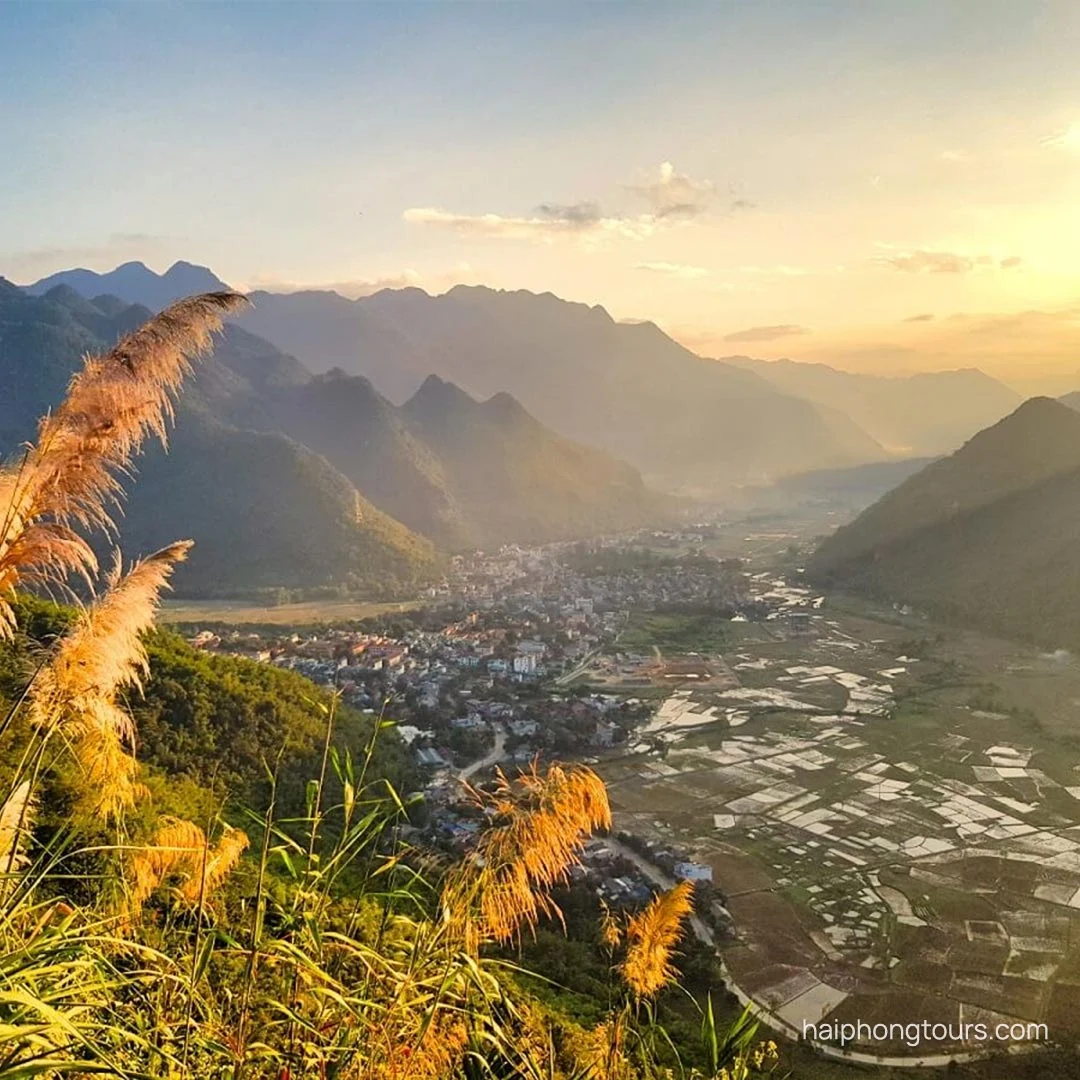
How many days should you spend in Mai Chau?
A day trip from Hanoi: possible, but road-heavy
A same-day visit uses roughly seven hours for the round trip by private vehicle before stops, traffic or hotel collection are added. It can work if your only goals are lunch, a short village visit and a brief cycle, but it gives little room for bad weather or a slower cultural activity.
Do not choose a day trip simply because Mai Chau looks close on a map. The approach includes slower mountain-road sections, and a shared vehicle may collect several passengers. One overnight usually produces a better balance between road time and time in the valley.
One night: the practical first visit
Leave Hanoi in the morning, arrive around lunchtime, and use the afternoon for Lac Village, Pom Coong and a bicycle ride. The following morning can hold a second ride, a village walk or a short nearby activity before the return journey.
One night suits a compact northern Vietnam itinerary and travelers who mainly want the central valley. It is less suitable if you want a long guided walk or have booked an outlying resort that requires additional driving.
Two nights: better for a slower trip
Two nights give you one complete day without checking in or traveling between cities. Use it for a guided walk, a longer cycling route, a community visit arranged through your host, or simply time at a countryside property.
This is the better choice for families, photographers and travelers who do not want to plan every activity around a departure time. Add a third night only when you have a specific longer outing or have deliberately chosen Mai Chau as a rest stop.
Where to stay in Mai Chau
Lac Village and Pom Coong: easiest for a first visit
Lac and Pom Coong are established community-tourism villages in the central valley. Their concentration of homestays, food and bicycle access makes them convenient when you arrive without your own vehicle.
This area also receives the most visitors. Ask whether your room faces a road or performance space if quiet sleep matters. Confirm whether a “homestay” booking means a private bedroom or a mattress in a shared stilt-house sleeping area, and whether the bathroom is private.
Best for: first-time visitors, short stays and travelers who want to walk or cycle from the door.
A lodge on the valley edge: scenery with more separation
A property outside the busiest village lanes can offer more space and a quieter evening while keeping the rice fields within cycling distance. The trade-off is fewer restaurants and shops within an easy walk.
Check the final approach before booking. A listing described as “Mai Chau” may be well outside the central valley, and a beautiful view does not guarantee a flat path between the vehicle, reception and room.
For a separate village base beyond Lac and Pom Coong, the Mai Hich village guide explains homestay room choices, longer guided walks and bamboo rafting on the Xia stream. Check the exact property pin before arranging your final transfer.
Best for: couples, relaxed two-night stays and travelers who value the property as part of the experience.
Hoa Binh Lake or an outlying retreat: a separate style of trip
Lake-side and mountain retreats sold under the wider Mai Chau destination can be far from Lac Village and Pom Coong. They suit travelers who want resort time, water views or activities arranged by the property. They are a poor base if your priority is independently walking between the central villages.
For a bathing-focused stay, compare Mai Chau Onsen Retreat.
Before paying, compare the property pin with every place you intend to visit. Ask about meals, return transport, activity arrangements and the cost of reaching the central valley.
Best for: rest-focused trips, longer stays and travelers using arranged transport.
What to do in Mai Chau
Cycle through the central valley
The flat lanes between fields and villages are Mai Chau’s most accessible activity. A bicycle lets you cover more ground than walking without turning the visit into a demanding trek. Start in the cooler morning or later afternoon when possible.
These are working village roads, not closed cycling tracks. Expect pedestrians, scooters, electric carts, animals and occasional vehicles. Test the brakes and saddle before leaving, wear a helmet when one is available, slow down at blind junctions and avoid narrow field paths after heavy rain.
If you cannot cycle, ask your accommodation to arrange an electric cart or a short vehicle circuit. This still gives access to the central villages, although it provides less freedom to stop along small paths.
Visit Lac Village and Pom Coong respectfully
The central villages combine stilt-house architecture, White Thai cultural traditions, weaving and visitor services. Walk beyond the main souvenir rows to understand how homes, fields and tourism share the same space.
Ask before entering a house, photographing people or treating a loom as a demonstration. Cultural performances and household meals should be arranged rather than assumed to happen every evening. When buying textiles, ask who made the item and what material was used if local production matters to you.
For a separate food-and-craft outing, the Mai Chau rice-wine and distillery guide compares a short bicycle visit with a longer trip that includes a driver. Choose a non-drinking visit when cycling, or arrange transport for the whole outing if you want to taste.
If you want to try the craft rather than watch briefly, the Mai Chau weaving and dyeing workshop guide distinguishes a hosted lesson, a cooperative visit and textile shopping. Choose the technique, language and take-home piece before booking, and keep workshop time separate from the village walk.
Arrange a guided village or hillside walk
The valley floor is gentle, but longer routes outside the center can include slopes, rough surfaces and sections with little shade. A local guide is useful when a route crosses farmland or links communities that are difficult to identify on a general map.
Agree on distance, expected walking time, elevation, road transfers and the finish point before leaving. After rain, ask whether the path is muddy or whether a shorter village route would be safer.
Consider Mo Luong Cave only as a flexible extra
Mo Luong Cave is close enough to be considered during a central-valley stay, but access, lighting and local arrangements can change. Ask your accommodation about same-day entry before building the day around it, and wear shoes with grip.
The cave should remain optional for anyone uncomfortable with uneven or damp ground. A valley ride or village walk is an easier alternative and is more central to the Mai Chau experience.
Treat Pu Luong and Hoa Binh Lake as extensions
Pu Luong Nature Reserve offers more pronounced terraces, village-to-village walking and a stronger trekking focus. It is not simply another stop within the central Mai Chau cycling loop. Read the Pu Luong guide to rice seasons, villages and walking conditions before deciding whether to replace Mai Chau or add extra nights.
Hoa Binh Lake also requires separate transport and activity planning. Do not add either destination to a one-night Mai Chau stay unless you are comfortable spending much of the trip moving between places.
Hang Kia and Pa Co: a separate Hmong highland stay
The Hang Kia and Pa Co guide covers the Sunday morning market, beeswax textile activities and highland homestays. Give these communities their own road journey and host appointment; a room in the central Mai Chau valley does not place you beside the market or cloud viewpoints.
When to visit Mai Chau
March to May and September to November
These periods generally provide a useful balance for cycling and outdoor time. Temperature, rain and the appearance of the rice fields still vary from week to week, so choose dates around the activity you want rather than a single promise of “perfect” weather.
Rice planting and harvest timing differ between fields and agricultural cycles. If green or golden paddies are essential to your trip, ask your accommodation for a recent photograph of the immediate valley before fixing a nonrefundable booking.
June to August
Summer can be hot, humid and wet. Monsoon rain may affect local roads and turn walking or cycling surfaces slippery. Plan outdoor activity early, keep the afternoon flexible and do not continue on a flooded or unstable path merely to complete an itinerary.
December to February
Winter can bring cool, damp or misty conditions. Views may be softer and fields may not have the color shown in harvest photographs. Check whether a stilt-house room is enclosed, how bedding is arranged and whether heating or hot water meets your needs.
How to get from Hanoi to Mai Chau
Private car
Hai Phong Tours lists the Hanoi–Mai Chau road distance at approximately 140 km and the private-car journey at about 3.5 hours. The private Hanoi to Mai Chau transfer provides door-to-door pickup and drop-off; give the exact property name and map pin because “Mai Chau” can describe a wide area.
A private car is most useful for families, groups, substantial luggage, an outlying property or a timed connection. Select the vehicle by both passengers and bags. Maximum seat capacity does not mean there is comfortable luggage space for every passenger.
Shared van or local bus
Shared services can cost less, but journey time and convenience depend on collections and the final stop. Confirm the departure point, luggage allowance and whether the vehicle reaches your accommodation, Mai Chau center or only a road junction.
Keep the property’s phone number available for the final connection. Avoid booking an activity immediately after the advertised arrival time because a shared journey can take longer than a direct car.
Motorbike
The Hanoi–Mai Chau route includes mountain-road sections and changing weather. Consider riding only if your licence is valid for the vehicle in Vietnam, your insurance covers the trip and you have suitable road experience. A rental shop’s willingness to hand over a motorcycle does not establish that you are legally licensed or insured.
For most first-time visitors, a transfer to Mai Chau followed by cycling in the valley removes the most demanding road section while preserving independent exploration at the destination.
Getting around without a motorbike
You can enjoy central Mai Chau without renting a motorcycle. Walk between nearby areas, rent a bicycle for the valley lanes, use an electric cart when available, and arrange a car or guide for outer communities.
Confirm evening transport before going to a restaurant or activity outside your accommodation area. Do not assume an on-demand car will always be available at the time or pin you choose.
Confirm arrival, local outings and departure separately
A ride into Mai Chau does not settle how you will leave an outlying homestay or return from an afternoon outing. Before arrival, ask your accommodation or transport provider to distinguish three bookings: the journey into the valley, any local trip with a return pickup, and your onward journey.
- For your accommodation: confirm whether the vehicle reaches reception or stops at a road junction. If there is a final walk or another vehicle, agree who meets you and how your bags reach the property.
- For a local outing: confirm whether the driver waits or returns later, the exact meeting point, the collection time and the total price. Being dropped at a trailhead does not arrange your ride back.
- For departure: have the pickup date, time, property pin, destination address, passenger count and luggage accepted together. If your host arranges the ride, get the transport contact and confirmation rather than relying on a general promise to help later.
You can send this message before committing to an onward connection:
We need a pickup on [date] at [time] from [property and pin] to [destination and address], for [people and bags]. Please confirm the actual meeting point, any final walk or vehicle change, the total price and a contact for departure day. Our onward check-in deadline is [time, if applicable]. This is separate from any local sightseeing ride.
Keep the confirmation available offline. If the car does not appear, contact the named provider from the agreed meeting point before arranging a second ride; the private-car pickup checklist explains how to report your location and resolve a replacement.
A realistic one-night Mai Chau plan
- Morning: leave Hanoi after breakfast and keep the mountain-road journey flexible for a comfort stop.
- Early afternoon: arrive, eat and check in before starting an activity.
- Late afternoon: cycle or walk through Lac Village, Pom Coong and nearby fields.
- Evening: have dinner at your homestay or a confirmed nearby restaurant; attend a cultural program only when it has been arranged.
- Next morning: take a quieter ride, a short guided walk or a confirmed cave visit.
- After lunch: return to Hanoi or continue to the next destination.
For the return journey, the Mai Chau to Hanoi private transfer uses the reverse door-to-door route. Choose a departure that allows for road conditions and your Hanoi hotel, train or flight connection; do not calculate the buffer from driving time alone.
A better two-night plan
- Day 1: travel from Hanoi, settle in and take a short central-valley ride.
- Day 2: arrange one substantial activity, such as a guided village walk, a longer cycle or an outing organized by your property. Keep a shorter wet-weather option.
- Day 3: use the morning for a final walk or rest, then leave after checking the onward travel time.
If Ninh Binh is next, you do not need to return to Hanoi. The private Mai Chau to Ninh Binh transfer is listed as approximately 140 km and three hours, with drop-off at a Ninh Binh hotel, Tam Coc boat terminal or another confirmed address in the destination area.
Practical checks for international travelers
Cash, meals and communication
Carry enough Vietnamese dong for small meals, drinks, crafts and local transport. Card acceptance varies, and an ATM may not be convenient from a village or outlying property.
Tell your host about dietary needs before arrival. “Vegetarian”, vegan, allergies and avoiding fish sauce are separate requests in Vietnam; write down the ingredients that must be excluded. Confirm whether dinner and breakfast are included in a homestay rate.
Download your hotel pin and essential booking details before the journey. Mobile signal and Wi-Fi quality can differ by property, so do not depend on a rural stay for a time-critical video call without checking directly.
Families and older travelers
The flat central valley is easier than many northern mountain destinations, but accommodation may still involve stilt-house stairs, low railings, shared bathrooms or uneven approaches. Ask for a ground-floor private room when stairs are a problem, and confirm bathroom access rather than relying on the word “resort” or “homestay”.
For children, confirm a suitable bicycle or child seat and keep them close on shared village roads. A private transfer and electric-cart circuit can make the trip simpler for a mixed-age group.
What to confirm before booking
- the property’s exact map pin and whether a vehicle can reach the entrance;
- a private or shared sleeping arrangement, bathroom type and stairs;
- included meals and dietary confirmation;
- bicycle condition, helmets, electric-cart availability or guide arrangements;
- pickup and drop-off addresses, luggage quantity and vehicle capacity;
- the same-day weather and a shorter alternative activity.
Is Mai Chau the right choice?
Choose Mai Chau for a gentle countryside break with cycling, village life and an easy one- or two-night structure. Choose Pu Luong for more substantial walking and terraced terrain, Ninh Binh for boat rides and major limestone attractions, or Sapa for higher mountains and a wider tourism infrastructure.
The strongest Mai Chau plan is simple: choose the correct base, keep one main outdoor activity per day and arrange transport to the exact property. That leaves enough time to experience the valley instead of using most of the visit to move between distant stops.