
Mo Temple and Pagoda is a worthwhile countryside stop from Hai Phong if you enjoy village worship, traditional architecture and stories connected to the landscape. The complex honors Princess Quynh Tran and contains an old silk-cotton tree whose spring flowers are part of its identity. Plan around an hour at the site, with road travel added separately.
Save the Vietnamese destination as Đền–Chùa Mõ, xã Nghi Dương, Hải Phòng. Older descriptions place it in Ngũ Phúc, Kiến Thụy. This is outside central Hai Phong, roughly 21 km from the center, so arrange a return journey instead of treating it as a quick stop on a downtown walk.
Choose the visit for the right reason
- For a quiet cultural stop: choose a daytime visit outside the main festival and allow time to look at both the temple and neighboring pagoda.
- For flowering-tree photography: March is the usual season to investigate. Ask for a recent photograph before making the journey mainly for blossoms.
- For community celebrations: the traditional festival falls around the 12th–14th days of the second lunar month. Check the year’s program and Gregorian dates before booking transport.
The appeal is a functioning religious complex and its local story. Visitors looking for a large museum, a scheduled English-language tour or an all-day attraction should plan something else alongside it.
Princess Quynh Tran and the meaning of Mõ
The temple commemorates Princess Quynh Tran, a daughter of the Tran-dynasty king Tran Thanh Tong. Local tradition connects her religious life here with establishing a settlement and helping people cultivate land, grow rice and plant mulberry for silk production.
The name Mõ is associated with a wooden percussion instrument. In the local story, its sound called people to work and to meals. That link between religious practice and everyday agricultural life gives the complex more context than simply knowing it is an old temple.
Keep the two functions in mind as you walk: the đền commemorates the princess, while the neighboring chùa is the Buddhist pagoda. An explanation arranged in advance can help distinguish the figures and rituals you encounter. Do not assume every altar represents the same person.
Look beyond the courtyard tree
The temple’s sequence of front hall, ceremonial hall and rear sanctuary gives the buildings their depth. Observe how the side buildings frame the approach and how the spaces become more enclosed toward the principal worship area. Enter only the parts open to visitors.
Where viewing is permitted, look for the contrast between the timber doors, red-and-gold wooden altar furnishings and the paired crane-and-tortoise figures. These details reward a slower visit, particularly if you have someone who can explain their use rather than merely translate names.
The site’s religious history reaches back to the Tran dynasty, but the present architecture includes rebuilding after wartime destruction. Avoid reading every building as an untouched thirteenth-century structure. The continuity of worship and community memory is a separate part of its significance.
The silk-cotton tree after Typhoon Yagi
The large cây gạo is a silk-cotton tree associated with the princess in local tradition. Its red flowers can be a striking subject in spring, especially when seen against the temple roofs. An ordinary visit still has cultural interest when the tree is not flowering.
Typhoon Yagi badly damaged the tree in 2024. It subsequently produced new growth and flowers, but its recovering crown is less full than in older photographs. Choose current images when deciding what to expect; photographs of the broad pre-storm canopy describe a different stage of the tree’s life.
Hai Phong Tours recommends treating the blossom as a possible addition to a temple visit, rather than the only reason for a fixed-date journey. Flowering varies, and a recent picture of the actual tree is more useful than a generic claim that March guarantees the best display.
Photograph from the permitted visitor area. Keep off the roots and away from conservation supports, and follow any temporary barriers or instructions around the tree.
Festival days are a different experience
The annual celebration brings surrounding communities together to commemorate Princess Quynh Tran. Processions, devotional music and traditional games may form part of the program. They belong to particular festival sessions and should not be expected as daily performances.
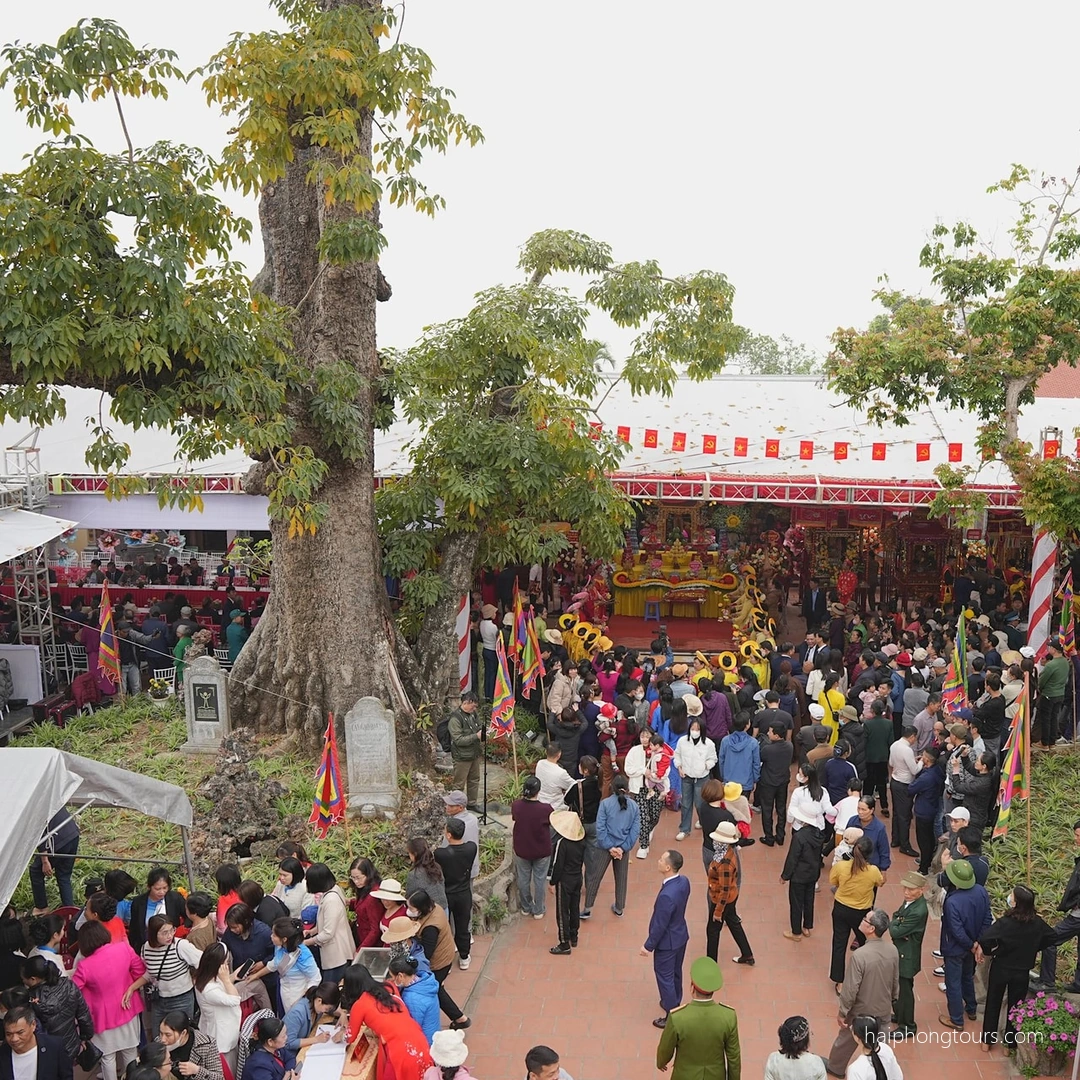
A lunar date is essential here: the second lunar month does not mean February on the Gregorian calendar. For a festival visit, establish the exact day and procession time first, then agree on vehicle access and where to meet afterward.
Choose an ordinary day if quiet observation matters more than ceremonies. During worship, stand back from offerings and processional routes. Ask before close photographs of participants; a public celebration does not remove the need to respect individuals.
Getting there and making the stop work
From central Hai Phong, a car with an agreed waiting period makes the return journey easier to plan. Send the full Vietnamese place name to your driver and have the location checked before departure. A short label such as “Mo Temple” can be ambiguous when entered into a map or translation app.
Allow approximately 45–60 minutes for a straightforward look around the accessible grounds and worship buildings. Treat that as a planning allowance, not a guided-tour duration. Add time for an arranged explanation, photography or festival attendance, and keep driving time separate.
Plan a daytime arrival. Before a special journey, have your accommodation or Vietnamese-speaking contact confirm that visitors can enter the areas you want to see, along with any entrance or parking arrangements. Do not build an itinerary around a map listing that appears to allow access at all hours.
Wear clothing appropriate for a place of worship, keep your voice low near ceremonies and ask before entering an inner sanctuary. Visitors who need step-free access should check the route from the vehicle to each building, including thresholds and toilet access. Being able to reach the courtyard does not establish that every interior is accessible.
Pair it with the Mac Dynasty Memorial
For a broader heritage outing in this part of Hai Phong, consider the Mac Dynasty Memorial in Kien Hung. Mõ focuses on a Tran-dynasty princess, religious life and village memory; the memorial introduces Mac Dang Dung and the area’s later royal connection.

Ask your driver to organize the two stops from your actual starting point, with access checked at both. This pairing makes more sense for someone interested in history than adding several unrelated sights just to fill a day. If your available time is short, choose the story that interests you most and leave room to understand it.

Useful guides for your trip
Would you like help fitting this experience into your trip? Contact us with your travel dates, starting point, available time and group size. Tell us about walking limits or special interests so we can suggest a practical itinerary.