
A day in Nam Dinh works well for local food, old commercial streets and a museum visit. Choose one museum, spend time around Hang Sat and Hang Dong, then finish with a walk by Vi Xuyen Lake. This gives you a coherent city visit without spending the afternoon driving between distant villages.
Allow most of a day in town for that combination, excluding the journey from Hanoi or Ninh Binh. With only a few hours, keep the food stop and one walking area. Nam Dinh’s appeal is in ordinary street life and the stories behind its buildings; choose a different outing if your priority is limestone scenery, boat rides or a beach.
Keep the city separate from the wider Nam Dinh region
Search for the Nam Dinh urban area when saving your hotel, station and sightseeing pins. Addresses may now use Ninh Binh Province, but Nam Dinh city is not the Tam Coc–Trang An sightseeing area. Nam Dinh and Ninh Binh also have separate railway stations.
The Phu Nhai and Bui Chu churches, Hai Hau villages and coastal attractions belong to a much wider journey. They are not stops on a central walking circuit. If one of those is your main reason for coming, reserve transport for that excursion and let the city supply a meal or an overnight base.
- Food and everyday streets: choose the old commercial area and Vi Xuyen Lake, adding a museum if its visiting session fits.
- Industrial history: arrange the textile museum first, then build the rest of the day around that appointment.
- Temple art and dynastic history: choose the provincial museum and, with enough time, Tran Temple–Pho Minh Pagoda by local road transport.
- A relaxed overnight: separate the museums or temple visit from the street walk, leaving time for an early breakfast and a cooler lakeside outing.
Build the day around one confirmed museum
Two different collections explain two different Nam Dinhs. Select the one that interests you rather than arriving at the nearest building labeled “museum.” Confirm the exhibition session before making it the fixed point of your day; access to outdoor grounds does not establish access to every gallery.
Archaeology and the flag tower at 1 Cot Co Street
Nam Dinh Museum, now Ninh Binh Provincial Museum Site 2, introduces regional archaeology and religious art. Its collection includes original door leaves from Pho Minh Pagoda, Ly-period carved stone and Tran ceramics. Save the full Site 2 address at 1 Cot Co Street so that a search for the provincial museum does not send you elsewhere.
The neighboring Nam Dinh Flag Tower, approached from the To Hieu area, is part of the same heritage stop. The tower visible today was reconstructed in 1997 after wartime destruction. View its raised base and shaft, then ask staff which parts are accessible; do not build the visit around an assumed climb to the top.
Leave roughly 90 minutes to two hours for a focused museum-and-tower visit as a planning allowance. Ask separately about English interpretation if you want more than a visual introduction to the objects.
Machinery and workers’ history at 5 Hoang Hoa Tham
The Nam Dinh Textile Museum, also called the Vietnam Textile and Garment Industry Tradition House, occupies a former French manager’s residence at 5 Hoang Hoa Tham Street. It suits visitors interested in the city’s factory workforce and the process of turning fiber into cloth.
Arrange a receiving time in advance. About an hour is a useful starting allowance for a focused visit, with longer needed for detailed interpretation. This is a museum collection, not a booked weaving class or access to a working production line.
Use the old streets as a walk, not a checklist
After your museum session, choose a small group of streets around Hang Sat, Hang Dong and Hang Tien. Their names preserve the memory of a trading town, but the businesses have changed. Hang Tien, for example, no longer consists only of the woodworking trade suggested by its historical identity.
Look for surviving older facades among newer shops rather than expecting an entirely preserved old quarter. Hang Sat has the Trieu Chau temple, associated with the Chinese community and the worship of Thien Hau. Treat it as a religious stop when access permits, with no assumption of a daily visitor program.
Rong Market can provide another commercial landmark, but you do not need to cross every market aisle to understand the neighborhood. Choose a short section, pause for a drink and look at how shops use the street. Ask before photographing people closely or entering a workshop.
Hai Phong Tours recommends deciding on one food stop before starting this walk, then keeping the surrounding streets flexible. Following a single worthwhile bakery or noodle shop is more useful than zigzagging across town to collect several nearly identical snacks.
Choose a meal and one contrasting snack
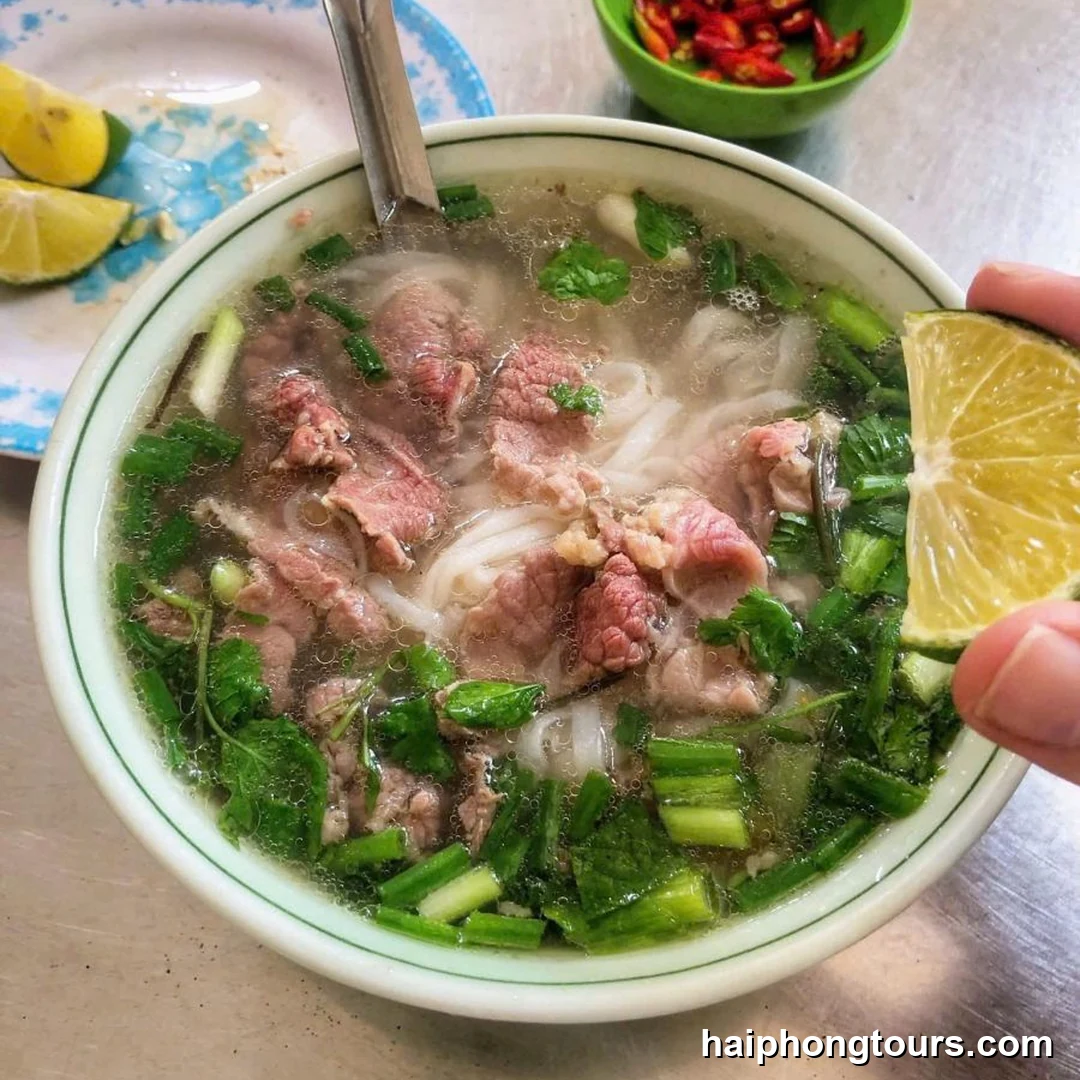
For a first visit, a bowl of beef pho followed later by a warm xiu pao pastry gives you two distinct local food traditions. If you prefer a fuller rice meal, consider xoi xiu, sticky rice with pork and savory sauce. The Nam Dinh food guide explains the dishes, ingredients and practical buying choices.
For a compact gift, look at packaged siu chau peanut-and-sesame candy. Keep it separate from meat-filled pastries, which need the seller’s storage advice and should not be treated as long-lasting souvenirs. Explain allergies before ordering; a pastry, broth or plain-looking rice dish may contain ingredients that are not obvious from its appearance.
Do not make an afternoon arrival depend on a breakfast shop still serving. Choose the meal around your actual arrival time, and ask about serving hours before traveling specifically for one address.
Finish at Vi Xuyen Lake
Save Hồ Vị Xuyên, Nam Định as the destination. The lakeside park brings together a local walking space, the Tran Hung Dao monument and the tomb of the poet Tran Te Xuong, widely known as Tu Xuong. It adds a quieter change of pace after shops and galleries.
Tu Xuong is associated with satirical poetry and the changing society of late nineteenth-century Nam Dinh. His modest memorial makes more sense when approached as a literary stop, rather than another large monument to photograph. Give people paying respects space, and keep food or posed photographs away from the tomb itself.
Allow around 30–60 minutes for a gentle lakeside pause, depending on the heat and your interest. That is an optional walking allowance, not a measured full-lake circuit. In hot weather, move this section toward early morning or late afternoon and use a taxi for an uncomfortable cross-city link.
Add Tran Temple and Pho Minh only by replacing something
Tran Temple and Pho Minh Pagoda form a separate heritage outing in the Tuc Mac area. Give the pair roughly two to three hours of sightseeing, plus the road journey. They should not be treated as an extra corner of the old-street walk.
If medieval architecture is your main interest, combine them with the Cot Co museum and shorten or drop the street section. If food and daily life matter more, keep the walk and lake, leaving the temple complex for a longer stay. Trying to include both museums, the temples and several distant villages makes a day return unnecessarily tight.
Arrival, luggage and a workable return
From Hai Phong, compare a direct bus with a car for the complete day using the Hai Phong–Nam Dinh transport guide. Check the operator’s Nam Dinh office location and the return departure before setting your sightseeing schedule, especially if you plan to stay for an evening football match.
For a visit from Hanoi, the Hanoi–Nam Dinh train guide covers ticket selection, the correct station and planning both directions. Use Ga Nam Định on Tran Dang Ninh Street. Arrange the local journey from the station rather than assuming your first attraction is beside the platform.
As an example, divide a full day into a confirmed morning museum, lunch and an old-street walk, then a lakeside stop before returning to the station. Reverse the museum and outdoor portions if the confirmed gallery session or the weather makes that more sensible.
Travel with a small bag for a walking day. If you have suitcases, arrange storage with your accommodation or transport provider beforehand; do not rely on unconfirmed station lockers. Keep the journey back to the station and a boarding margin outside your sightseeing time. Aim to arrive around 30 minutes before departure, with more time if you need assistance.
For travelers who find steps or uneven pavements difficult, use short car links and ask each museum about its actual entrance and gallery route. A map showing nearby attractions does not establish a continuous accessible walk. With rain, reduce the street portion and give more time to a confirmed indoor visit and a seated meal.
The most rewarding first day is a selective one: understand one part of Nam Dinh’s history, eat a few local dishes and leave time to notice the working city between the landmarks.
Would you like help fitting this experience into your trip? Contact us with your travel dates, starting point, available time and group size. Tell us about walking limits or special interests so we can suggest a practical itinerary.