
Ninh Binh Museum’s Site 1 is the provincial history museum on Le Dai Hanh Street in urban Hoa Lu. Visit for prehistoric tools, objects from the tenth-century capital and the Dinh-period Buddhist scripture pillars. Allow 60–90 minutes as a planning estimate, choose a confirmed gallery session and use the full branch name when arranging transport.
Museum telephone: 0229 387 1462, or +84 229 387 1462 from an overseas number. Ask for “Bảo tàng tỉnh Ninh Bình, Cơ sở 1, đường Lê Đại Hành”. This is a separate destination from Hoa Lu Ancient Capital, the temples outside the urban centre.
Find the correct museum branch
The provincial museum operates three sites following the institutional merger in July 2025. For this visit, save Site 1, 25 Le Dai Hanh Street, Hoa Lu ward. Include the branch and street when sharing a map pin with your driver.
| Site | Published address | What to put in your plan |
|---|---|---|
| Site 1 | Le Dai Hanh Street, Hoa Lu ward, Ninh Binh province | The museum covered in this guide, in the urban Ninh Binh area |
| Site 2 | 1 Cot Co Street, Nam Dinh ward | The separate Nam Dinh museum site |
| Site 3 | Ly Thai To Street, Phu Van ward | The separate Ha Nam museum site |
Older maps may label Site 1’s surroundings Thanh Binh ward, Ninh Binh city. The museum’s current address uses Hoa Lu ward. Keep the street and branch name with your saved pin, rather than asking a driver for “the Hoa Lu museum” alone.
Opening hours and weekend arrangements
The museum’s published regular schedule is Monday to Friday, with a midday closure:
| Season | Morning | Afternoon |
|---|---|---|
| Summer | 07:00–11:00 | 13:30–17:30 |
| Winter | 07:30–11:30 | 13:00–17:00 |
The notice does not define the exact seasonal changeover dates. Confirm the applicable session for your travel date. Arriving at 11:00 leaves little or no gallery time, depending on the season; arriving at lunchtime does not give continuous access.
Saturday and Sunday visits are offered to groups that contact the museum in advance. An individual traveler should obtain a specific agreement rather than assume a weekend walk-in. State your date, party size and preferred session when calling, and confirm the holiday schedule if relevant.
Admission, guiding and what to confirm
The museum’s public opening-hours information does not give a current standard admission or guiding tariff. Call 0229 387 1462 for the charge, if any, for your visit.
For a useful reply, give the number of adults and children, language required, arrival time and any mobility needs. Ask whether the permanent galleries are open, whether a guide is available and whether the quoted amount includes the activity you want. English interpretation should be requested explicitly; ordinary opening hours do not establish that an English-speaking guide is on duty.
A school programme advertised for a particular month is also not a standing menu of daily workshops. If your group wants an educational session, agree on its subject, duration, language and price before building the rest of the itinerary around it.
Four collections worth slowing down for
Prehistoric tools and the Mán Bạc material
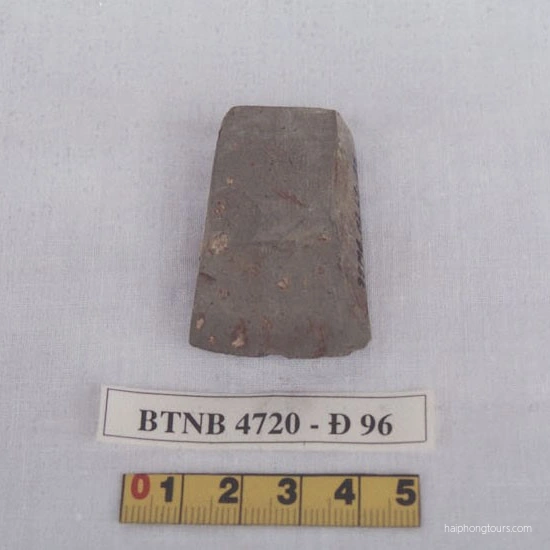
The museum’s archaeological collections help connect the region’s dramatic landscape with everyday settlement. Research at Mán Bạc has produced axes, grinding stones, pottery, ornaments and traces of posts and hearths. These are evidence of making, cooking and building, rather than simply a list of old objects.
Choose a tool and look for its working edge, then compare it with a storage or cooking vessel. Read its excavation location on the label. The museum’s online prehistoric catalogue also discusses small clay balls whose purpose is debated. That is a useful reminder that an archaeological interpretation can remain uncertain.
The Dinh-period Buddhist scripture pillars
These stone pillars were commissioned by Dinh Khuong Lien, a son of Emperor Dinh Tien Hoang, in 973–979. The collection received national-treasure recognition in January 2024. Each pillar is assembled from six stone components, including its base, inscribed shaft and lotus elements, fitted together with joints.
Look for the construction before trying to understand every inscription. The surviving writing contains Buddhist text and dedication information that helps date the objects. At around 1.4 metres high, the pillars reward close observation of the joins and lettering; view them without touching their surfaces.
Lotus paving bricks and architectural decoration
The lotus-decorated brick in the museum’s catalogue is a square fired-clay object with a raised flower, corner decoration and a patterned border. Such bricks formed palace floors, courtyards and ceremonial paths. They make the former capital easier to imagine at human scale: the surface under someone’s feet, rather than only a dynasty on a timeline.
Compare the repeated pattern with other architectural pieces on display. A damaged edge can help reveal an object’s thickness and construction, while the decorated face shows what visitors to the original building would have seen.
The Thái Bình Hưng Bảo coin
This small bronze coin belongs to the Dinh period. The museum gives a diameter of approximately 23.5 mm: a very different scale from the pillars and paving bricks. It has a central square hole, the Thái Bình Hưng Bảo inscription on the front and the Dinh name on the reverse.
Use it to connect royal authority with ordinary exchange. Read the case label carefully to establish whether the object shown is an original, a reproduction or an explanatory image. A collection entry does not guarantee that every named object is accessible during your particular visit.
Exhibition announced for 21 November–15 December 2026
A provincial culture-department announcement dated 13 November 2026 schedules the first exhibition of notable Ninh Binh antiquities at Site 1. The announced opening is 10:00 on Saturday, 21 November, with the exhibition continuing through 15 December 2026.
The stated scope runs from Hoa Binh and Dong Son cultures through the Dinh, Early Le and later dynasties. The programme also announces an outdoor display about the Three Realms Mother Goddess tradition, provincial heritage photographs and antique stalls. Confirm the day’s exhibition sessions when booking, particularly for a weekend visit.
A manageable 60–90-minute visit
For a suggested visit, spend roughly 15 minutes on landscape and early settlement, 25–35 minutes on the Hoa Lu material, and the remaining time on another collection or the temporary exhibition. Adjust the order to the galleries open on the day.

With children, choose three things to find: a tool, an object for storing food and an object connected with belief. Ask what each was made from and how someone might have used it. This simple family activity works without promising access to a supervised workshop.
Ask staff about photography, flash and bags before beginning. For wheelchair access or a stroller, establish the route from the entrance to the galleries you want to see, including any lift or stairs. The public opening notice does not provide enough detail to promise a fully step-free visit.
Fit the museum into a Ninh Binh day
A confirmed 09:00–10:15 or 14:00–15:15 gallery visit fits within both published seasonal schedules. Add your actual road journey separately. From Tam Coc or Trang An, arrange the correct museum drop-off and a return pickup rather than assuming the driver will wait.
Pair the objects with a separate visit to Hoa Lu Ancient Capital if historical context is the priority. If your day centres on scenery, compare the Trang An and Tam Coc boat routes and protect enough time for the boat journey before adding the museum.
For making a souvenir or trying a rural craft activity, compare the separate Tam Coc Museum workshops. Choose that venue for a booked practical activity and the provincial museum for its historical collections.
Need a practical route between your hotel, the museum and other Ninh Binh stops? Contact Hai Phong Tours with your date, pickup location, group size and confirmed museum session. Include luggage, walking limits and your next train or hotel check-in so the transport plan has enough time at each stop.