
North Vietnam is best for cycling when the ride is local rather than the main intercity transport. Tam Coc and Mai Chau offer the easiest leisure cycling, Cat Ba and Viet Hai add island scenery, and Pu Luong, Sapa, Ha Giang and Cao Bang suit experienced riders with vehicle support and a route checked for elevation, road surface and weather.
Do not choose a ride from distance alone. Ten flat kilometers on quiet lanes can be easier than three kilometers of steep concrete, broken road or mixed traffic. Confirm the bike, route, return transport and safe turnaround before leaving.
Choose the type of cycling
- Short leisure ride: one or two hours on village lanes near accommodation.
- Half-day countryside ride: a loop with stops, water and an agreed return.
- Full-day supported ride: a guide and vehicle carry luggage, food, tools and riders who stop early.
- Point-to-point tour: different start and finish, requiring luggage transfer and exact pickup.
- Mountain biking: off-road or steep terrain requiring a suitable bike, technical skill and guide.
- E-bike ride: useful for moderate assistance, but battery range, gradients, water and repair support must be checked.
A bicycle included in a general day tour is usually intended for a short local section. It should not be compared with a fitted touring or mountain bike.
Inspect the bicycle before accepting it
- Frame size and saddle height fit the rider.
- Front and rear brakes engage firmly without reaching the handlebar.
- Tires have usable tread, correct pressure and no visible damage.
- Wheels run straight and quick-release levers or axles are secure.
- Gears shift under light load.
- Pedals, crank and handlebars have no looseness.
- Lights or reflectors are available for low visibility.
- A correctly fitted helmet is provided or brought by the rider.
- A lock, pump, tube, patch kit and basic tools match the route.
Take a short test ride before leaving the rental point. Photograph existing damage and save the shop contact. If the brakes, steering or wheels feel wrong, change the bicycle rather than hoping they improve.

Tam Coc and Ninh Binh: the easiest first ride
Tam Coc is the strongest leisure-cycling base because accommodation, food, rental bikes and rural lanes are close together. The landscape combines limestone, rice fields, village roads and temple approaches without requiring a long transfer to begin.
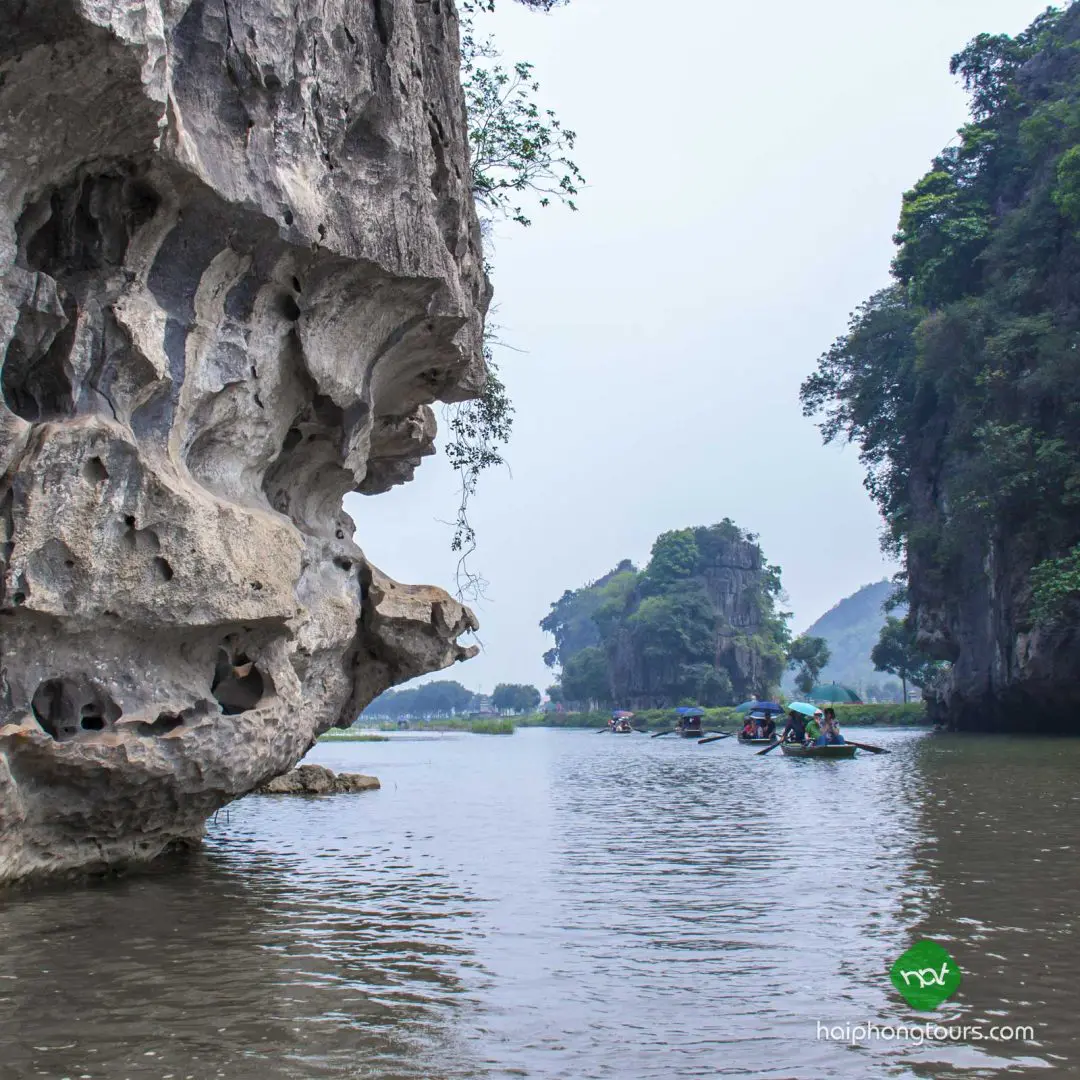

Tam Coc’s river scenery near the countryside cycling base, not a cycling trail.
Traffic and surface still vary. Main roads carry buses, cars and motorbikes; narrow lanes can include farm vehicles, dogs, children and wet edges. Ride early when heat and group traffic are lower, and avoid staring at scenery while moving.
A sensible half-day uses one nearby loop and one stop. Do not combine a long boat ride, Hang Mua climb and ambitious cycling distance without considering heat and fatigue.
For local options, compare the Ninh Binh cycling programs by riding distance, return arrangements and booking eligibility.
Travelers visiting from Hanoi can choose a current Ninh Binh day tour with a cycling option. The ride is one component of selected Hoa Lu itineraries rather than a standalone long-distance cycling tour, so confirm the chosen package and whether the bike section suits each traveler.

Trang An, Hoa Lu and rural Ninh Binh
These areas offer quieter scenery but are more spread out than central Tam Coc. Use a mapped loop and avoid major roads where a parallel lane exists. A bicycle is useful between nearby countryside points; a taxi or car is better for separated attractions and the long transfer back to the hotel.
Do not leave a rental bike unsecured at a boat pier or temple. Ask where to park, what fee applies and whether the attendant is responsible for the bicycle. Keep the rental receipt or contact until return.
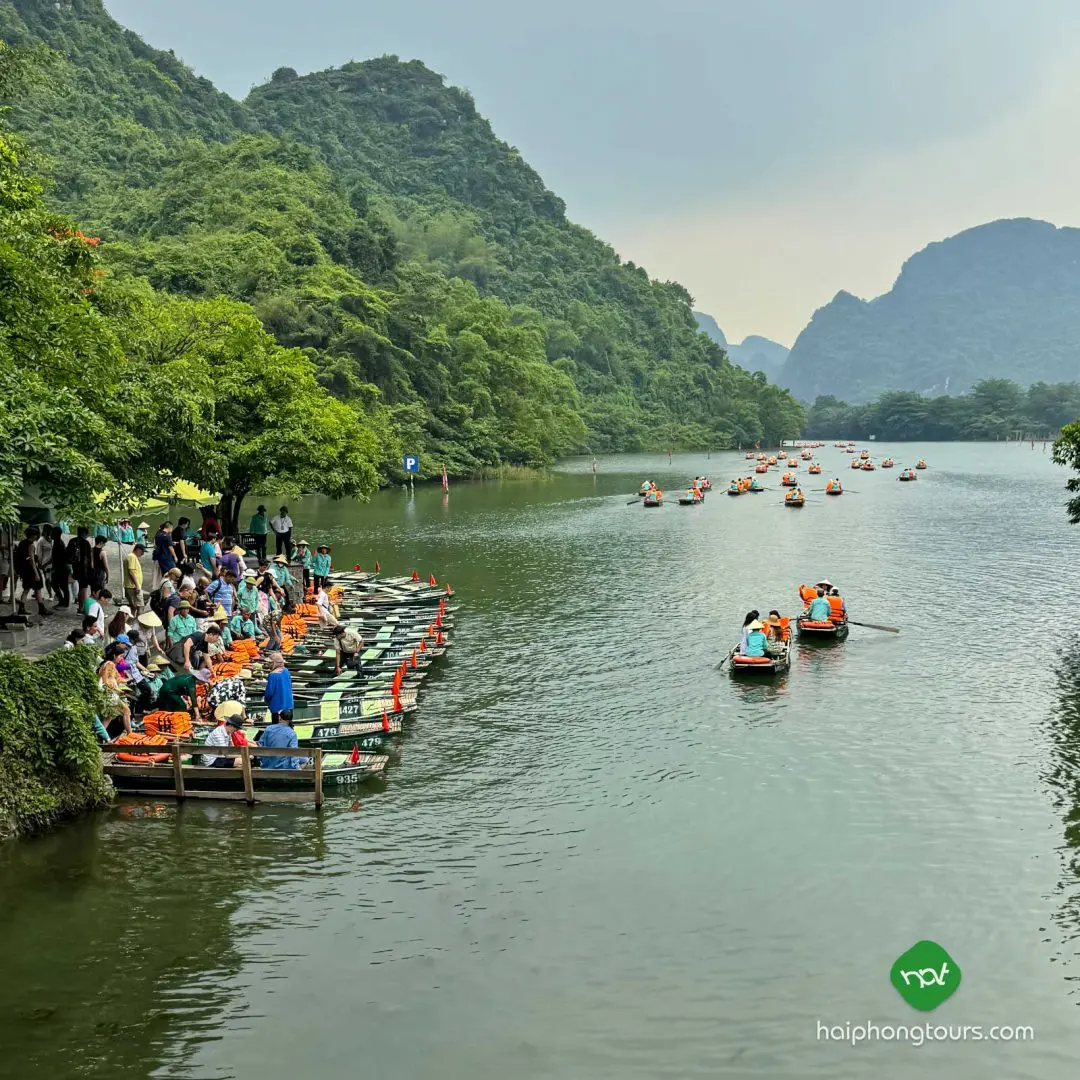
Mai Chau: valley lanes and gentle pace
Mai Chau is well suited to leisure cycling around valley villages and rice fields. A centrally located stay allows short loops without carrying luggage. The terrain is gentler than the surrounding mountain roads, but village traffic, livestock, children and farm activity still require slow riding.
Ask the accommodation for a current route that avoids construction and heavy traffic. Rice conditions change with local cropping, so choose the valley experience rather than promising a specific field color.
Stay on public or agreed paths. Do not ride onto terrace walls, through planted fields or into private courtyards for a photograph.
Pu Luong: hills require support
Pu Luong looks close-knit on a map but lodges, villages and trailheads can be separated by steep roads. A casual hotel bicycle may not suit the gradients or broken surfaces. Use a guide, suitable gears and vehicle support for anything beyond a short local ride.
Confirm total climbing, the steepest sections, road material, water stops and bailout points. After heavy rain, concrete can be slick and soil tracks may be unsuitable. A one-way supported ride can be more enjoyable than forcing a loop back uphill.
Cat Ba and Viet Hai
Cat Ba provides two different cycling settings. Roads around the island include hills, traffic, tunnels and longer distances. Viet Hai village cycling is usually a shorter activity linked to a boat or park route.
 Overnight Cruise
Lan Ha Bay
Mila Grand Cruise 3 day 2 night tour
 Overnight Cruise
Lan Ha Bay
Aqua Luxury cruise 3 day 2 night tour
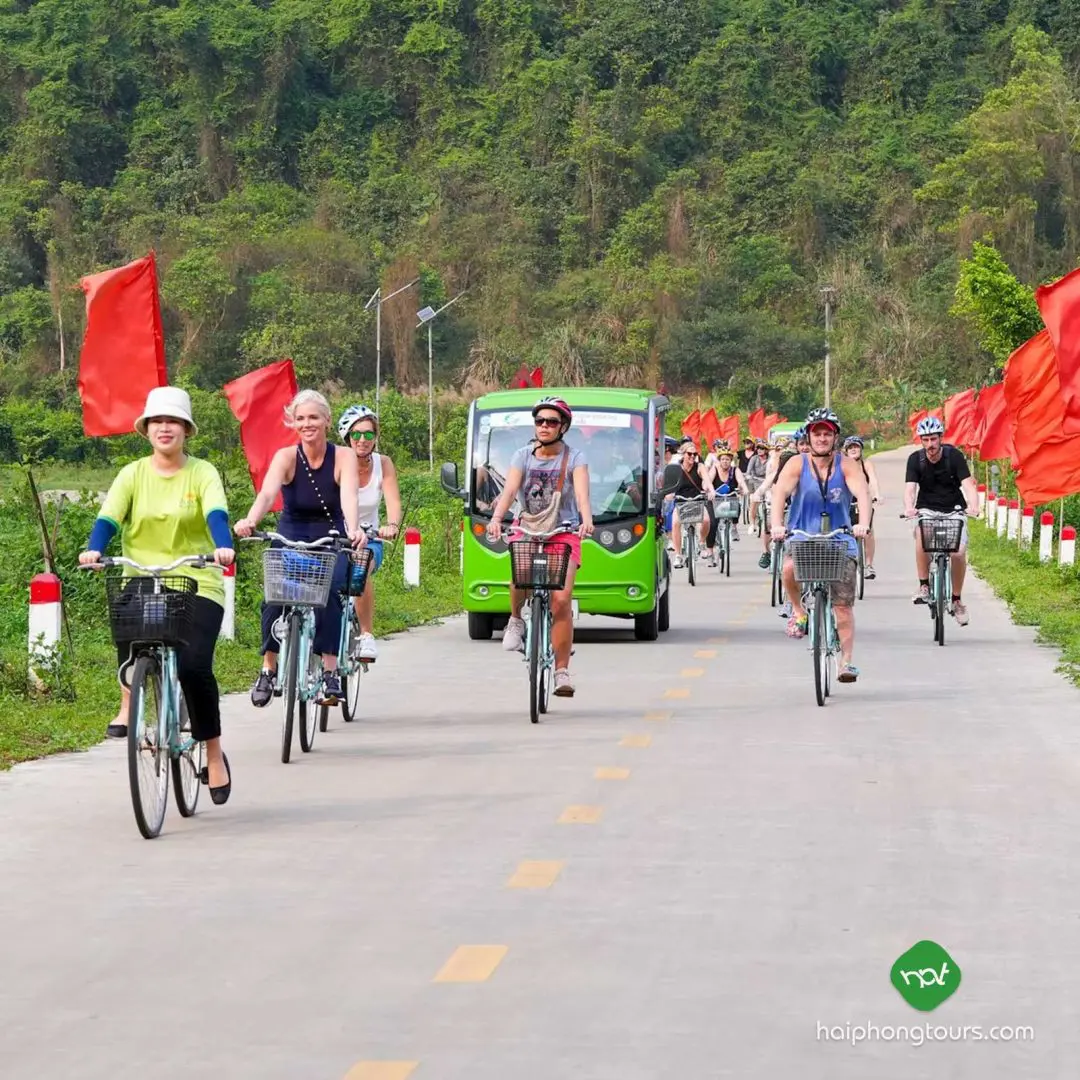
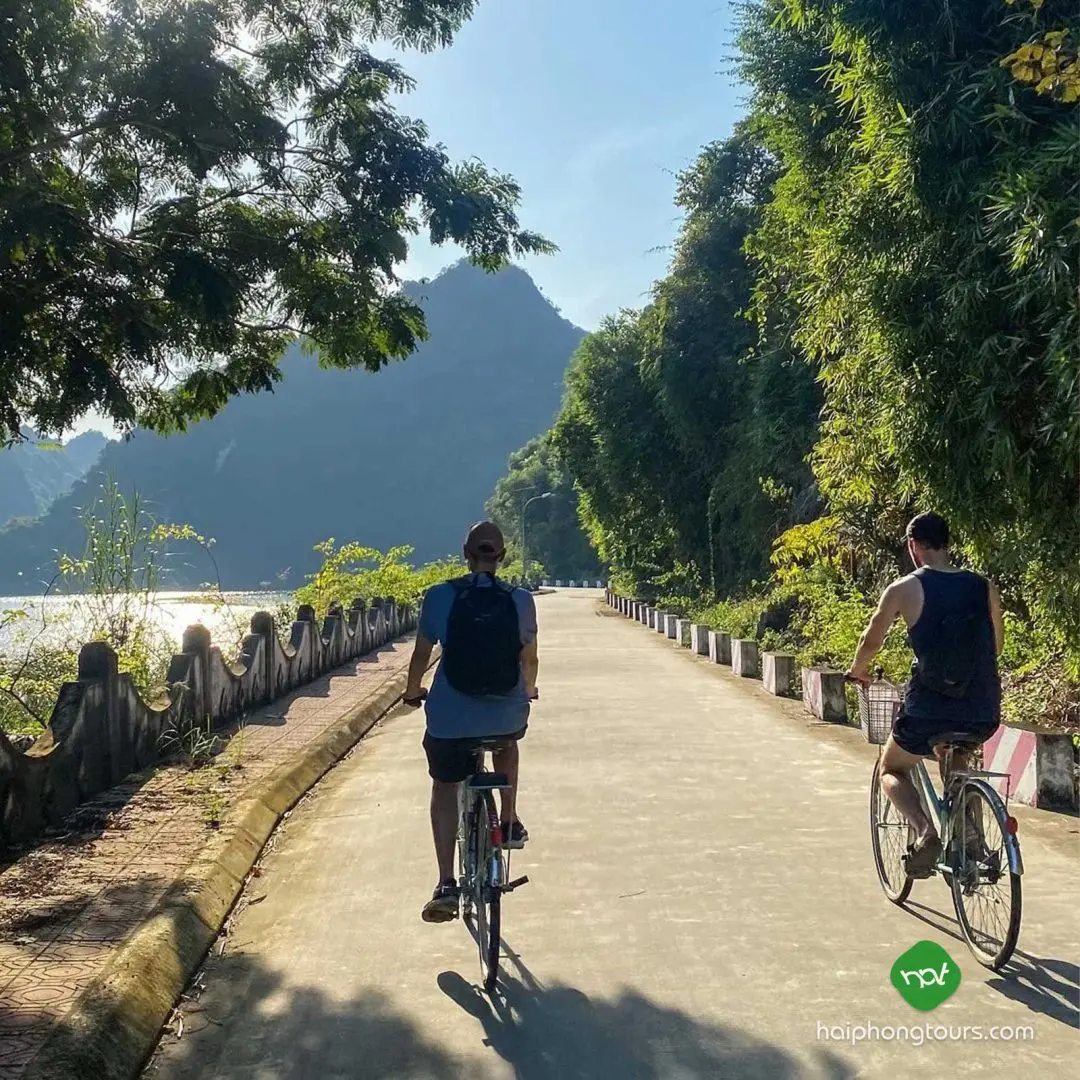
Cycling in Viet Hai, with village roads shared by other traffic.
For a Viet Hai excursion, ask whether cycling or an electric vehicle is included, how far the route goes, and what happens if you choose not to ride. A bicycle supplied as part of a boat trip should still receive a brake and fit check.
For independent island cycling, avoid tunnels or fast roads unless the route and equipment are appropriate. Carry lights even for a daytime plan, use a visible position and arrange a return vehicle if the hills exceed the group.
Hanoi: city cycling is not the beginner option
Hanoi traffic is dense, intersections are complex and bicycle lanes are not a continuous tourist network. A traveler comfortable on quiet countryside roads may still find the city demanding.
Choose a guided early ride with a defined route, or transport the bicycle to a calmer outer area. Do not use headphones, hold a phone while moving or follow another rider through an intersection without checking every traffic stream yourself.
The Hanoi countryside cycling guide compares a shorter river-and-village ride with a full day that begins with a drive to the outer suburbs. Check the starting point as carefully as the riding distance.
For an independent city ride, compare Hanoi bicycle rental shops and their collection arrangements.
Walking, taxi and ride-hailing are more practical for a first central sightseeing day. Cycling should be selected because you want the riding experience, not because it appears cheaper than local transport.
Hai Phong and Do Son
Hai Phong is flat in many urban and rural sections, but port traffic and major roads require care. Use quieter countryside routes or a planned coastal section rather than riding beside heavy vehicles.
Do Son includes hills and busier approaches. A bicycle suitable for the city may have limited gearing for climbs. Ask where a route becomes steep and where it is safe to stop.
Sapa: steep terrain changes the category
Sapa is not a simple leisure-cycling destination. Town streets and valley roads can be steep, wet, busy or under construction. A downhill route still requires strong braking, cornering and surface judgment.
The Sapa mountain-biking guide compares a short Topas village circuit with a longer valley ride ending in a vehicle transfer. Both require suitable bike fit and riding ability; their lack of a following support car matters when choosing for a mixed-ability group.
Use a mountain bike or e-bike suited to the planned terrain, a local guide and a support vehicle. Ask whether the route uses public roads, concrete village paths or off-road trail, and confirm the climb back.
Fog reduces visibility for riders and drivers. Rain increases braking distance and can cover potholes. Choose a walking or vehicle-based valley day when conditions are poor.
Ha Giang: for experienced, supported riders
Ha Giang has long climbs, descents, sharp bends, trucks, buses, variable surfaces and fast-changing mountain weather. It is a serious touring route rather than an alternative for someone who does not want to ride a motorbike.
Use a specialist operator that can provide a fitted bike, luggage vehicle, mechanic support, realistic daily elevation and an evacuation plan. Do not copy motorbike loop timings; bicycle days need a different distance and rest pattern.
Descending skill matters as much as climbing fitness. Test the brakes, use a conservative speed and never cross the center line for a better curve or photograph.
Cao Bang and Ba Be
Cao Bang and Ba Be offer quieter rural landscapes, but attractions are dispersed and roads remain shared with other traffic. Use a vehicle to carry the bike between selected sections instead of treating the entire intercity route as a ride.
The Cao Bang cycling guide compares a five-day mixed-terrain loop with a longer Ha Giang–Cao Bang road expedition. Check the daily climbing and vehicle meeting points before choosing a supported bicycle trip.
Near rivers and waterfalls, recent rain can affect road edges, mud and visibility. Confirm border-area rules and do not photograph or stop near controlled facilities. A local guide helps identify public routes and safe lunch or water stops.
Mu Cang Chai and Y Ty
Terrace regions have steep road approaches, long distances and working farm paths. They suit experienced riders with support rather than casual rental bikes. Crop scenery changes with irrigation and harvest, while rain can affect narrow mountain roads quickly.
Use a local driver and ride selected sections if the full elevation is unrealistic. Stay off terrace walls and obtain permission before entering farm land.
E-bikes: useful assistance with different risks
An e-bike can help on rolling terrain but does not remove the need to balance, brake and control speed. Battery range changes with rider weight, hills, assistance level, surface and temperature.
Before leaving, confirm:
- battery capacity and realistic supported range for the route;
- charger, key and spare-battery plan;
- what happens if power ends away from the base;
- water resistance and the operator’s rain policy;
- bike weight and whether you can pedal it unassisted;
- repair and recovery contact.
Do not take the battery or bicycle onto another vehicle without checking the transport provider’s current rules.
Road behavior and traffic
Traffic travels on the right in Vietnam. Road position, turning behavior and vehicle size vary, and drivers may use the horn to announce their presence. Do not make a sudden movement because of a horn; hold a predictable line while checking the actual vehicle.
- Ride in daylight.
- Use a helmet and visible clothing.
- Keep both hands available for control.
- Signal clearly but confirm that drivers have responded.
- Avoid the inside of turning trucks and buses.
- Do not draft large vehicles.
- Stop off the carriageway for maps and photos.
- Use lights in rain, fog, shade and tunnels.
A painted road edge is not a protected bicycle lane. Choose quieter roads and a conservative time of day.
Heat, rain and air quality
Heat and humidity can turn a short ride into a demanding effort. Start early, drink regularly and include shade. Heavy rain reduces visibility, hides surface damage and makes painted lines, stone and concrete slippery.
Cooler mountain weather can still produce strong sun, wind and rapid temperature changes. Use the North Vietnam weather-by-month guide for broad planning, then check hourly conditions and recent rain.
On poor air-quality days in Hanoi or another urban area, reduce hard outdoor effort or move the ride to a cleaner location. Do not use a mask as proof that strenuous riding is suitable for your health.
Carry only what supports the ride
- Water and a reliable refill plan.
- Small snack appropriate to the route.
- Rain shell and sun protection.
- Phone, offline map and power reserve.
- Cash, identification and accommodation contact.
- Pump, tube or repair kit matched to the bicycle.
- Personal medication and basic first-aid supplies.
- Dry bag or sealed pouch for electronics.
The North Vietnam packing list covers seasonal layers and luggage. Keep heavy suitcases at the hotel or in a support vehicle rather than carrying them on a leisure ride.
Bicycles on trains, buses and boats
Do not assume a bicycle is accepted because the vehicle carries ordinary luggage. Space, packaging, battery and advance-booking rules vary by operator and service.
Ask whether wheels or pedals must be removed, whether a bag or box is needed, what fee applies and where the bicycle will be stored. For an e-bike, disclose the battery and obtain explicit approval. Confirm again for every connecting vehicle or boat.
If your own bike needs workshop attention before departure, use the Hanoi bicycle servicing and packing guide to plan the work and collection.
The North Vietnam transport guide helps plan the passenger journey. A support car is often simpler for several bicycles, a point-to-point ride or a route with uncertain weather.
Arrange the railway handover before buying your seat
For a northern rail journey, contact Vietnam Railways customer service at and request the departure station’s baggage contact. Give the exact stations, date, train number, bicycle type and packed dimensions if boxed. Hai Phong Tours recommends settling the bicycle’s journey before purchasing a passenger ticket that depends on it.
- Acceptance: establish whether the complete bicycle or packed bike can be carried on that particular service, including any battery.
- Handover: ask whether you deliver it to a station baggage office or a designated attendant, and obtain the location and check-in deadline.
- Arrival: confirm whether it travels on your train, where you collect it and when collection is possible.
- Price and documents: request the total charge, required sender and recipient details, and the receipt or baggage ticket needed to claim it.
Label the bicycle or package as instructed, secure loose accessories and photograph its condition before handing it over. Keep the receipt with you, separate from the bicycle. A baggage arrangement to Hai Phong or Lao Cai does not establish acceptance by the next ferry, bus or mountain-transfer vehicle. Confirm each leg before planning to ride away from the final arrival point.
Families and mixed-ability groups
Choose the route from the least confident rider. Check child-bike size, helmet fit, brakes, trailer or seat attachment and whether the route includes traffic. A child who rides confidently in a park may not be ready for mixed village roads.
Use a short protected or quiet loop with a vehicle fallback. Separate stronger riders only when the meeting point and supervision plan are clear. Do not pressure someone to ride because cycling appears in the paid itinerary; ask for the non-riding alternative.
Guide and support questions
- What is the exact route, distance and elevation profile?
- Which bicycle model and size will each person use?
- Is a helmet included, and can the fit be changed?
- Which roads are paved, unpaved or shared with heavy traffic?
- Does a support vehicle follow the route?
- Who repairs a puncture or mechanical problem?
- What is the bad-weather route?
- Can a rider stop and enter the vehicle?
- Where does the ride finish, and what happens to luggage?
Two realistic cycling plans
Easy six-day plan
- Hanoi: two nights, with walking rather than city cycling.
- Ninh Binh: two nights and one Tam Coc countryside ride.
- Mai Chau: two nights with a short valley loop.
This plan uses leisure cycling as one activity, not constant transport. A car or scheduled service connects the bases.
Active nine-day plan
- Hanoi: two nights and equipment check.
- Mai Chau and Pu Luong: four nights with supported point-to-point sections.
- Ninh Binh: two nights and a recovery ride.
- Hanoi: final night.
Use a support vehicle for luggage, hard climbs and bad weather. Do not add Ha Giang unless it replaces another region and receives its own time.
Common mistakes
- Accepting a bicycle without a brake and fit check.
- Comparing routes by distance without elevation.
- Using a city bike on steep or broken terrain.
- Riding through midday heat without enough water.
- Assuming an e-bike battery will cover an advertised distance.
- Following a motorbike itinerary on a bicycle.
- Depending on a bus or train to accept the bike without confirmation.
- Stopping in the traffic lane for photographs.
Frequently asked questions
Where is the easiest cycling in North Vietnam?
Tam Coc and Mai Chau are the clearest leisure choices. Both offer concentrated rural scenery and short loops, although traffic, heat and road conditions still need checking.
Can I cycle in Sapa as a beginner?
Sapa is steep and weather-sensitive. A beginner should choose a short guided route with a suitable bike and support vehicle rather than an independent downhill ride.
Is Cat Ba good for cycling?
Viet Hai can provide a short cycling component on some boat itineraries. Independent island roads are hillier and more traffic-exposed, so route and equipment matter.
Should I bring my own helmet?
Bring one when fit and quality are important to you. If using a supplied helmet, inspect its condition and adjustment before accepting the ride.
Can I take a bicycle on a train?
Some services may carry bicycles, but packaging, space, fee and advance arrangements vary. Confirm the exact train and station process before booking the passenger ticket around it.
Do I need a guide?
A guide is useful for city traffic, remote roads, mountain terrain and point-to-point routes. Short Tam Coc or Mai Chau loops can be independent when the route and return are clear.
Ride the section that suits the bicycle
North Vietnam cycling is most rewarding when the bike unlocks a valley, village or island rather than carrying the entire itinerary. Inspect the equipment, compare elevation and surface, ride in daylight and keep a vehicle option for weather, fatigue or mechanical trouble.
Travelers who prefer a smaller daily workout can use the running in North Vietnam guide for routes, traffic, heat, air quality and safer timing.
Would you like help fitting this experience into your trip? Contact us with your travel dates, starting point, available time and group size. Tell us about walking limits or special interests so we can suggest a practical itinerary.