
North Vietnam’s festival calendar is strongest from the first lunar month through spring, with another group of major events in autumn. The most useful choices for an international traveler are a pilgrimage festival such as Yen Tu or Perfume Pagoda, a performance tradition such as quan ho at Lim Festival, an ancestor commemoration at the Hung Kings Temple, a local identity event such as Hai Phong’s Red Flamboyant Festival, or a focused regional event such as Khau Vai Love Market.
Plan by the Vietnamese lunar date and the official program for that specific year. A familiar festival name does not guarantee the same Gregorian date, venue, parade, ticket system or road plan. The religious or community purpose comes first; public entertainment may occupy only one part of the event.
Quick festival decisions
- Best major pilgrimage season: Yen Tu or Perfume Pagoda after Lunar New Year.
- Best traditional singing focus: Lim Festival and quan ho culture in the Bac Ninh area.
- Best nationally significant commemoration: Hung Kings Temple Festival in Phu Tho.
- Best ritual festival near Hanoi: Giong Festival, after choosing the correct temple and date.
- Best mountain cultural event: Khau Vai Love Market, when the long route fits the trip.
- Best Hai Phong city event: Red Flamboyant Festival, using the annual program rather than a fixed recurring venue.
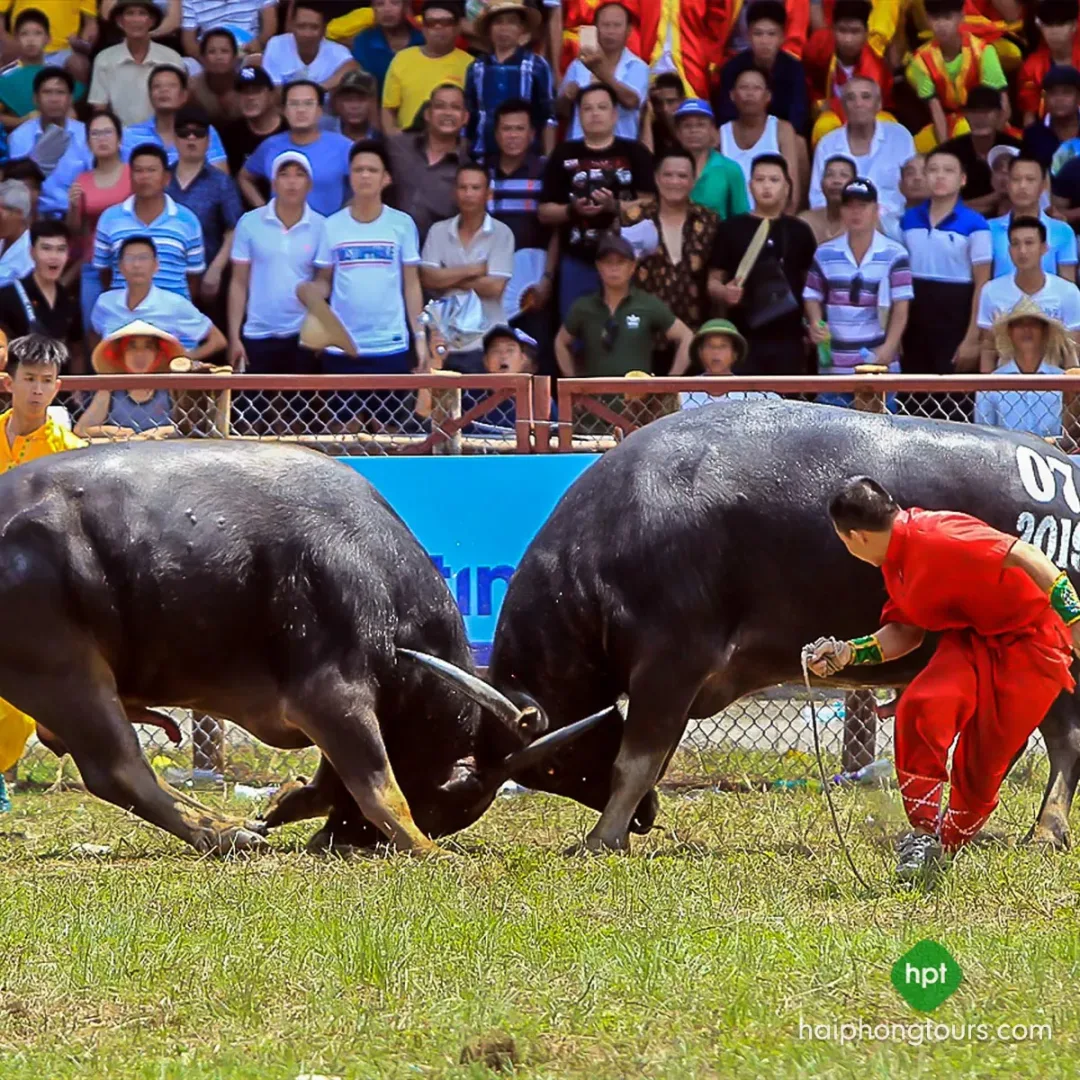
- Most ethically difficult event: Do Son Buffalo Fighting Festival; understand the animal-welfare issue before deciding to attend.
- Best crowd strategy: stay nearby, arrive before the main movement and leave space for processions and worship.
- Best planning rule: confirm the lunar date, Gregorian date and official venue as three separate facts.
How the Vietnamese lunar calendar changes the trip
Many traditional festivals use lunar months and days. Their Gregorian dates move each year, so copying last year’s calendar can put you at the right place on the wrong day. Some events also have a ceremonial opening, a main ritual day and a longer festival season.
When checking a program, record:
- the Vietnamese lunar date;
- the converted Gregorian date for the travel year;
- the opening ceremony time;
- the main ritual or performance time;
- the exact temple, square, stadium or village;
- whether entry requires a ticket, invitation or registration;
- temporary traffic and parking arrangements;
- the organizer’s weather or crowd update.
Use a lunar-calendar conversion only as the first check. The provincial or city organizer’s final announcement should decide the itinerary.
Tet: a national holiday, not one public festival
Tet, the Vietnamese Lunar New Year, changes transport, business hours, family life and public space across the country. The first days center on family visits, ancestor worship and rest. Flower displays, markets, fireworks or public performances vary by city and year.
Do not expect every shop, museum or restaurant to operate normally. Intercity tickets can sell out before the holiday, while streets may become quieter during the first days. Book essential transport and accommodation early, then keep meals and sightseeing flexible.
A traveler is not automatically included in private family rituals. Accept an invitation warmly, bring a modest host gift when appropriate and follow the household’s guidance about altars, seating and photographs.
Yen Tu Spring Festival: pilgrimage across a mountain
The Yen Tu Spring Festival begins on the tenth day of the first lunar month and continues through the spring pilgrimage season. The site is associated with Truc Lam Buddhism and is part of the Yen Tu–Vinh Nghiem–Con Son, Kiep Bac complex inscribed on the UNESCO World Heritage List in 2025.
Yen Tu is a route of religious sites across a mountain landscape. Cable cars reduce some climbing, but queues, stairs, transfers between sections and exposed walking remain. A festival day can be far slower than a normal visit.
Day trip or overnight
A day trip works when you accept an early departure, a defined turnaround point and possible queues. An overnight allows a quieter early period and more flexibility, but it does not remove steep access or bad weather. The Yen Tu day-trip versus overnight guide explains the trade-off.
From Hanoi, the current Hanoi to Yen Tu private transfer provides direct one-way transport to the Yen Tu area. Confirm pickup, luggage, return arrangement and festival traffic for the chosen date.
Perfume Pagoda Festival: boat, valley and pilgrimage
The Perfume Pagoda complex lies about 70 kilometers from central Hanoi and receives large numbers of pilgrims during its spring season. The journey normally combines road transport, a small boat and walking or cable-car access to religious sites.
This is not a single pagoda beside a parking lot. Boat queues, wet steps, crowd pressure and the distance between stages can turn a simple day trip into a long physical day. Confirm which sites the itinerary includes and where the guide meets you after each transport stage.
What makes the festival difficult
- early-spring crowds can lengthen every transfer;
- small boats require stable boarding and weather awareness;
- steps and slopes may be wet or congested;
- food, offerings and souvenir sales can dominate the approach;
- mobile signal may not solve a missed meeting point;
- a cable-car ticket does not create a fully step-free route.
Travelers who want the landscape and religious architecture with less crowding should consider a non-peak date. The North Vietnam temples and pagodas guide compares Perfume Pagoda with Yen Tu and other spiritual routes.
Lim Festival: hear quan ho in its cultural setting
Lim Festival in the Bac Ninh cultural region takes place in the first lunar month and is associated with quan ho folk singing. UNESCO inscribed Quan Ho Bac Ninh folk songs on the Representative List of the Intangible Cultural Heritage of Humanity in 2009.
Quan ho is an exchange tradition with specific social and musical forms. A loud stage show, a village-house performance and singers exchanging verses in a smaller setting do not create the same experience.
How to listen well
Check the annual schedule for the main venues and singing sessions. Arrive early, keep conversation low and avoid blocking the performers or regular participants. Do not interrupt a verse exchange for a posed photograph.
A local guide can explain the relationship between lyrics, melody, roles and village custom. Avoid reducing the tradition to costumes or a quick recording.
Giong Festival: choose the correct temple
The Giong festivals at Phu Dong and Soc temples commemorate the legendary hero Thanh Giong and take place in outlying districts of Hanoi. UNESCO inscribed the element in 2010. The two festival settings follow different calendars and ritual sequences.
Do not search only for “Giong Festival Hanoi” and assume the first map pin is correct. Confirm whether the program names Phu Dong Temple or Soc Temple, then match that place to the current date and main ceremony.
Processions, offerings, symbolic performance and competition for ritual objects can create dense movement. Stay behind local stewards, keep exits open and do not push into a ritual space for a photograph.
Hung Kings Temple Festival: national ancestor commemoration
Worship of the Hung Kings in Phu Tho was inscribed by UNESCO in 2012. The main national commemoration falls on the tenth day of the third lunar month, while associated activities and pilgrimages may extend across more days.
The festival expresses ancestor remembrance at a national scale. Large crowds climb through the temple complex, and formal ceremonies can restrict access or movement. Arrive with a realistic walking plan and follow instructions around procession routes and offering areas.
Build the day around the ceremony
Do not add a distant attraction before a fixed ritual time. Stay in or near Viet Tri when the main commemoration is the purpose. A Hanoi return on the busiest day needs extra road time and a flexible evening.
Khau Vai Love Market: a remote annual gathering
Khau Vai Love Market is held around the twenty-seventh day of the third lunar month in the Ha Giang highlands. The gathering is associated with people meeting former partners, friends and communities, while the modern festival program may add performances, competitions, markets and tourism activities.
Do not describe the event as a dating market or treat participants as characters for visitors. Personal meetings remain private. Ask before photographing individuals, especially couples, older residents and children.
Khau Vai is remote even within a Ha Giang journey. Road time, mountain weather and festival traffic make a quick side trip unrealistic. Use several nights and a local driver or guide who knows the current traffic plan.
Long Tong festivals: local agricultural rites, not one event
Long Tong, often translated as “going to the field,” is associated with Tay and other northern communities and prayers for favorable weather, crops and well-being. Different places hold their own festival in the early lunar year.
There is no single national Long Tong schedule. Verify the village, district, date and host organization. Some programs combine ritual, games, singing, food and staged tourism activities, while others remain more community-centered.
A local event is not less authentic because residents use microphones, modern clothes or online promotion. Judge the visit by consent, community control and respectful behavior rather than by whether it matches an old photograph.
Con Son–Kiep Bac: two seasons and several historical layers
Con Son and Kiep Bac hold spring and autumn festival traditions connected with religious practice, historical figures and commemoration. The sites are now part of the wider UNESCO-listed Yen Tu–Vinh Nghiem–Con Son, Kiep Bac complex.
Annual programs can include incense offerings, processions, water-related ritual, performances and remembrance ceremonies. Confirm which site hosts each activity because Con Son and Kiep Bac are distinct places within the same destination area.
This is a strong extension from Hai Phong for travelers interested in Tran-dynasty history and Truc Lam Buddhism. Use the North Vietnam history and heritage guide to place the sites within a longer chronological route.
Hai Phong Red Flamboyant Festival: a modern city program
Hai Phong’s Red Flamboyant Festival is a modern civic and cultural program associated with the city’s May celebrations. The opening show, public performances, exhibitions and side events can use different venues and dates each year.
Do not book a hotel solely from an old opening-ceremony location. The 2026 program used the Bac Song Cam administrative-center area for its opening ceremony, showing why the current official map matters.
The Hai Phong Red Flamboyant Festival guide explains how to verify the current schedule, venue zones, access and road closures.
Do Son Buffalo Fighting Festival: make an informed ethical choice
The Do Son Buffalo Fighting Festival is a recognized local tradition whose main competition is associated with the ninth day of the eighth lunar month. Ritual, community identity and preparation form part of the event, but the central spectacle involves animals fighting and can result in injury or death.
Travelers who object to animal fighting should skip the stadium event. Cultural status does not remove the welfare concern. Never enter restricted animal areas, provoke an animal or ignore crowd barriers.
If you are considering attendance, read the Do Son Buffalo Fighting Festival visitor guide for the calendar, access, ticket uncertainty, safety and animal-welfare context.
Mid-Autumn Festival: neighborhood scale matters
Mid-Autumn Festival falls on the fifteenth day of the eighth lunar month, with activity often building beforehand. Lanterns, mooncakes, lion dances and children’s events appear across cities and towns, but there is no single North Vietnam program.
Choose a public street or organized venue and leave private family celebrations alone. Crowded Old Quarter streets can be difficult with young children, wheelchairs or large luggage. A neighborhood event may offer a calmer view than the most photographed commercial street.
Modern carnivals, flower festivals and tourism weeks
Ha Long Carnival, highland flower festivals, horse-racing programs and provincial tourism weeks are scheduled events rather than fixed traditional-calendar guarantees. Names, stages, routes and sponsors can change. Some programs are announced only weeks before opening.
Use them when they already fit the destination. Do not build a non-refundable long-distance journey around a promotional poster without a final organizer notice, exact venue and transport plan.
Festival, ceremony, performance or market?
These words describe different experiences:
- Ceremony: a formal ritual with participants, sequence and controlled space.
- Procession: movement along a route that must remain clear.
- Pilgrimage: a religious journey in which visitors share paths with worshippers.
- Performance: a scheduled presentation that may be traditional, adapted or newly staged.
- Market: a trading and social space whose purpose is wider than tourism.
- Tourism festival: a modern event designed to promote a city, season or destination.
Knowing the format tells you when to watch, when to move, when to remain quiet and when photography may be welcome.
How to verify a festival program
Use the most local responsible authority available. Check the city or provincial government, heritage-site management board, official tourism authority or named organizing committee. A hotel, tour operator or social post can help, but it should not override a later official change.
Confirm again within forty-eight hours because weather, crowd control, national mourning, security or site conditions can alter public access. Save the venue name in Vietnamese for drivers and map searches.
Transport and crowd planning
- Stay near a remote festival instead of relying on a same-day return.
- Ask where the vehicle can legally stop after road closures begin.
- Agree on a meeting point outside the densest crowd.
- Carry the hotel address and driver number offline.
- Keep enough walking time between the parking area and ceremony.
- Do not schedule a flight, train or cruise connection immediately afterward.
- Expect mobile data to slow when thousands of people gather.
- Carry small cash, water and only the belongings you can secure.
Accommodation during a festival
Ask whether the property is inside a road-control zone, how late check-in works and where a vehicle can approach. A central room may provide easy walking but also loudspeakers, rehearsals and late crowds.
For pilgrimage and mountain events, confirm heating or air-conditioning, hot water, stairs, breakfast time and distance to the actual start. A town carrying the festival name may still be far from the ceremony venue.
Clothing and behavior
Wear clothing suitable for an active religious or memorial site when the festival includes one. Cover shoulders and knees where requested, remove hats or shoes when directed and keep offerings, doors and processional paths clear.
Do not touch ritual objects, take incense from another person’s offering, imitate sacred gestures for a photograph or step between a worshipper and an altar. Follow the North Vietnam culture and etiquette guide when visiting temples, homes, villages and memorials.
Photography and consent
A public festival is not blanket permission to photograph every person. Ask before a close portrait, especially during prayer, preparation, costume changes or family interaction. Keep flash and drones away from ceremonies unless the organizer explicitly permits them.
Do not direct a ritual participant to repeat an action. Do not block a singer, musician, procession or emergency route. When an image depends on disrupting the event, leave it untaken.
Food, cash and personal safety
Festival food stalls may be busy and temporary. Choose food cooked thoroughly and served hot, check allergens as clearly as possible and carry medication for known conditions. Use sealed water and clean your hands before eating.
Keep cash divided, secure the phone and avoid displaying a large wallet in a compressed crowd. Agree on prices before using an informal service. Leave an area when pushing, unsafe barriers, aggressive animals or poor crowd control make the situation uncomfortable.
Accessibility
A festival may change an otherwise manageable site. Temporary barriers, parked vehicles, stairs, mud, dense crowds and distant drop-off points can remove practical access. Ask about the festival-day route rather than the site’s normal facilities.
Travelers with limited mobility should choose a defined viewing area, private transport and a quiet arrival window. Pilgrimage mountains and small boats require specific checks; a cable car alone does not guarantee step-free travel.
Responsible spending
Buy food, crafts or guiding from a clearly identified local provider when the product interests you. Ask who made an item instead of assuming everything at a heritage festival is locally produced.
Do not buy wildlife products, ritual objects removed from a sacred context or souvenirs made from unclear animal material. The responsible travel guide explains community benefit, wildlife choices and respectful purchasing.
Common festival mistakes
- Using last year’s Gregorian date
- Confusing the opening ceremony with the main ritual day
- Going to the wrong temple for Giong Festival
- Treating a pilgrimage site as a stage set
- Expecting every named activity to run all day
- Booking a tight onward connection after a crowd event
- Assuming normal parking and drop-off rules
- Photographing private meetings at Khau Vai without consent
- Ignoring animal welfare at fighting or racing events
- Calling a modern tourism festival an ancient tradition
Build the trip around one meaningful event
Choose one festival whose purpose matches your interest, then give it enough time. A Yen Tu pilgrimage needs a mountain plan; Lim Festival needs careful listening; Hung Kings Temple needs crowd and ceremony planning; Khau Vai needs several highland nights; the Red Flamboyant Festival needs the current city map.
Verify the lunar and Gregorian dates, exact venue, official program and transport changes. Arrive as a guest in an event that belongs first to its worshippers, performers and local community. That approach produces a better experience than collecting crowded festival photographs without understanding what is happening.
If the athletic side of a celebration is the main reason for your trip, compare boat racing, water-ball wrestling, village wrestling, Giong’s symbolic battle and Do Son in the traditional sports and festival games guide.
When a festival, concert or sporting event fixes the date of the whole journey, use the North Vietnam event trip planning guide for access checks, tickets, hotel buffers and departure transport.
Travelers who want the stories behind ritual places can use the North Vietnam legends and folklore itinerary to connect Giong, water puppetry, Hanoi and Ninh Binh without confusing legend with documentary history.
Festival programs often include sound and performance traditions that deserve more context. The traditional music trip guide for North Vietnam explains how to plan around ca tru, quan ho and Xoan without assuming a show runs every day.