
A useful industrial-heritage trip in northern Vietnam links Long Bien Bridge in Hanoi, a daytime train to Hai Phong, the city’s railway station and its museum. Add the Cement Museum only after arranging access. Allow two days for the main route, or three if you want an overnight in Hai Phong and time for a specialist visit.
The connection between these places is movement: goods arriving by sea, railways carrying them inland, factories processing materials and the commercial city growing around that work. The Hanoi–Hai Phong railway opened in 1902 and later formed part of the corridor reaching Lao Cai and Yunnan. Travel along it today and the geography becomes easier to understand.
Hanoi: start with Long Bien Bridge
Long Bien Bridge makes the river crossing itself the subject of the visit. Construction began in 1898 and the bridge was inaugurated in 1902. Look at the relationship between the central railway and the narrow routes for other users, then consider how a permanent crossing changed movement between the city’s two banks.
After repairs, pedestrians, motorbikes and non-motorised vehicles were allowed back from 28 May 2026. This supersedes the spring 2026 closure notices still found online. Follow the barriers and instructions in place when you visit; use the pedestrian route and keep off the central railway.
Allow about 45–60 minutes for an unhurried look from the city-side approach and an appropriate section of the pedestrian route. A complete crossing is optional. If the path feels too confined, keep the visit to public space around the approach. A handheld camera is easier to manage here than a tripod that obstructs people passing.
Make the Hanoi–Hai Phong train part of the visit
Choose a morning departure so you can see the route and still reach Hai Phong before an afternoon museum visit. These two services appeared in the booking display checked on 15 November 2026 for travel on 16 November:
| Train | From Hanoi station | At Hai Phong station | Journey |
|---|---|---|---|
| HP1 | 06:00 | 08:25 | 2 hours 25 minutes |
| LP3 | 09:25 | 12:00 | 2 hours 35 minutes |
For that date, Vexere displayed 128,000 VND per person, one way, for a soft seat on these departures, excluding insurance. This is a dated seller quotation. The selected train, carriage, seat and travel date determine the price you actually pay; it is not a fixed VIP fare.
The railway’s official booking channel is dsvn.vn, and its published customer-service numbers are 1900 0109 and 1900 1520. Select the exact departure station. Hanoi station is at 120 Le Duan; Long Bien and Gia Lam are separate boarding points. For this city walk, choose Hai Phong station at 75 Luong Khanh Thien as your destination.
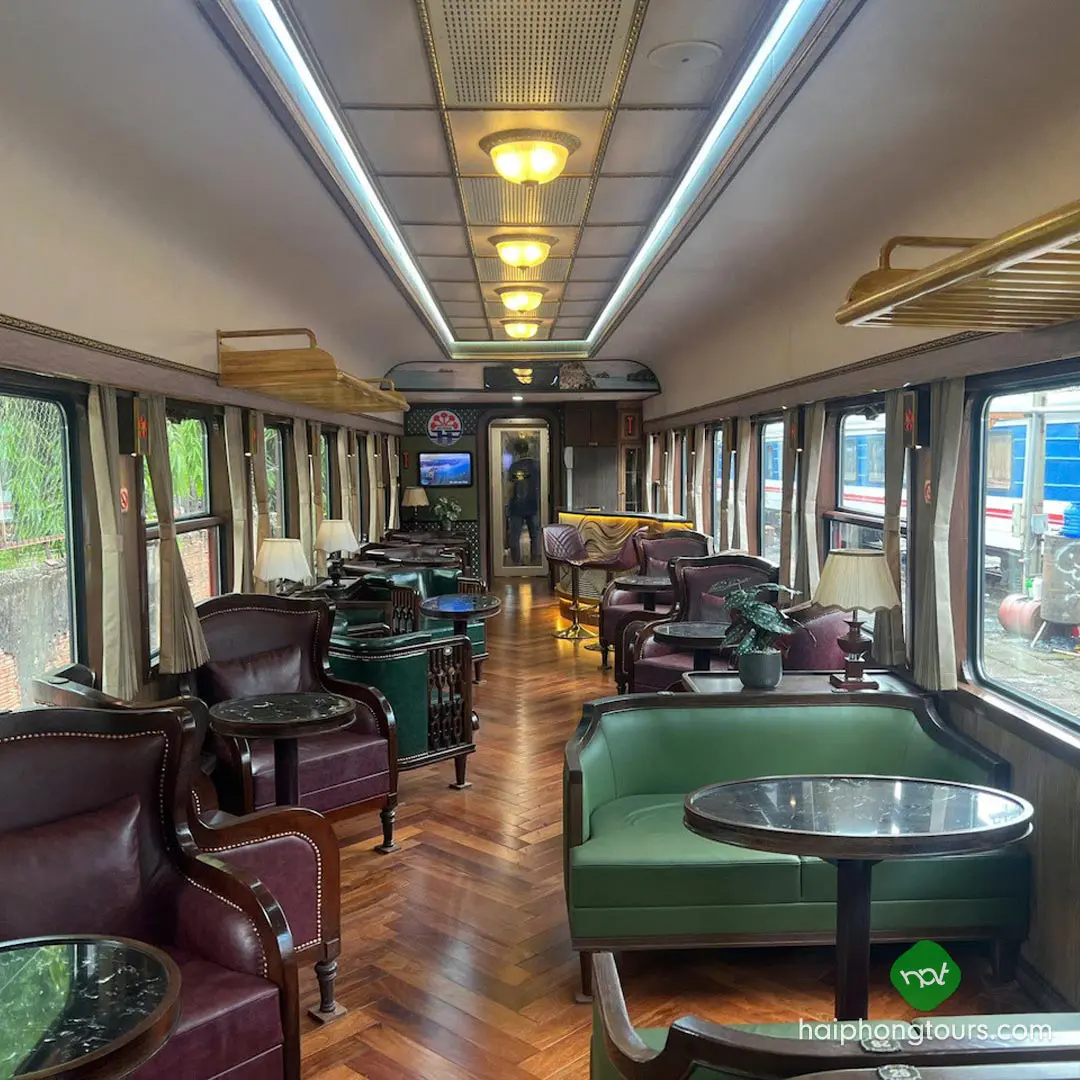
The Hanoi–Hai Phong train guide explains the carriage choices. Book a seat that suits your comfort and viewing priorities, and keep sightseeing separate from boarding: arrive with time to find your carriage rather than trying to explore the station at the last minute.
Hai Phong station and the commercial city
Hai Phong station opened with the railway in 1902. Its role as the passenger terminus is one part of a wider transport story: the railway also connected with the port’s freight activity. The historic line was built within a colonial system of trade and extraction, so the story includes the work behind the buildings as well as their appearance.
On arrival, take time outside to see how the station forecourt connects to the street. Inside the areas available to passengers, notice how the ticketing, waiting and platform spaces organise movement. These are useful things to observe in an operating station, where daily use is part of its heritage.
Continue to the Opera House square at 28 Tran Hung Dao. This adds civic and cultural context to the rail stop. View the exterior as part of the walk; an interior performance or visit needs its own arrangement. From the square, continue towards the museum on Dien Bien Phu.
Hai Phong Museum: a former bank with urban history inside
The central museum is at 66 Dien Bien Phu, Hong Bang ward; the national heritage directory also lists 11 Dinh Tien Hoang. Its building formerly housed the Franco-Chinese Bank. That previous function is relevant to this route: finance belongs alongside docks, railways and factories when reading the development of a commercial city.
The published regular schedule is Tuesday–Sunday, 08:00–11:00 and 14:00–17:00, with free admission. Leave the midday break for lunch. Do not schedule this stop for Monday simply because trains are running.
Start with material about the old city and maritime heritage, both identified among the museum’s permanent themes. Compare the buildings and waterfronts in historical photographs with the route you have just walked. Look for who is working, what is being moved and which part of the scene has changed, rather than only comparing architectural styles.
Allow 60–90 minutes as a planning estimate. For a specialist explanation, contact 0225 3823 451 or baotanghp@gmail.com and state your interest in transport, industry or port workers. Arrange any guide or language support beforehand. The Hai Phong museum comparison helps distinguish this city museum from other institutions.
Hoang Dieu port: understand the change underway
Historical photographs of Hoang Dieu show railway wagons beside ships and quays, illustrating direct transfers between sea and rail. The old port’s group of six warehouses also explains the name Ben Sau Kho, or Six Warehouses Wharf. These connections help explain why a railway journey belongs in a port-city itinerary.
Current access needs particular care. In a 13 November 2026 interview republished by VIMC, the operator described relocation, warehouse handovers and removal of cranes for the Nguyen Trai bridge and riverside redevelopment. It also said the city had decided to preserve the Port Workers Monument, the operations building and Warehouse 6.
Preservation does not establish public visitor access. The port-train experience discussed in 2024 was a proposal; it is not a confirmed tour for this itinerary. Keep the walk on public streets and leave any port or construction-site visit out unless the responsible organisation has accepted your visit in advance.
An optional specialist stop: the Cement Museum
The Vietnam Cement Museum occupies part of the former Hai Phong cement-factory site, now within the Vinhomes Imperia area in Hong Bang. A documented collection includes wooden cement containers, a Romanian-made 100 kg scale used to check cement sacks, equipment from a 1930s kiln and two outdoor grinding machines.
These objects make production easier to understand: packaging, weighing, power transmission and grinding each represent a different task. If a visit is arranged, follow those processes through the displays and consider how much work involved moving materials between stages.
Public reporting says organisations should arrange visits in advance. VICEM’s current directory lists its Hai Phong company at 0225 3875 356. This is a corporate enquiry contact: ask to be directed to the museum team. A current public tariff and regular opening timetable were not established, so include the stop only after a response confirms access.
A practical two- or three-day plan
- Day one, Hanoi: visit the Long Bien approach in daylight, then continue your city sightseeing. Keep the railway outing for the following morning.
- Day two, Hai Phong: take a morning train, visit the station exterior and Opera House square, have lunch, then enter the city museum for its afternoon session. Choose a Tuesday–Sunday for this museum day.
- Optional third day: use an overnight for the prearranged Cement Museum visit or a slower urban walk before your onward journey.
Keep one question running through the trip: how did people, materials and money move between these places? That connects a bridge, a passenger train, a former bank and industrial objects into a coherent history.
Would you like help arranging this route? Contact Hai Phong Tours with your dates, train preference and main interest, such as railway architecture, port history or industrial collections.