
Start a North Vietnam textile trip with museum objects in Hanoi, compare labelled products at a specialist shop, then book one technique you want to try. A practical combination is the Vietnam Museum of Ethnology, Craft Link on Văn Miếu Street and, during a Sa Pa stay, Indigo Cat’s wax-resist and indigo workshop. They offer different kinds of learning, so choose according to the time and route you already have.
Start with textiles at the Vietnam Museum of Ethnology
The museum is on Nguyễn Văn Huyên Street, Nghĩa Đô, Hanoi. It publishes opening hours of 08:30–17:30, Tuesday–Sunday, with Monday and Lunar New Year closures. Standard admission is 40,000 VND per person. Allow around two hours for a selective textile visit rather than trying to cover the entire museum and architectural garden.
For an English-guided visit, call 024 3756 2193, extensions 100 or 101. The museum lists foreign-language indoor guiding at 300,000 VND per group, separate from admission; outdoor guiding is a separate service. Request a textile focus and book ahead, since a normal entrance ticket does not reserve a guide.
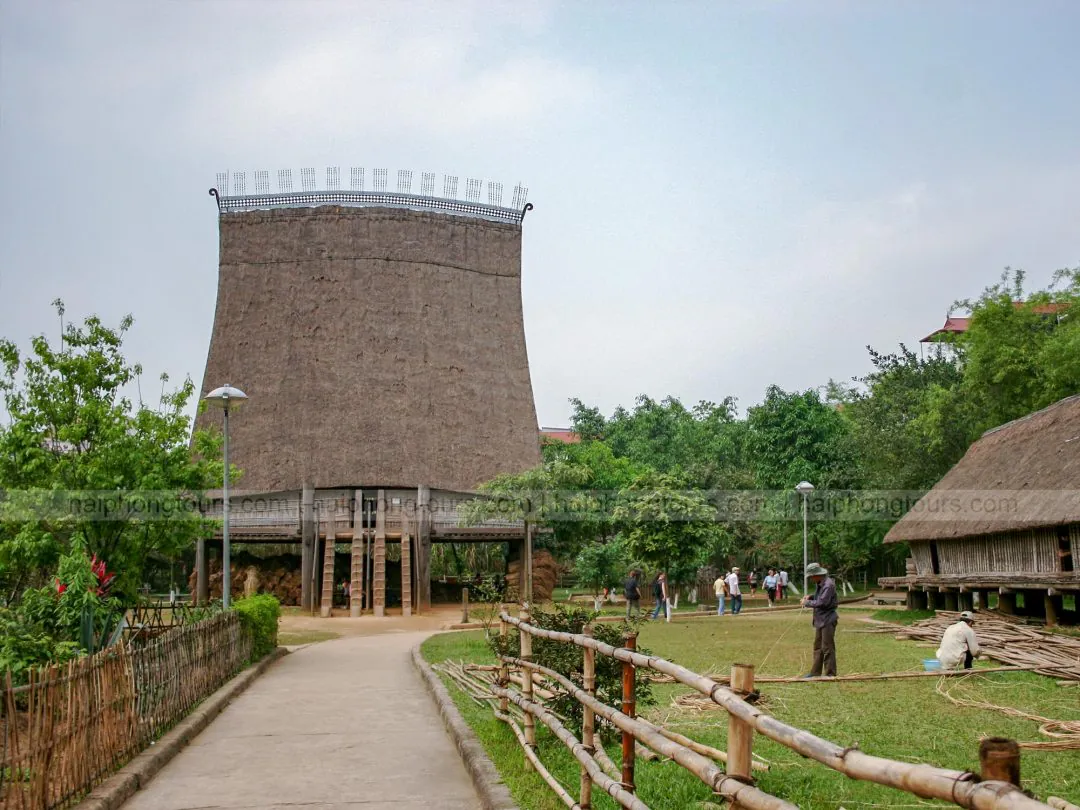
Head to the Hmong–Dao display on the second floor of the Trống Đồng building. Read the community name, place and date on each label before comparing colours. “Hmong clothing” includes several local traditions, so one garment should not become a template for every village you later visit.
A documented example to look for is a Flower Hmong skirt made by Sồng Thị Dinh in Kim Nọi in 1995, collected by the museum in 2000. Its middle band uses beeswax patterns, while the lower band combines embroidery and sewn fabric decoration. That single object demonstrates why a colourful textile may involve several processes. Its catalogue entry is a reference, not a guarantee that the object is displayed on every visiting date.
Read the technique as well as the pattern
| Technique | What to look for |
|---|---|
| Weaving | Threads crossing to form the cloth; a pattern can be built into that structure |
| Embroidery | Stitches added with a needle to an existing cloth |
| Appliqué | Separate pieces of fabric attached to a ground cloth |
| Batik or wax resist | Wax protects parts of the fabric during dyeing, leaving a design when removed |
The museum’s batik explanation follows wax application, dyeing and removal of the wax with hot water or scraping. Repeating stages can produce several colours. A pattern that resembles batik may also be printed, so the useful question is how that particular piece was made.
Fibre is a separate question. Cotton, hemp, silk and synthetic thread can all carry patterns. A cotton workshop sample does not become hemp because its design resembles a Hmong garment. Record the material actually used, along with the maker and technique.
Compare finished work at Craft Link in Hanoi
Craft Link, 51 Văn Miếu, publishes shop hours of 09:00–18:00 daily. Contact 024 3733 6101, internationally +84 24 3733 6101, or craftlink@craftlink.com.vn. Its office has shorter weekday hours, so distinguish a retail visit from a professional appointment.
Use the shop to compare two products with different construction, such as embroidery on a prepared base and a woven textile. Have staff identify the producing group and explain which part was made by hand. Ask whether a contemporary bag uses new cloth, older panels or a mixture; the answer changes how you describe and care for it.
Craft Link’s maker relationships are also documented by a 2025 University of Wisconsin–Madison collaboration. Students worked with distinct communities practising indigo dyeing in Pà Cò, hemp weaving and batik in Lùng Tám, and embroidery and reverse appliqué in Pa Xac. Those were arranged study visits, not an open-access tourist circuit. The useful lesson for a buyer is that place and technique should be identified together.
Book a hands-on session at Indigo Cat in Sa Pa
Indigo Cat, 39A Fansipan Street, Sa Pa, Lào Cai, offers a workshop for 500,000 VND per person. It runs for approximately two to two and a half hours, with sessions offered daily around 09:00 or 14:00.
The fee covers a teacher, a 40 × 40 cm cotton square, wax and the indigo-dyeing process. You draw the resist design, dye the cloth and see the pattern after the wax is boiled out. Prepared cloth makes a short session possible.
Phone or WhatsApp +84 982 403 647; the operator recommends WhatsApp for last-minute requests. General email is info@indigocat.asia. Children and adults are welcome, but agree on a child’s participation around hot wax and water with the teacher. Confirm the instruction language and when the finished cloth can be packed.
Choose a simple first design and wear clothes that can take stains. Let the teacher guide handling of wax, hot water and the vat.
What “natural indigo” establishes
Indigo can come from plants or be manufactured synthetically. Kew identifies true indigo, Indigofera tinctoria, as one plant source, alongside related species. A deep blue colour by itself therefore does not establish the dye’s source, and that botanical name should not be assigned to every northern Vietnamese vat.
Ask the dyer what plant or purchased dyestuff they use, how the vat is prepared and whether other colours use the same process. A garment can combine naturally dyed cloth with commercially coloured embroidery thread. Describe those components separately rather than treating “natural” as a claim about the whole object.
Buy, photograph and pack with useful information
For a purchase, keep the maker or producing group’s name, fibre, technique, dimensions and price on the receipt or in a photograph of the label. Inspect the seams and the reverse as well as the decorative face. A new product made for visitors can be worthwhile when its materials and maker are described clearly.
Ask before photographing a person, work in progress or a design close-up. Let the maker explain whether a motif or garment has a particular use; buying a souvenir does not give you a reliable story about every pattern associated with that community.
Get care instructions for the actual piece. Let a workshop textile dry before packing, and keep a newly dyed item separate from pale clothing until you know its first-wash requirements. Do not use colour rubbing off as proof that a dye is plant-derived.
Keep the Hanoi museum and shopping visit within a city day, then add the Sa Pa class during a longer mountain stay. If your route already passes Mù Cang Chải, the batik and indigo workshop guide compares a different village setting. The North Vietnam craft-workshop guide helps combine textiles with other crafts. Contact Hai Phong Tours with your route and preferred technique if you want help planning the visits.