
North Vietnam is better for habitat-based wildlife travel than for guaranteed animal sightings. Choose Cuc Phuong for conservation centers and forest walks, Xuan Thuy for serious wetland birding, Van Long for a quiet limestone-wetland boat trip, and Cat Ba for a rare-species conservation story where responsible visitors should never chase the animals.
The most reliable wildlife experience may be a guided rescue-center visit rather than a wild encounter. Mammals are elusive, bird activity changes with weather and tide, and protected species must not be approached for a photograph. A useful trip rewards habitat, behavior and conservation knowledge even when no headline species appears.
Quick wildlife decisions
- Best first wildlife destination: Cuc Phuong National Park, for forest, guided conservation-center access and several activity levels.
- Best specialist birding: Xuan Thuy National Park, planned around season, tide and a knowledgeable local guide.
- Best gentle wetland experience: Van Long Nature Reserve, with a quiet boat trip and no sighting guarantee.
- Best island biodiversity context: Cat Ba, where habitat protection matters more than finding a langur.
- Best easy bird attraction near Tam Coc: Thung Nham, for visitors who value convenience over a fully wild setting.
- Best lake-and-forest stay: Ba Be, with two or three nights and realistic expectations for mammal sightings.
- Best ethical rule: never feed, touch, call, corner or pursue wildlife.
- Best equipment: binoculars before a long camera lens.
Choose the type of wildlife experience
Conservation center
A legitimate rescue or conservation center keeps animals for rescue, rehabilitation, breeding, research or education. Visitor access may be guided and limited. The purpose is not entertainment, handling or a close-contact photograph.
This is the most dependable way to learn about threatened Vietnamese primates or turtles. Ask how admission supports the program and follow all instructions about noise, distance and photography.
Wild habitat
A national park, wetland or protected landscape offers the richest ecological context but the least certainty. Animals control the encounter. A forest walk with tracks, calls, insects and plant relationships can be successful even without a clear mammal view.
Managed nature attraction
Some sites combine gardens, caves, boats, planted landscapes and predictable bird gathering. They can be accessible and enjoyable, but they should not be described as equivalent to remote field birding. Confirm whether birds are wild, free-ranging, habituated or kept in managed areas.
Specialist wildlife tour
A serious birding or mammal trip should use a guide who knows target habitat, seasonal movement and site rules. Ethical expertise is more valuable than a long target list. No operator can honestly guarantee a wild species that moves freely.
Cuc Phuong: conservation and forest in one base
Cuc Phuong is the strongest first wildlife stop because it combines forest access with established conservation programs. The Endangered Primate Rescue Center focuses on rescue, rehabilitation, breeding, research and conservation. Guided public visits are arranged through the national-park tourism office rather than by walking into animal-care areas.
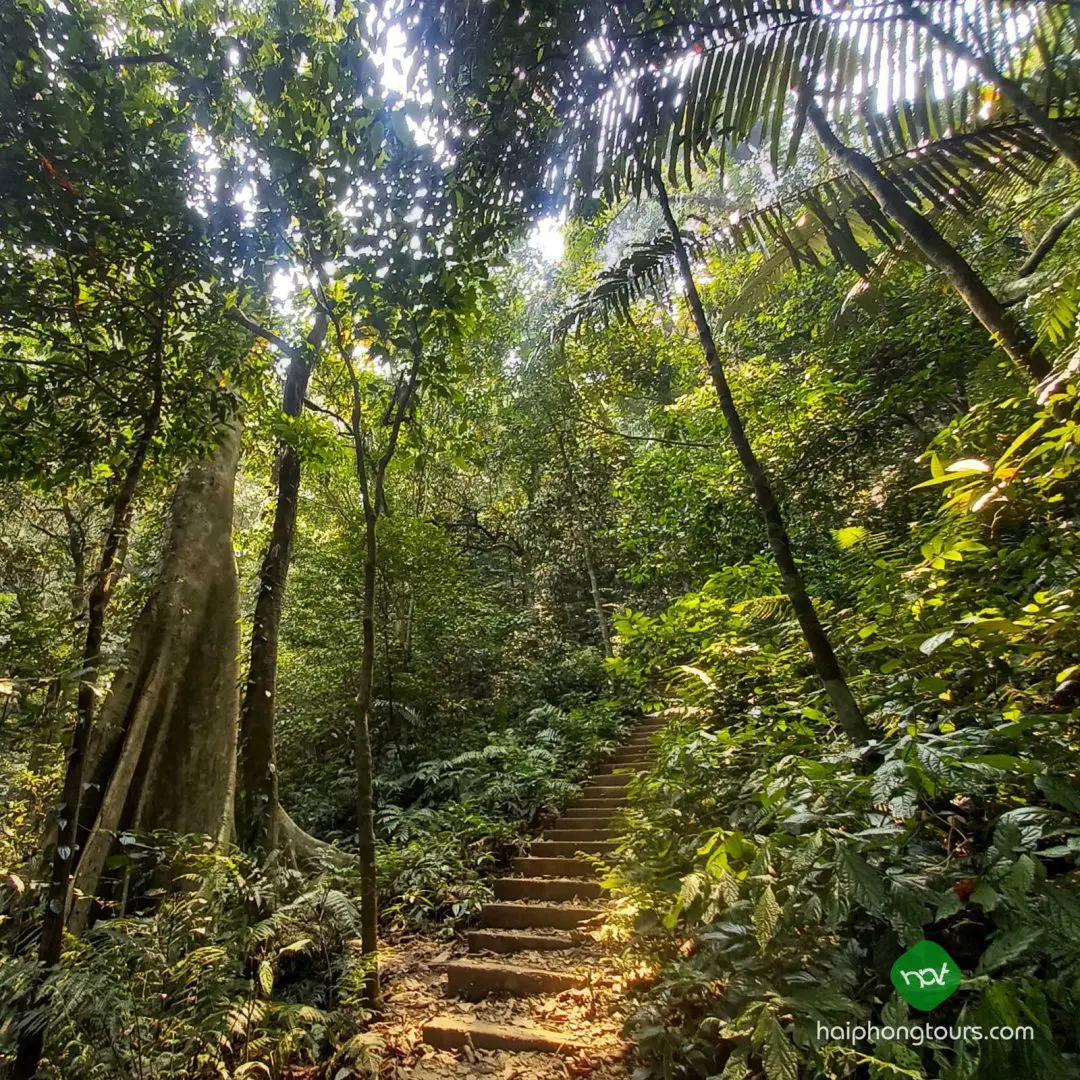
The Turtle Conservation Centre also has an education role within the park. Access, tour times and visitor areas can change according to animal welfare and operations, so confirm them directly with the park for the day of the visit.
What to expect in the forest
Forest wildlife is easier to hear than to see. Birds, cicadas, butterflies, frogs and signs of animal activity may be more apparent than mammals. Rain, temperature, wind, visitor noise and time of day change the experience.
Choose a route by distance and surface, then add a guide if wildlife interpretation is the main purpose. A fast group hike and a slow observation walk are different products even on the same trail.
The Cuc Phuong National Park guide explains trails, conservation stops, accommodation areas and the day-trip-versus-overnight decision.
How long to stay
A Hanoi day trip can include an introductory trail and one conservation visit, but it loses the quiet early and late hours. One night is better for naturalists. Two nights allow a slower trail, a guided center visit and a weather alternative without racing the forest road.
Cat Ba: protect the langur, do not chase it
The Cat Ba langur is a critically endangered primate restricted to the Cat Ba archipelago. Its rarity makes it a conservation priority, not a normal sightseeing product. Do not buy an unofficial “langur tour,” request nest or troop locations, imitate calls or ask a boat to approach cliffs for a closer view.
If a chance sighting occurs, remain quiet, keep your distance and let the animal choose its route. Do not publish precise real-time locations. A long lens does not justify leaving a permitted route.
The Cat Ba langur ethical viewing guide explains why sightings cannot be promised and how a visitor can support habitat protection without increasing pressure.
Cat Ba beyond the langur
The Ha Long Bay and Cat Ba Archipelago World Heritage property includes extensive limestone islands, marine areas and forest habitats. A responsible visit can focus on geology, forest structure, birds, intertidal life and conservation interpretation rather than one species.
Use an established national-park trail and stay within permitted areas. The Cat Ba National Park trails guide compares Ngu Lam, Trung Trang and Viet Hai-related routes by surface and transport needs.
Van Long: wetland, limestone and patient observation
Van Long in Ninh Binh offers a small-boat experience through wetland and limestone scenery. It is often associated with Delacour’s langur, but a traveler should book the trip for the habitat and quiet journey, not for a guaranteed primate sighting.

Bring binoculars, keep conversation low and follow the boat operator’s route. Do not ask to land in a restricted area or move closer to a cliff. Morning or later-day light may improve comfort and observation, but water level, weather and animal movement still determine the result.
Van Long works well for travelers who want a calm nature stop with lower physical effort. It does not replace a guided forest walk or a specialist birding day.
Xuan Thuy: plan serious birding around tide
Xuan Thuy is an internationally recognized wetland in the Red River Delta. It suits travelers interested in waterbirds, migratory patterns, mudflat ecology and coastal livelihoods. Species and numbers vary greatly by season, tide, weather and disturbance.
Arrange a guide before arrival. Ask which habitat will be accessible, what transport is required and whether the day’s tide supports observation. A midday arrival without a route plan can produce heat and distant views rather than useful birding.
What to bring
- binoculars and, for serious identification, an appropriate spotting scope;
- sun and rain protection for exposed wetland conditions;
- quiet clothing in muted colors;
- water and food arranged without leaving litter;
- offline species notes and a notebook;
- dry protection for optics and electronics.
Stay on permitted routes. Mudflats, mangroves and roosting areas can be sensitive even when no barrier is visible.
Thung Nham: accessible bird interest near Tam Coc
Thung Nham combines a managed visitor attraction with a bird-gathering area, caves, paths and gardens. It can suit families and travelers already based near Tam Coc who want a structured half-day with easier facilities.
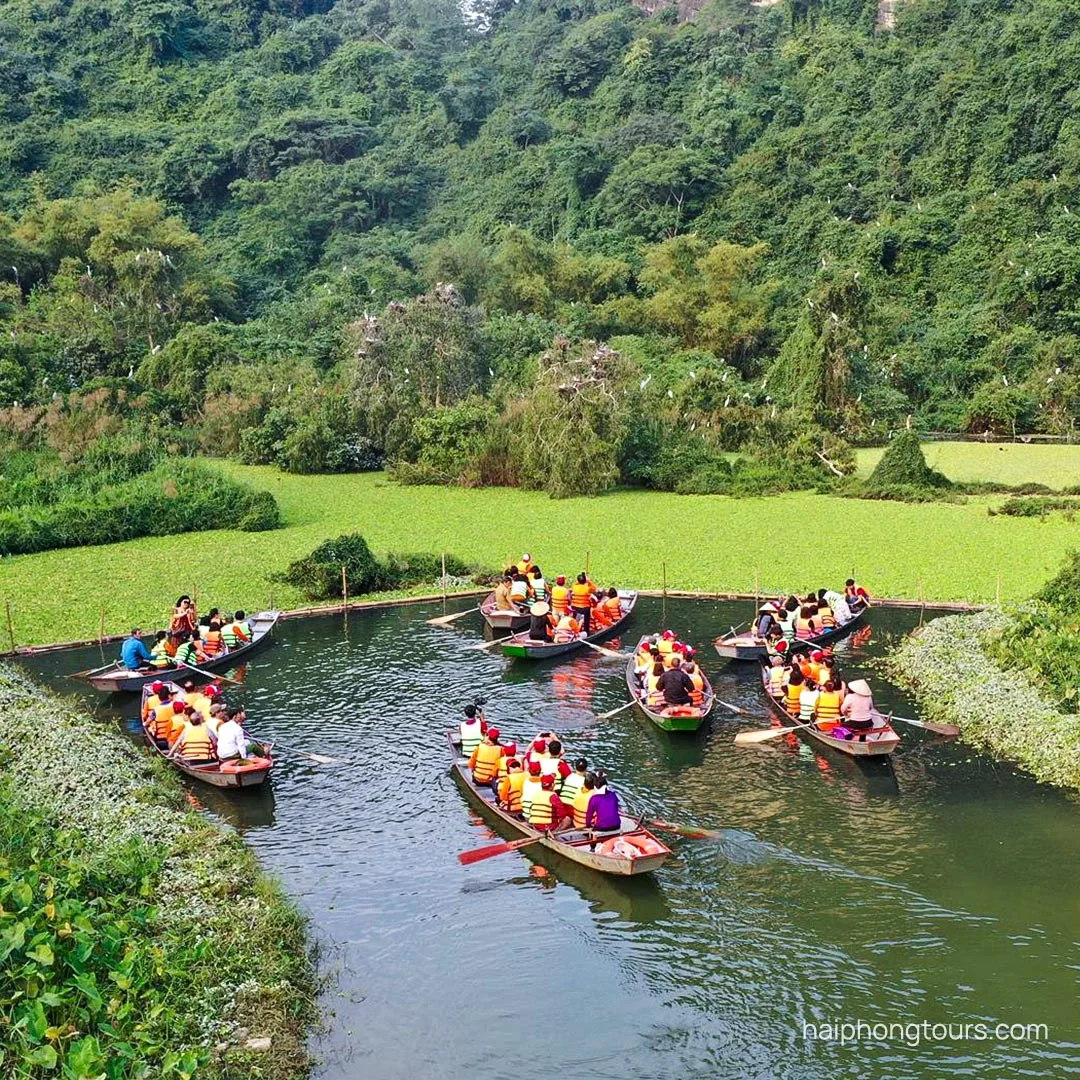
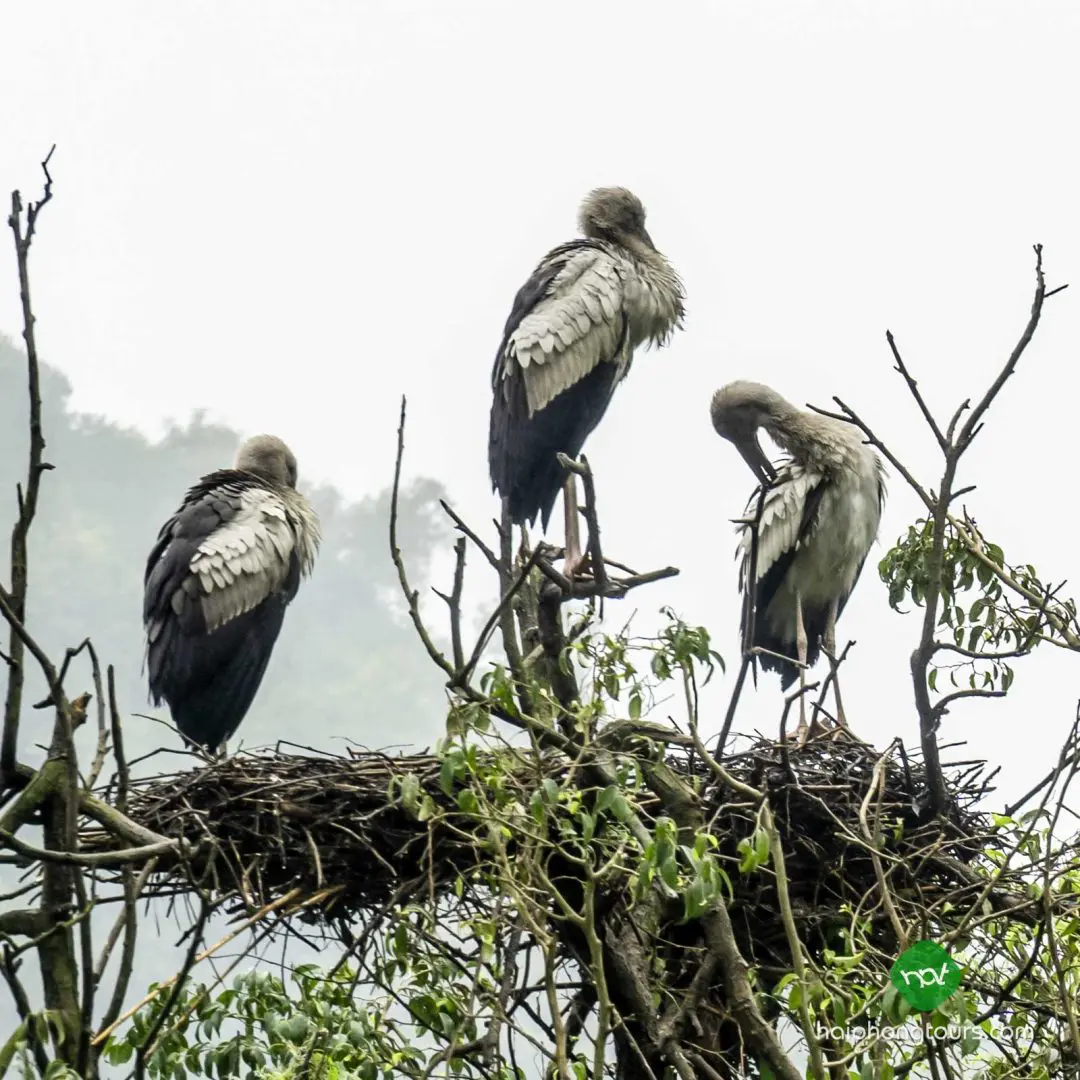

Rowboats and birds in the wetland landscape at Thung Nham.
Bird activity near the roost changes with time, season and weather. Ask for the current boat and viewing arrangements rather than relying on an old fixed program. Keep the experience in perspective: convenient observation in a managed attraction is different from specialist wetland fieldwork.
The Thung Nham from Tam Coc guide covers timing, transport and the half-day decision.
Ba Be: lake and forest, not a wildlife guarantee
Ba Be is useful for travelers who want an inhabited lake-and-forest landscape with boat travel, caves, village stays and walking. The ecological experience is broad; large mammals are difficult to observe and should not be promised.
Use two nights to reduce road pressure and allow a full local day. Ask a local guide about a suitable forest route, water level and community access. A boat circuit and a forest walk reveal different habitats.
The Ba Be Lake guide explains boats, homestays and trip length. Choose it for an integrated landscape experience rather than a target-species checklist.
Wildlife seasons are habitat-specific
Migratory-bird season
Coastal and delta wetlands receive different birds across the migration cycle. Exact arrival and departure vary each year. A local birder with recent observations is more useful than a generic month list.
Warm and wet periods
Insects, amphibians and forest activity may increase, while rain makes trails slippery and can reduce visibility. Leeches and mosquitoes are part of some forest conditions. Clothing and route choice matter more than trying to eliminate every encounter.
Cooler and drier periods
Walking can feel easier, but cold, fog and wind affect mountain and coastal observation. Some species become less active or harder to detect. Carry layers and protect optics from condensation.
Use the North Vietnam weather guide for regional planning, then ask for current habitat conditions.
How to evaluate a wildlife operator
- The operator names the legal site, permitted route and guide.
- No wild species is guaranteed.
- Group size and observation distance are controlled.
- Playback, feeding, handling and baiting policies are clear.
- The guide will abandon a sighting if the animal shows stress.
- No precise nest, den or rare-species location is promoted publicly.
- Night activity uses a permitted route and restrained light.
- Fees and conservation contributions are explained honestly.
- A weather or access alternative is available.
Reject any offer to hold a wild animal, enter a closed zone, buy wildlife products or approach a protected species beyond official rules. A guide who ignores boundaries for one photograph is not providing expert access.
Photography without changing behavior
Use binoculars to locate and observe before raising a camera. Stay on the route and let the subject move away. Do not surround an animal, block its path or push a boat closer to a resting place.
Avoid flash on nocturnal animals and inside conservation facilities unless explicit permission is given. Recorded calls can disrupt territorial and breeding behavior; do not use playback unless a qualified program permits it for a defined reason.
Remove location metadata before sharing images of highly threatened species. The North Vietnam photography guide adds practical advice for lenses, humidity, people and sacred sites.
Health and field safety
- Use insect repellent and clothing suited to the route.
- Check skin and clothing after forest and grassland walks.
- Do not touch bats, primates, dogs, cats or other mammals.
- Seek prompt medical advice after an animal bite or scratch.
- Carry personal medication and enough treated drinking water.
- Wear shoes with grip on roots, mud, wet limestone and boat landings.
- Tell someone the route and expected return time.
- Turn back when storms, heat or fading daylight make observation unsafe.
Wildlife can carry disease without appearing ill. A rescue center barrier protects both the animal and the visitor; never reach through it.
Do not buy wildlife
Do not purchase live animals, meat, medicine, ornaments or souvenirs made from wildlife. Avoid products advertised as ivory, horn, turtle shell, coral, wild bird, reptile skin or rare timber. Unclear origin is a reason to leave the item.
Do not pay for a photo with a restrained animal. Money turns handling into a repeatable business model even when the individual seller describes it as rescue.
Children and wildlife trips
A conservation-center visit, short forest trail or managed wetland boat can work well for children when expectations are simple. Set one observation goal, build in food and toilet stops, and stop before fatigue becomes noise or unsafe movement.
Teach children not to feed or touch animals. Keep them within direct reach near water, cliffs and roads. A quiet fifteen-minute observation can be more valuable than forcing a long species list.
Accessible wildlife planning
Ask about the complete movement chain: vehicle drop-off, path surface, steps, boat boarding, toilet access, seating and time without shelter. A destination described as “easy” may still involve a low boat, muddy bank or uneven forest path.
Conservation centers and selected managed attractions may offer more predictable access than long forest trails. Confirm current arrangements directly; do not assume that a paved entrance continues through the full visit.
Three realistic wildlife itineraries
Three days: Cuc Phuong and Ninh Binh
- Travel from Hanoi to Cuc Phuong and take a short orientation walk.
- Join a confirmed conservation-center visit and a guide-led forest route.
- Continue to Van Long for a low-impact wetland boat trip, then return or stay in Ninh Binh.
Four days: Cat Ba biodiversity
- Travel to Cat Ba and settle into the chosen area.
- Use a permitted national-park trail with a guide when interpretation matters.
- Take a licensed Lan Ha Bay activity focused on landscape and marine habitat, without approaching protected cliffs.
- Keep a flexible morning for weather, a conservation talk or a shorter walk before departure.
Four days: Xuan Thuy and Ba Be
Do not combine them directly as a rushed loop. Give Xuan Thuy one guide-led, tide-based day from a delta base, then return through Hanoi before using two or three nights for Ba Be. The distance between habitats is part of the trip, not empty time.
Measure success by what remained undisturbed
A good wildlife day does not require a rare mammal photograph. It can produce a better understanding of a wetland tide, a rescue program, a forest layer or the reason a protected cliff must remain quiet.
Choose one habitat, use a qualified guide and accept uncertainty. Keep distance, record observations without exposing sensitive locations and spend with services that protect access. The responsible travel guide for North Vietnam provides the wider framework for community, waste, wildlife and transport decisions.
Plan a dedicated birdwatching trip
If birds are the main purpose of the journey, the birdwatching in North Vietnam guide compares forest, wetland, island and mountain habitats, with realistic timing for Cuc Phuong, Xuan Thuy, Cat Ba, Ba Be and Tam Dao.
Would you like help fitting this experience into your trip? Contact us with your travel dates, starting point, available time and group size. Tell us about walking limits or special interests so we can suggest a practical itinerary.