
A useful transfer pickup pin must identify the entrance where the vehicle can legally and physically stop. Sending the center of a hotel, airport or village is not enough. Add the property name, entrance description, passenger contact and a backup meeting point.
The goal is simple: the driver and passenger should be able to describe the same curb without a long phone call. This matters most in Hanoi’s narrow lanes, apartment complexes, airports, cruise ports, mountain homestays and properties with more than one gate.
Send four pieces of information together
- Map pin: the vehicle entrance or legal stopping point.
- Written name: hotel, building, terminal, pier or landmark.
- Entrance note: street, gate, floor, pillar, lane or visible sign.
- Contact: passenger name and phone or messaging account that works in Vietnam.
A pin without a written name can be opened in the wrong map app or shifted during forwarding. A name without a pin can match several branches. Send both in one booking thread and ask the operator to repeat the pickup point.
Place the pin where a car can reach
Zoom in before sharing. Satellite view or street imagery can help distinguish a front entrance from a service gate, but the property’s current instructions are more important. Put the marker on the road edge or driveway used for vehicle collection, not on a room, garden or center of the building.
Check the direction of travel when the road has a median, one-way restriction or separate carriageways. A pin across the street can create a long detour. If the driver must approach from one direction, include that detail.
Do not choose an illegal stopping point merely because it is closest to the lobby. A nearby hotel, bank, convenience store or wide junction can be a safer meeting place when the curb is restricted.
Hotels and apartments
Send the exact branch name and reception entrance. Chains, similarly named homestays and apartment towers can share a district. If the booking uses a unit number inside a complex, give the public gate or lobby where an outside driver is allowed to enter.
Ask reception whether private cars can stop at the door. In Hanoi Old Quarter, pedestrian streets, market hours and narrow lanes can prevent pickup at the displayed address. Agree on a nearby road and walk there before the vehicle arrives.
For an early departure, tell reception the previous night and keep luggage ready. A driver waiting at a gate should not have to search multiple floors or call a sleeping host.
Airports
Include airport code, terminal, domestic or international status, arrival or departure, floor, door or pillar and lane when the operator provides them. At Noi Bai, Terminal 1 is domestic and Terminal 2 is international; “HAN airport” alone does not establish the meeting point.
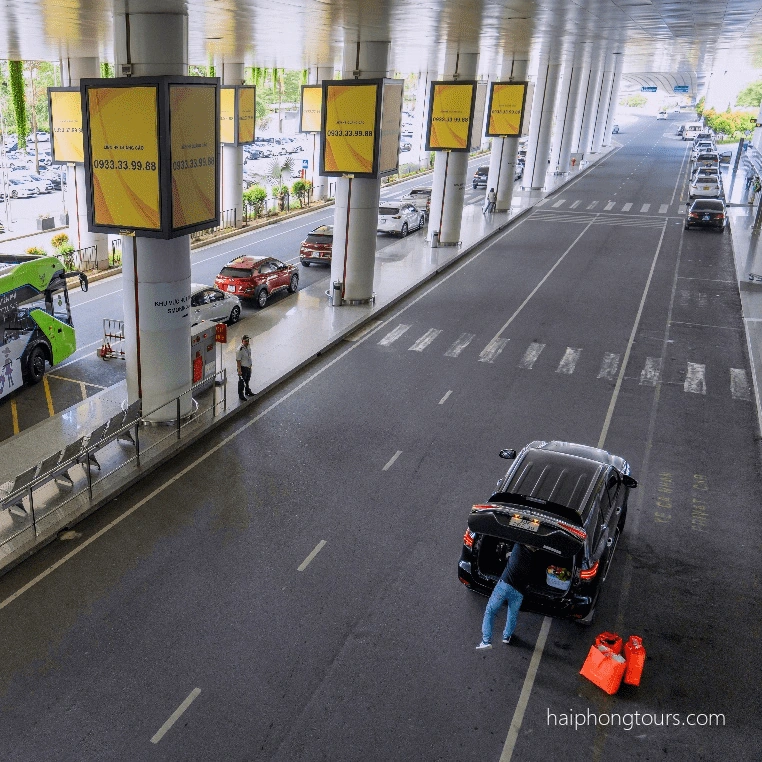
For an arrival, the pickup pin is usually a public meeting point after baggage claim, not the baggage belt. Send the live flight number so a delay or terminal change can be followed. Confirm whether the driver holds a sign or waits in parking until contacted.
For departure, pin the hotel entrance first and give the terminal required by the airline. The driver must know whether the endpoint is T1 or T2; do not rely on the airport name alone.
Bus and railway stations
A station can have several gates, roadside offices and surrounding pickup points. Send the station name in Vietnamese, entrance or operator office and ticketed departure. In Hai Phong, Vinh Niem and Thuong Ly are different terminals; in Hanoi, a train service may use a specific station or entrance.
When arriving by coach, ask where passengers actually leave the bus. The route may finish at an office rather than the main terminal. A private driver should receive the drop-off pin printed or confirmed by the coach operator, not a pin guessed from the route name.
Cruise ports, marinas and ferry areas
Ha Long International Cruise Port, Tuan Chau Marina, a ferry terminal and a day-boat pier are different pickup areas. Send the cruise name, operator lounge, pier and expected disembarkation time. “Ha Long port” is too vague.
At Tuan Chau, the ship, tender or office may use a particular lot or terminal. Ask the cruise operator for the current meeting instruction, then forward that exact instruction to the driver. Do not move to another pin because a map search ranks it first.
For Cat Ba, identify whether the passenger is in Cat Ba Town, at a ferry terminal or at another island pier. A vehicle on the mainland cannot collect from an island pin without an agreed crossing plan.
Remote homestays and mountain properties
The property pin may mark reception even when the last road is too narrow, steep or rough for the booked vehicle. Ask the host where normal cars stop and whether a motorcycle, electric cart or smaller local vehicle completes the last section.
Send both pins: the main-road handover and the property. State who meets the passenger and who carries luggage. In rain, fog or darkness, use a stable landmark rather than an unmarked bend.
A village, commune or district name covers too much area for a pickup. Use a named bridge, school, market, hotel or junction where waiting is permitted, then share a current entrance photograph if the location is hard to recognize.
Use live location only as a supplement
Live location can help during the final approach, but it should not replace the planned pin. Mobile data can fail, battery can run low and location accuracy can drift between buildings. Send the fixed meeting point before travel.
Share live location only with the verified driver or dispatch contact and only for the necessary period. Do not publish it in a public group. Stop sharing after pickup.
If the driver and passenger appear close but cannot see each other, compare street names, direction of travel, storefronts and plate. A phone map may place one person on the parallel road or opposite carriageway.
Add a photograph without exposing private information
A daylight photo of the gate, sign or curb can solve an ambiguous entrance. Avoid including room numbers, passport details or unrelated people. For a night pickup, describe lighting, gate color and the sign that remains visible after businesses close.
Ask the host or reception for a current vehicle-access photo when online imagery is old. Construction, barriers and pedestrian rules can change the practical entrance while the business pin remains the same.
Create a backup meeting point
Choose a nearby place that is easy for both sides to recognize and safe to wait at. It should be reachable on foot with luggage and open at the pickup time. Record when the passenger should move there; do not have the driver search two points at once.
At an airport or terminal, the backup can be an information counter, named exit or numbered pillar. At a remote property, it can be a main-road shop or junction confirmed by the host.
Hai Phong Tours recommends deciding the backup before an early-morning, late-night or time-critical transfer. It is far easier than improvising while the phone battery and connection time are disappearing.
What to send the day before
“Pickup on [date] at [local time] for [passenger name]. The main pin is [link], at [property/entrance description]. Please approach from [street/direction]. We have [bags] and will wait [exact spot]. If vehicle access is blocked, use [backup pin]. Our working phone is [number/account]. Please confirm the driver contact and plate-assignment timing.”
For current private routes, choose the exact direction in the Hai Phong Tours transfer directory before sending the pins. A correct route with a vague pickup can still fail; a precise pin turns the booking into an executable plan.
If the driver asks for the pin again
Send it again. Dispatch details can be forwarded between office staff and the assigned driver, and the driver may use a different map app. Repeat the name and entrance note with the link instead of answering “same as before.”
If the new driver or plate differs from the earlier message, require confirmation from the original operator. Do not enter an unknown vehicle based only on a location request.
Would a private transfer make this journey easier? Contact us with your travel date, exact pickup and drop-off, number of travelers and bags. Include any flight, train or cruise deadline so we can assess a suitable plan and quotation.