
Nui Tram is a limestone landscape southwest of central Hanoi where you can combine a village-edge walk with Tram Pagoda, the Buddhist shrine inside Long Tien Cave and the small hillside pagoda of Vo Vi. It suits a half-day outing for travelers interested in both scenery and local history. Make the religious sites the core of the visit; climbing the exposed rocks is optional.
The practical distinction is between visiting the pagodas and exploring the mountain. The latter involves uneven limestone, steep edges and openings in the rock, rather than a continuous paved viewpoint trail. Restoration work can also change access around the heritage buildings, so have your driver or guide check which areas are receiving visitors before leaving Hanoi.
Find Nui Tram in Chuong My, not Soc Son
Use Núi Trầm or Chùa Trầm, phường Chương Mỹ, Hà Nội when arranging transport. Older addresses use Phung Chau commune in the former Chuong My District. This is the southwestern side of Hanoi, beyond Ha Dong, rather than the Soc Son hills north of the city.
The limestone outcrops rise from a landscape of villages and fields. Expect a compact rural excursion within greater Hanoi, not remote wilderness or a substitute for several days in the northern mountains. The attraction is the close relationship between the rock, cave shrines and settlements.
Keep three names separate when sharing pins with a driver:
- Chua Tram: the pagoda beside the mountain, also called Long Tien Tu.
- Chua Hang or Dong Long Tien: the cave shrine at the foot of the mountain, also associated with the name Hang Tram.
- Chua Vo Vi: a separate pagoda on a small neighboring rocky hill, reached by stone steps.
Chua Tram and Chua Tram Gian are also different places. The extra word Gian identifies another pagoda; a driver should not substitute it for the Tram Mountain stop.
Start with the pagoda and Long Tien Cave
Chua Tram: a living place of worship
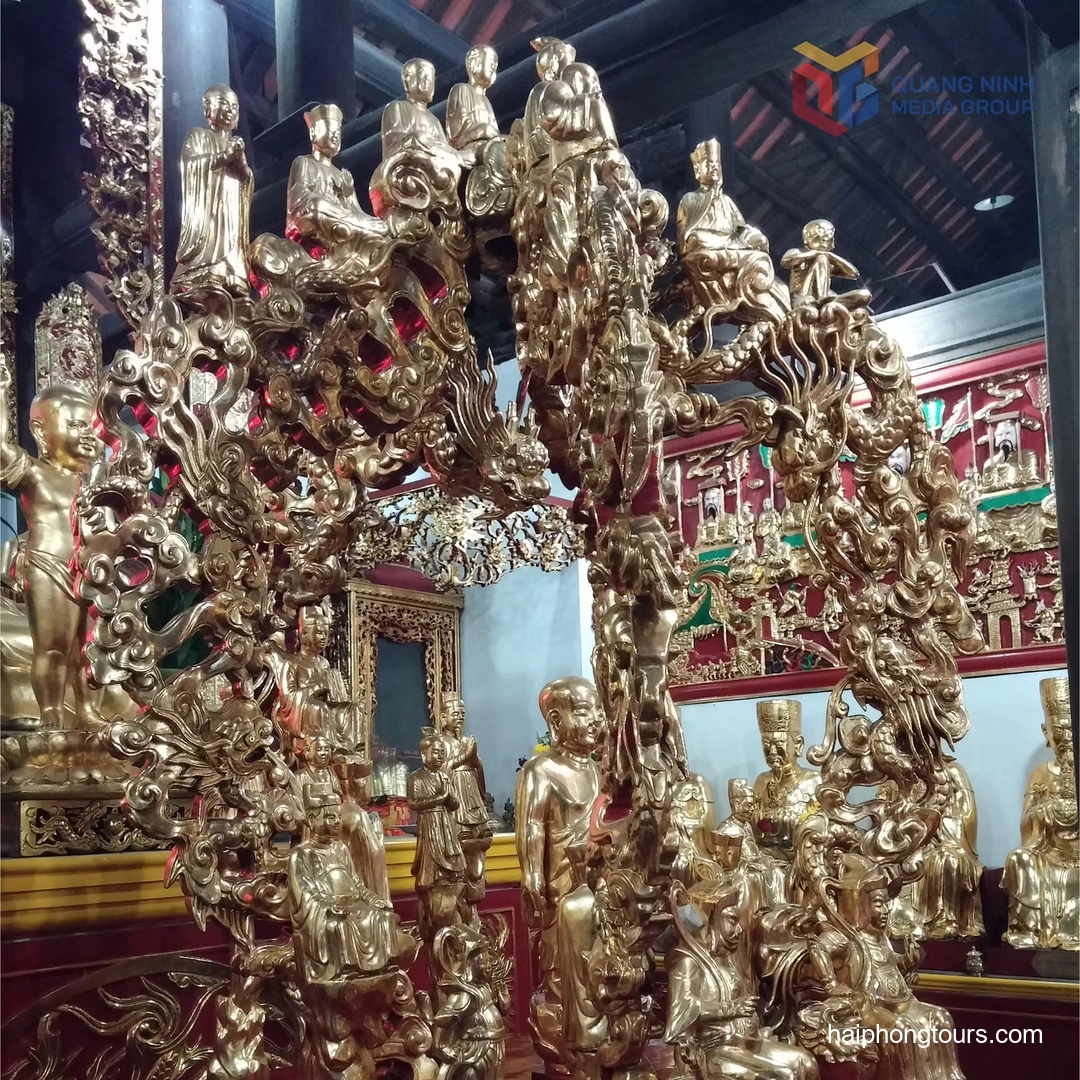
Begin with the pagoda’s outdoor setting, where the built worship spaces sit against the limestone. Inside, Buddhist figures share the wider religious setting with Mother Goddess altars. A guide can help distinguish the figures and explain how the different worship spaces are used.
This is a better use of interpretation time than collecting a long list of supposed founding dates. Buildings here have been repaired and altered, and the current appearance includes restoration. Follow the open visitor route around any works rather than expecting every courtyard and hall to match an older photograph.
Chua Hang: inscriptions and a shrine within the rock
The cave shrine is the most distinctive part of the cultural visit. Inside Long Tien Cave, religious statues and inscriptions share the space with natural limestone formations. Notice how the worship area uses the cave itself, then look for the writing on the rock walls. An explanation of one inscription is more useful than trying to photograph every surface.
Wear shoes with grip even if you are skipping the mountain walk. Take time for your eyes to adjust at the entrance and remain within the accessible worship area. A visit to Chua Hang does not mean that other dark holes or passages in the mountain are open for exploration.
The cave also has a specific place in Vietnamese broadcasting history. During the opening stage of the war against French colonial rule, the Voice of Vietnam operated from Hang Tram and broadcast Ho Chi Minh’s appeal for nationwide resistance in December 1946. He later delivered a lunar New Year greeting here in 1947. This adds a historical layer to a visit that might otherwise focus only on the rock formations.
If that history is your main interest, arrange someone who can explain it in English. A new exhibition building or a project shown on a development plan should not be assumed to be open. Confirm the actual visitable space, including cave access, rather than booking around a future museum display.
Vo Vi is a separate stair climb
Vo Vi Pagoda stands on its own small rocky hill, less than a kilometer from Chua Hang. Its compact buildings follow the shape of the rock, with stone steps connecting the entrance and worship spaces. The elevated setting gives a different perspective on the surrounding fields and settlement.
Small does not mean level. Some of the passageways are narrow and exposed, so let people descending pass before continuing upward. The climb and the return steps deserve more attention than the pagoda’s size suggests. You can stop short of a higher passage if the footing or exposure is uncomfortable.
Tell your driver whether Vo Vi is included. A drop-off for Chua Tram is not the same as arranging movement between all three sites. Walking the local connection may appeal in cooler weather; a short vehicle repositioning can be more comfortable in heat or when someone wants to conserve energy for the steps.
Decide separately about walking on the mountain
The open rock gives wider views than the lower pagoda area, but Nui Tram is not a managed stair ascent where you simply follow a railing to a summit. Rough rock, gaps and steep edges matter more than the modest height of the hills. Do not choose a route merely because a photograph makes it look accessible.
For a first visit, use a local guide who knows the currently usable paths and can agree on a short route with a clear return. Stay away from holes and cliff edges, keep children close and turn back before the walk requires a scramble beyond your comfort. A low viewpoint can be enough; there is no need to reach every exposed outcrop.
Choose a dry morning and keep the return in daylight. Wet limestone, poor visibility, thunder or strong heat are reasons to shorten the plan. Carry water and sun protection: the exposed hill has a very different feel from the sheltered cave.
If traveling with young children or someone who has balance or knee difficulties, prioritize the lower religious sites after checking their steps and thresholds. Vo Vi and the open hill are separate decisions. Neither the word “pagoda” nor a short distance on a map guarantees step-free access.
A practical half-day plan from Hanoi
Allow roughly two to three hours locally for a selective visit to the pagoda, cave and Vo Vi, including short movements and rests. This is a planning allowance, not an official circuit time. Keep additional room for the road journey from your actual hotel and for any longer hill walk.

- Start at the Chua Tram area: establish which paths and buildings are open, then visit the pagoda and Chua Hang.
- Move to Vo Vi if the steps suit you: take the ascent slowly and leave time for the descent.
- Add an open-hill walk only in suitable conditions: agree on the route and turnaround before setting out.
- Return for lunch or an unhurried afternoon in Hanoi: avoid attaching a distant attraction merely to fill the day.
A prearranged car with waiting time is straightforward for this outing. The usual approach is through Ha Dong toward Chuong My on the National Highway 6 corridor, followed by local roads. Agree on the named stops and return pickup before accepting the quote.

Public transport requires more planning than reaching the Chuong My area. Check the current service, the final connection to the pagodas and the return journey; do not assume an old bus number still follows the same route or that it stops at the cave. Avoid relying on finding an immediate return car after a late walk.
Carry small cash for any posted admission, parking or agreed guiding charge. Keep donations separate from those payments. Cover shoulders and knees in worship spaces, ask before photographing ceremonies and avoid touching inscriptions or statues. Bring back food packaging, and do not treat informal camping photographs as permission to pitch a tent or light a fire on the hill.
Choose the outing for the experience you want
Choose Nui Tram for the combination of limestone, a cave shrine, broadcasting history and a small hilltop pagoda. If your main interest is a lakeside temple landscape with covered bridges, compare the Thay Pagoda visit instead. They are separate outings with different focal points.
The broader Hanoi day-trip guide helps compare a short cultural excursion with a full landscape day farther away. For Nui Tram, the useful choice is how much walking you want after the pagoda and cave, then confirming access and transport for that specific plan.
Useful guides for your trip
Would you like help fitting this experience into your trip? Contact us with your travel dates, starting point, available time and group size. Tell us about walking limits or special interests so we can suggest a practical itinerary.