
Phao dat is a Vietnamese folk game in which teams shape a large piece of clay, lift it and bring it down onto the ground with a sharp bang. Despite the English nickname “clay firecrackers,” there is no gunpowder, flame or firework. Trinh Xuyen village in western Hai Phong is one place to watch this rural tradition, especially during its spring communal-house festival.
The visit works best around a confirmed contest or an agreed demonstration. Do not travel to Trinh Xuyen expecting a performance every day: the communal house, a village festival and a session with the players are different reasons to come. For travelers interested in community traditions, the preparation and teamwork can be as absorbing as the noisy moment when the clay lands.
What to watch during a phao dat contest
Before the throw, players knead and shape the clay carefully. The broad piece has a worked rim, and its consistency matters: producing an effective throw begins with handling the material, not simply lifting something heavy. Watch how several teammates work around the same piece before they help raise it for the main thrower.
The thrower supports the clay, steadies it and brings it down onto the prepared surface. The impact produces the bang and sends a strip of the clay rim outward. That strip is called the manh phao. In competition, judges measure the resulting clay strips to calculate the score; the loudest bang alone does not decide the winner.
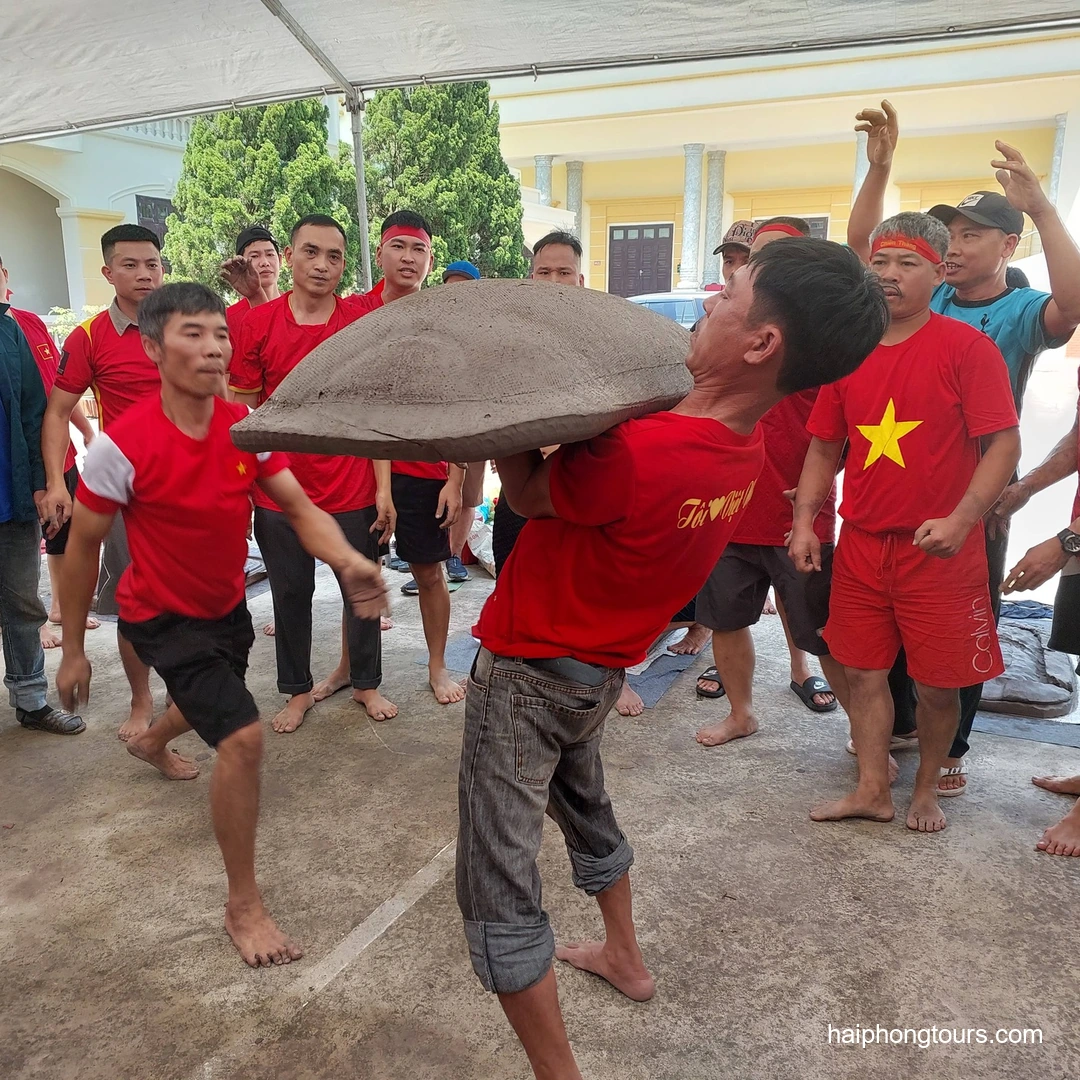 A phao dat player prepares a throw at a Vinh Lai club event.
Stay to watch the measuring as well as the throw. It makes the crowd’s reaction easier to understand, even without Vietnamese commentary. A teammate’s encouragement, a clean release and a long strip all become part of the contest rather than a series of unexplained crashes.
The game belongs to the farming communities of the former Hai Duong region. Its festive noise is associated with hopes for a good harvest, while the shared preparation and competition bring different village teams together. Experienced older players remain important to passing on the technique.
Find Trinh Xuyen, not Tranh Xuyen
Use Đình Trịnh Xuyên, thôn Trịnh Xuyên, xã Vĩnh Lại, Hải Phòng when discussing a visit. This is Trinh Xuyen communal house in Vinh Lai commune, in the western part of the enlarged city. Older addresses describe it as Nghia An commune, Ninh Giang district, Hai Duong Province. The local tourism name Pháo đất Nghĩa An still uses that older commune name.
Trinh Xuyen and Tranh Xuyen are different names. The latter is associated with Den Tranh Temple, another destination in the former Ninh Giang area. Save the full Vietnamese name and ask the host for a meeting pin rather than relying on a similar-looking search result.
Plan transport to the actual village or announced contest venue. “Hai Phong” alone is too broad for estimating a pickup time from a central hotel or Cat Bi Airport. For a rural outing, agree on the return journey and any driver waiting time before leaving.

Choose a festival visit or ask about a demonstration
The spring festival
Trinh Xuyen’s spring communal-house festival takes place in the second lunar month. Its program combines worship and village activities, including phao dat. The Gregorian dates change each year, and the competition can take place on a different day from the opening ceremony.
Obtain the program for the year you are visiting and identify the specific phao dat session. Ask for its starting time and ground, not just the festival’s opening date. Clubs also hold exchanges elsewhere in Vinh Lai, so an announcement for a local contest does not automatically mean it will be at Trinh Xuyen communal house.
A visit outside festival dates
Contact Trinh Xuyen communal-house management on , or from an international phone, to ask whether a suitable session can be arranged. Ask your accommodation or a Vietnamese-speaking organizer to help if you need interpretation.
Give your date, group size and whether you want to watch or try a supervised activity. Before paying for transport, settle these details:
- The activity: a full contest, a demonstration by players or a short introduction to shaping clay.
- The arrangement: the exact venue, start time, expected duration and who will meet you.
- The cost: any group minimum or demonstration charge, and what it includes.
- The explanation: whether someone can introduce the technique and scoring in English.
A request is not a confirmed performance. If no players are available on your date, choose the communal house for its architecture or build your day around another agreed activity.
Watching comfortably and respectfully
The clay pieces used by experienced competitors are substantial, and the release needs a clear working area. Follow the organizers’ spectator boundary, keep children beside you and avoid stepping into the measuring area for a photograph. Leave kneaded clay and equipment untouched unless a player invites you to examine them.
For young children or anyone sensitive to sudden noise, watch from farther back and bring suitable ear protection. A supervised introduction with a small piece of clay, if offered, is a different activity from lifting a competition piece. Do not treat an adult contest as a drop-in lesson.
Wear shoes that can cope with a dusty or damp courtyard. If seating, shade, toilets or step-free access affect your visit, ask about the actual venue when confirming the session. A festival crowd and a small arranged demonstration can offer very different viewing conditions.
Make it part of a western Hai Phong cultural day
At Trinh Xuyen, allow time for the communal house itself. It honors Vu Duc Phong, a Tran-period general, and preserves carved timber decoration. This is a place of worship as well as a festival setting; follow the caretaker’s guidance inside and ask before photographing ceremonies.

A confirmed Hong Phong water-puppet performance can complement the clay game with a different village tradition. The troupe is associated with Bo Duong village in Khuc Thua Du commune. Arrange that show separately and allow your hosts to agree a workable order for the two visits.
Alternatively, use the Den Tranh Temple visitor guide for a religious and architectural stop in the same wider area. Keep its Tranh Xuyen address distinct from Trinh Xuyen when planning the route.
Hai Phong Tours recommends making the confirmed clay-game session the fixed appointment of the day, then adding one nearby stop with flexible timing. The value comes from understanding the players’ skill and the village setting, rather than rushing between places in the hope that a performance will be happening.
Useful guides for your trip
Would you like help fitting this experience into your trip? Contact us with your travel dates, starting point, available time and group size. Tell us about walking limits or special interests so we can suggest a practical itinerary.