
Phu Day is a worthwhile cultural visit if you want to understand Vietnam’s Mother Goddess traditions through active shrines, architecture and local religious life. Begin with Phu Tien Huong, Phu Van Cat and Lang Mau Lieu Hanh. Allow roughly two to three hours for that selective circuit, with more time during a festival or a permitted ceremony.
The destination is also written Phu Giay in older travel material. It is a group of separate sacred sites in the Nam Dinh area, now within Ninh Binh Province. Plan a dedicated local route rather than expecting one enclosed attraction or a guaranteed performance of a ritual.
Locate the three main sites before traveling
Use the current address Vu Ban Commune, Ninh Binh Province. Older maps may show Kim Thai Commune, Vu Ban District, Nam Dinh Province. Save each main site separately:

- Phủ Tiên Hương: also called Phủ Chính or Phủ Chính Tiên Hương.
- Phủ Vân Cát: also called Phủ Vân; a separate shrine from Tien Huong.
- Lăng Mẫu Liễu Hạnh: the stone mausoleum, also called Lăng Mẫu.
Tien Huong and Van Cat are about a kilometer apart. Include the connecting journeys in your plan and ask a local guide or driver to put the mausoleum into a sensible sequence. “Phu Day” alone is too broad a pickup or drop-off instruction when you are trying to meet someone at a particular entrance.
From Hanoi, reserve a full day for travel, the shrine circuit and lunch. From accommodation in the Nam Dinh area, a half-day is a more natural starting point. If you are staying around Tam Coc or Trang An, check the exact road journey before booking: the present provincial name does not make Phu Day part of the nearby limestone sightseeing circuit.
What Mother Goddess worship means here
Phu Day is closely associated with Thanh Mau Lieu Hanh, a central figure in Vietnamese Mother Goddess traditions. Her stories belong to a living religious tradition and are best understood as sacred narratives rather than a straightforward biography of a documented ruler.
The beliefs of the Three Realms connect Mother Goddesses with heaven, water, and mountains and forests. Their practice includes everyday devotion, festivals and ceremonies, carried by communities, shrine guardians, ritual practitioners and musicians.
UNESCO inscribed the practices related to these beliefs on its Representative List of the Intangible Cultural Heritage of Humanity in 2016. The recognition concerns living knowledge and practice. It is different from designating the Phu Day buildings as a UNESCO World Heritage property.
A phủ in this context is a shrine associated with this religious world. Do not label every altar or ceremony “Buddhist” simply because it uses incense or has a temple-like building. The guide to northern Vietnam’s temples and pagodas explains the different roles of shrines, pagodas and communal houses.
A focused first circuit
Phu Tien Huong: start with the approach and courtyards
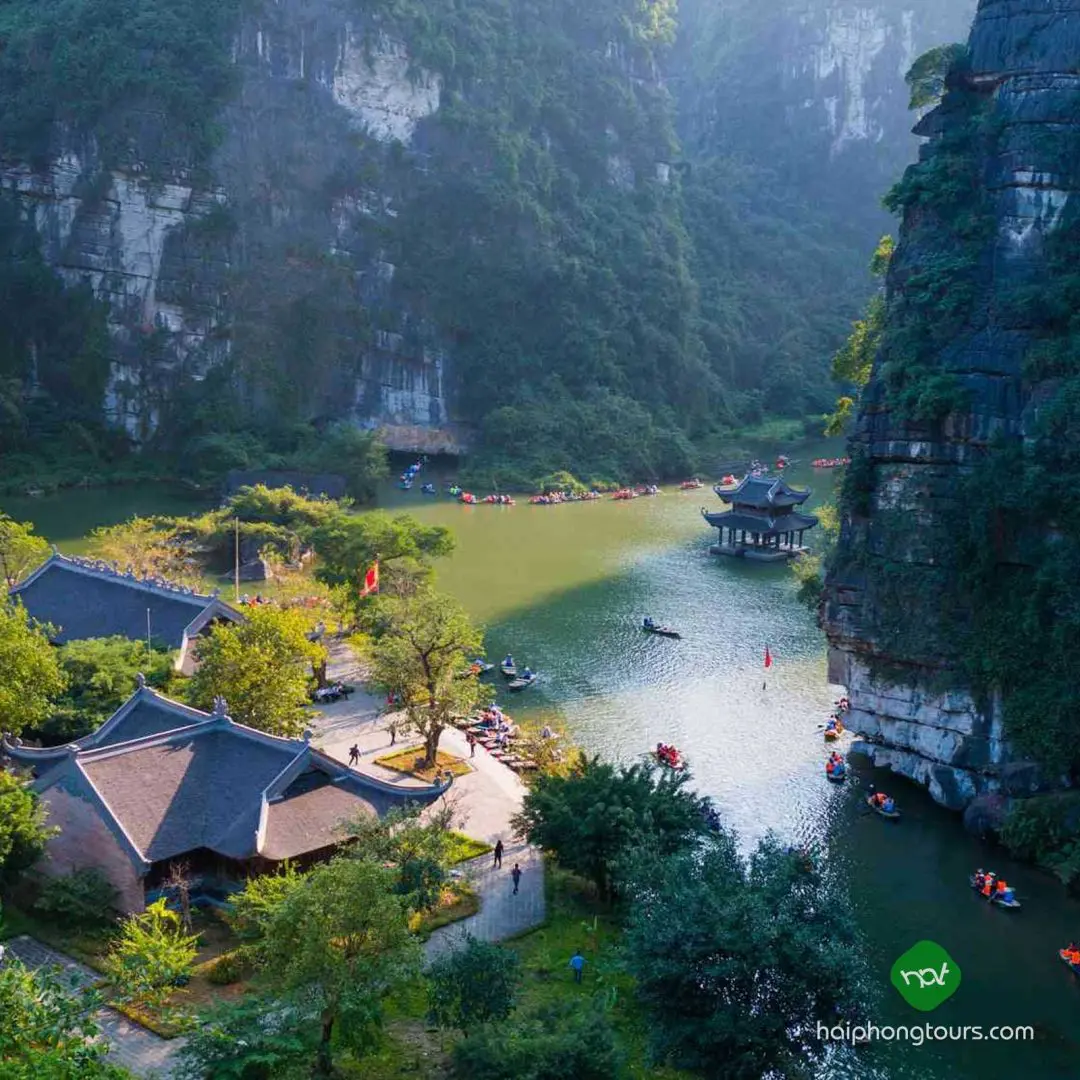
At Tien Huong, give the approach as much attention as the altar rooms. Water, pavilions, courtyards and successive buildings create the transition into the sacred space. Pause outside to understand that arrangement before following the flow of visitors inward.
The name Phu Chinh refers to Tien Huong, so keep the full name on your map. If you have a guide, ask for an explanation of the principal figures and the sequence of worship spaces. A clear introduction here will make the other stops easier to understand.
Suggested time: around 45–60 minutes, adjusted for access and worship. A ceremony can require a slower visit or a different route around the courtyard.
Phu Van Cat: compare a different architectural composition
Van Cat has its own entrance sequence, including a semicircular pond, a pavilion in the water and a substantial multi-level gateway. Compare the view across the pond with the spaces you have just seen at Tien Huong.
The two shrines should not be treated as duplicate names for one place. You can keep the interior visit selective while using the second stop to see how the same religious tradition is expressed in another setting.
Suggested time: roughly 30–45 minutes for a first visit. Leave extra time if your group wants a detailed architectural explanation.
Lang Mau Lieu Hanh: finish with stone and lotus forms
The mausoleum presents a different experience from the roofed shrine halls. Its stone walls, successive enclosures and lotus-shaped details draw attention to the memorial space at the center. Move slowly and leave the central area clear for people paying respects.
You do not need to search out every smaller shrine on a first visit. These three principal sites give a coherent introduction, while leaving time to ask questions and travel between them without rushing.
Suggested time: around 20–30 minutes. Together, the stops and local movement fit a two-to-three-hour planning allowance on a relatively quiet day.
Seeing hau dong and hearing chau van respectfully
Hau dong, also called len dong, is a spirit-medium ritual within Mother Goddess practice. Music, costume changes, gestures and offerings can form part of it. Chau van is the devotional musical tradition associated with these practices; a musical presentation and a religious ceremony are not automatically the same event.
There is no reason to assume a ceremony will begin when a sightseeing group arrives. If observing one is important to you, ask a knowledgeable local guide to establish whether visitors are welcome, where they may sit and whether photography is permitted. An invitation to enter a shrine is not permission to record every participant.
During a ceremony, keep conversations and movement to a minimum. Stay outside the space needed by practitioners and musicians, and accept instructions about sitting, standing or stepping out. Do not move offerings, reach over participants or request that a gesture be repeated for your camera.
You can learn from the architecture and an informed explanation even when no ceremony is taking place. Avoid making a guaranteed ritual encounter the condition for enjoying the day.
Festival days and quieter visits
The main Phu Day festival traditionally centers on the third to eighth days of the third lunar month. Convert these to your travel year and check the local program. Processions, devotional music and community activities take place at specific times and locations rather than continuously at every shrine.
Choose festival time for the collective religious atmosphere and allow for crowds, traffic management and a more distant vehicle meeting point. For architectural observation and a first introduction, an ordinary day gives you more control over the pace.
The nearby Chợ Viềng spring-market celebrations are a separate event in the first lunar month. Do not confuse a market date with the third-month Phu Day festival when arranging accommodation or transport.
Guiding, costs and comfortable access
An English-speaking guide is most useful here for interpretation and communication, not for collecting as many shrine names as possible. Ask whether the guide understands Mother Goddess practices and can explain the difference between sacred narrative, architecture and present-day ritual.
For a car booking, confirm the three stops, waiting time, parking and the final return address. For a guided arrangement, ask for a total that separates transport, interpretation, meals and any locally paid charges. Do not assume an offering package or a donation is automatically part of sightseeing.
Use designated donation arrangements if you choose to contribute. Confirm the price of any flowers, incense or other items before accepting them. A respectful visitor does not need to imitate a ritual they do not understand.
- Clothing: cover shoulders and knees, remove hats inside, and follow each shrine’s instructions about shoes.
- Walking: allow for thresholds, steps and uneven surfaces between halls. Ask about the exact route if step-free access is needed.
- Heat and rain: carry water and weather protection; the connecting journeys are part of the outing.
- Children: keep the circuit short enough for quiet behavior in occupied halls, and supervise them beside ponds and roads.
- Essential interiors: confirm access shortly before departure rather than relying on a universal opening-hours claim for the entire complex.
Leave room for a meal and reflection
Combine the selected shrine route with a simple meal in the wider Nam Dinh area. The Nam Dinh food guide explains options such as beef pho, bun dua and xiu pao, with ingredient checks for travelers who have dietary restrictions.
For a meal and time outdoors near the shrine area, the Nui Ngam visitor guide explains the recreation complex, dining and overnight options. Keep any organized activities separate from the shrine circuit and confirm what your booking includes.
Phu Day is most rewarding when you arrive with curiosity about the people and beliefs behind the buildings. Save the three site names, arrange interpretation if needed and choose deliberately between a festival visit and a quieter day. That preparation adds more value than trying to see every shrine or arranging the day around an unconfirmed ceremony.
Would you like help fitting this experience into your trip? Contact us with your travel dates, starting point, available time and group size. Tell us about walking limits or special interests so we can suggest a practical itinerary.