
Quang Phu Cau Incense Village is a worthwhile half-day trip from Hanoi if you enjoy craft photography and want to understand the work behind Vietnam’s incense sticks. Around 35–40 km southwest of central Hanoi, the area combines working households with courtyards where colorful bundles are arranged for visitors. Plan for a dry morning, allow about 1.5–2 hours at the village, and arrange your return transport before leaving the city.
The familiar photographs show only part of the experience. Many of those red, fan-shaped bundles are bamboo incense cores, called tăm hương, before the fragrant coating is applied. A visit to a photo courtyard and a visit to a production workshop can be different bookings, so choose according to what you want to see.

Plan your visit at a glance
- For photographs: choose a courtyard with the arrangement you want and confirm that it will be set up on your date.
- For the craft: arrange access to a working household or workshop, with an explanation in a language you understand.
- For a simple Hanoi outing: reserve roughly 4–5 hours by private car, including travel and a village visit. This is a planning estimate, not a fixed tour duration.
- For an onward journey: a prearranged stop before continuing to Ninh Binh can work; agree the complete route and final hotel address in advance.
Where is Quang Phu Cau Incense Village?
Quang Phu Cau is now in Ung Thien Commune, Hanoi. Older maps and travel listings may still show Quang Phu Cau Commune, Ung Hoa District. The name refers to a wider craft community across several villages, rather than one workshop with a single entrance.
A concrete destination to give your driver is Điểm du lịch làng nghề tăm hương Quảng Phú Cầu, thôn Cầu Bầu, xã Ứng Thiên, Hà Nội, the craft tourism point in Cau Bau hamlet. Visitor hotline: 0985 384 098 (international: +84 985 384 098).
If you have chosen a particular photo yard or workshop, use its own map pin and entrance instructions. Sending a photograph of the display you want can also help avoid being dropped at a different courtyard.
What you can see beyond the colorful photographs
Bamboo preparation, sorting and dyeing
The local craft dates back more than 100 years. A major part of production is making the slender bamboo cores supplied to incense makers. Bamboo is processed into sticks, smoothed and sorted; unsuitable pieces are removed before the bases are dyed and the bundles dried.
Traditional skills now work alongside machines. You may see mechanical processing as well as people grading, handling and arranging the sticks. The stages visible during your visit depend on the household and its work that day.
Finished incense and its cultural role
Some producers also make finished incense by applying the aromatic mixture to the core and drying it again. Incense is used in ancestor remembrance and religious observances, which helps explain why demand increases before Tet, Vietnam’s Lunar New Year.
If learning about ingredients or trying a production stage matters to you, request that experience when booking. A photography ticket alone should not be treated as a promise of a hands-on class or a demonstration of every stage.
Courtyards arranged for photography
The circular bundles have a practical connection to drying, but the elaborate visitor displays are deliberately composed. Depending on the yard, arrangements may include flower-like patterns, Vietnam’s map or flag designs. Red and pink are familiar colors, while additional shades help create the photographic layouts.
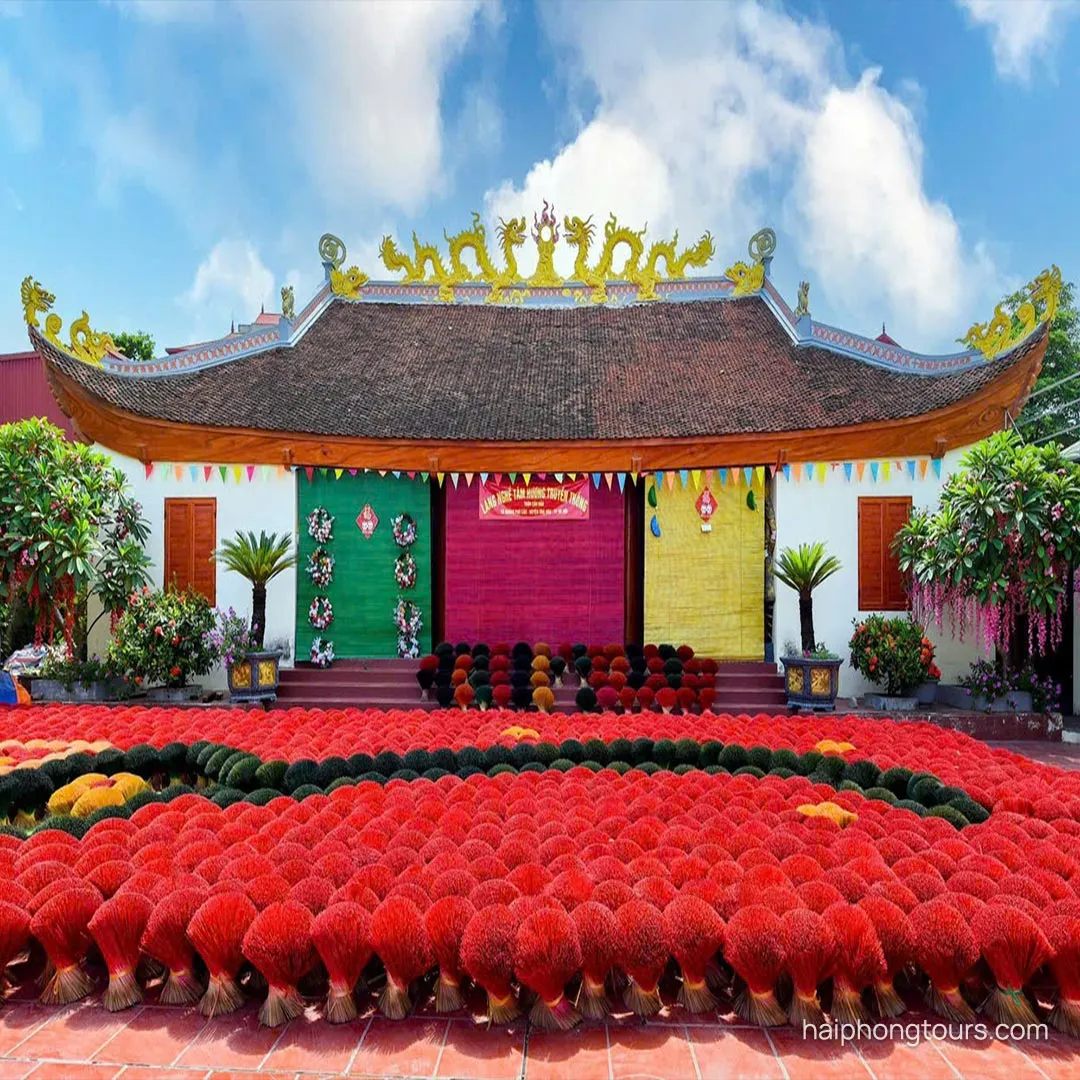
These spaces offer a different experience from watching everyday production. Combining one courtyard with an arranged workshop visit gives you both the visual setting and an explanation of what you are looking at.
Best time to visit: choose the conditions, then the hour
A dry morning around 8–10 a.m. is a useful target for photography. Confirm when your chosen courtyard will have its display ready; arriving very early for soft light is less useful if the bundles have not yet been put out.
Sunshine matters because outdoor drying is part of the work. Rain can limit the displays and change what you can see, even if a workshop or visitor area still receives guests. If photographs are the main reason for your trip, check the forecast and ask about the setup before departing Hanoi.
- September–November: often a comfortable period for an outdoor visit, with cooler conditions than midsummer. A dry forecast still matters more than the month alone.
- December–March: expect cooler, sometimes misty or damp weather. Do not assume spring always brings clear skies and low humidity.
- April–August: prepare for heat; summer also brings humidity and rain. Start early and allow a weather alternative.
- The weeks before Tet: production is usually busier. Confirm your exact date if traveling during the holiday itself, since pre-Tet activity does not establish holiday opening.
Entrance fees and opening hours
Treat admission and visiting hours as arrangements with the individual courtyard or workshop. Walking through the village is different from entering a household’s production space or a managed photography area.
Before you travel, confirm the current admission price and what it covers: photographs, production access, any hands-on activity, and optional clothing or props. Ask about separate charges if you plan a professional shoot. Carry Vietnamese cash as a backup, and confirm the arrival time directly rather than relying on a village-wide opening schedule.
How to get to Quang Phu Cau from Hanoi
Hanoi City Group Tour: Morning or Full Day
The Hanoi City Group Tour with Quang Phu Cau offers a guided visit with transport. Choose Morning for the incense village, Train Street and lunch, or Full Day to add afternoon sightseeing in Hanoi. The Afternoon package does not include the village.
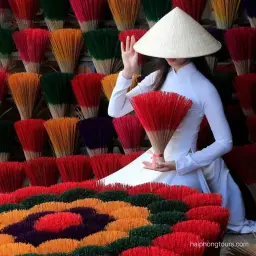


Visitors photographing arranged incense displays at Quang Phu Cau. A visitor among arranged incense bundles at Quang Phu Cau.
The morning itinerary lists 7 a.m. pickup from Hanoi Old Quarter hotels and hotel return after lunch. An English-speaking guide and entrance tickets are included; children under five have separate ticket and meal rules. Confirm your selected package and pickup arrangements when booking.
Choose the group tour for an organized introduction to the craft. A private car gives you more control over courtyard choice, photography time and onward travel to Ninh Binh.
Private car with a return arrangement
A private car is a practical choice for families, travelers carrying camera equipment, or anyone fitting the visit into a limited morning. Allow approximately 1–1.5 hours each way from central Hanoi, depending on your hotel, traffic and the courtyard entrance.
Hai Phong Tours offers a Hanoi to Quang Phu Cau private transfer with one-way travel or a drive, wait and return arrangement. Old Quarter hotel pickup is listed; other Hanoi pickup locations may carry a surcharge. Specify your chosen courtyard, visit length and return destination when requesting the trip.
Confirm that the quote covers both directions and the agreed waiting time if you need a return journey. Also check visitor admission and guiding separately: the transfer page lists vehicle entrance and parking fees, which should not be confused with your own courtyard ticket.
Taxi or ride-hailing car
A taxi or ride-hailing car can suit an independent visit, provided you check service availability for the actual destination. Send the precise entrance pin and plan how you will get back. Do not leave the return journey dependent on a car becoming available nearby when you are ready to leave.
Metro and local bus
For a lower-cost journey, travel to Yen Nghia bus station and take bus 91 toward Phu Tuc. The Cat Linh–Ha Dong metro line terminates at Yen Nghia, making it one way to reach the bus connection from the city.
Check the current route in the Hanoi bus information service before setting out. Show the conductor your courtyard’s map pin and ask for the appropriate stop; the final walk depends on which yard you choose. Allow extra time for reaching the metro, changing vehicles and walking, and check the return bus arrangements before starting your visit.
A manageable half-day itinerary
For a first visit, keep the morning focused on one photography area and one production visit if you have arranged access. The sequence below is a flexible plan, not a published operating schedule.
- Leave Hanoi with enough travel time to reach your confirmed courtyard during the morning photography window.
- Start with the outdoor display while the weather and setup suit photography.
- Visit the workshop or household to see the available production stages and ask about the difference between incense cores and finished sticks.
- Return to Hanoi around lunchtime if traffic and your visit length allow, or continue on a separately agreed onward journey.
Allow about 1.5–2 hours on site for a balanced visit. A detailed photography session, several courtyards or a hands-on activity will need a longer booking.
Quang Phu Cau to Ninh Binh, and visits after Halong Bay
Continuing to Ninh Binh
If your next overnight stop is Ninh Binh, consider booking the full journey from Hanoi through Quang Phu Cau to your hotel. This avoids returning to central Hanoi simply to begin another southbound journey. Give the driver the exact hotel pin: Tam Coc, Trang An and Ninh Binh city are different drop-off locations.
Agree the village waiting time, luggage capacity and onward driving estimate before booking. Keep the afternoon flexible, especially if you want a boat trip as well. A stop at the incense village must be included explicitly in the itinerary; it is not automatically part of a standard Hanoi–Ninh Binh transfer.
Train and scheduled bus options require a separate connection from the village to the confirmed departure point. Compare that complete journey before buying tickets, including the local transfer and connection buffer.
Arriving from Halong Bay
Quang Phu Cau lies southwest of Hanoi, so visiting after a Halong Bay cruise requires a deliberate detour and a suitable arrival time. It is better planned as an agreed private itinerary than treated as a quick stop on the direct return to central Hanoi. For photography, a separate morning from Hanoi usually gives you more control over timing and weather.
Photography etiquette and practical preparation
- Ask before photographing people. Keep work routes clear, and follow the household’s instructions around machinery and drying areas.
- Leave the bundles in place. Use the spaces provided for visitors rather than stepping across or moving sticks to change your composition.
- Bring sun protection and water. Choose comfortable shoes and clothing that can tolerate dust or an accidental dye mark.
- Check access needs directly. If steps or uneven surfaces are difficult, ask about the route from the vehicle to the courtyard, seating and toilets before choosing a venue.
- Choose souvenirs by intended use. If buying incense to burn at home, ask for finished incense rather than decorative bamboo cores, and request packaging that protects the sticks.
Quang Phu Cau rewards a visit planned around both the craft and the photographs. Choose the courtyard you actually want to see, add production access if it interests you, and confirm the weather-dependent display and return journey before leaving Hanoi.
Useful guides for your trip
Would you like help fitting this experience into your trip? Contact us with your travel dates, starting point, available time and group size. Tell us about walking limits or special interests so we can suggest a practical itinerary.