
Quang Yen makes a rewarding historical half-day from Ha Long or Hai Phong when you want to understand the Bach Dang river battles through actual places. The strongest combination is Bach Dang Museum, the Tran Hung Dao Temple–Vua Ba Shrine pair and Yen Giang Stake-yard. Together they connect objects, local remembrance and the river landscape rather than giving you three versions of the same monument.
Plan roughly three to four hours in Quang Yen, with the drive from your accommodation added separately. This suits travelers interested in Vietnamese history, archaeology or the wider Yen Tu World Heritage property. Choose a different outing if your priority is a spectacular mountain panorama, a beach or a large museum with extensive English interpretation.
Make sure you are going to the Quang Yen sites
“Bach Dang” can bring up several very different destinations. This route is on the Quang Yen side in Quang Ninh, centered on the 1288 victory associated with Tran Hung Dao. Bach Dang Giang at Trang Kenh, Cao Quy Stake-yard and Tu Luong Xam are separate places on the Hai Phong side of the wider historical landscape.
Save these Vietnamese names with their Quang Yen map pins:
- Bảo tàng Bạch Đằng: the local museum in central Quang Yen.
- Đền Trần Hưng Đạo – Miếu Vua Bà: the neighboring temple and shrine in the Bach Dang relic area.
- Bãi cọc Yên Giang: the protected archaeological site also called Yen Giang Stake-yard.
- Đình Yên Giang: an optional communal-house visit, separate from the stake-yard.
If you are choosing between the two river-history areas, the Hai Phong Bach Dang sites comparison explains the different role of Trang Kenh, Cao Quy and Tu Luong Xam. Give your driver the actual site list rather than asking for a generic “Bach Dang tour.”
Start with the museum when its galleries are open
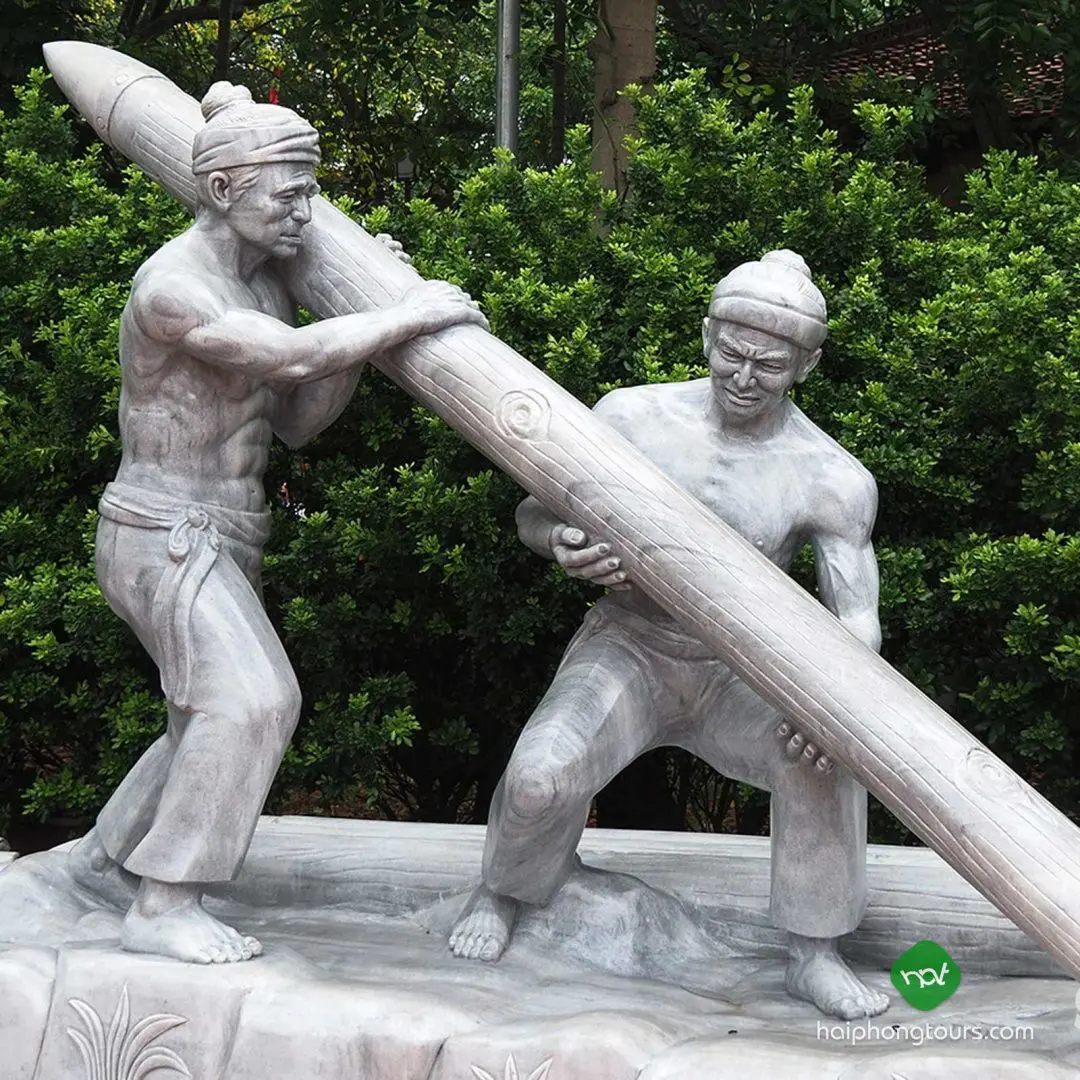
Bach Dang Museum provides context for the outdoor sites. Its subject is broader than a single battle: the collection includes Quang Yen’s development, archaeological material and later local history, alongside the Bach Dang victory. Look for the wooden stakes and their excavation provenance, then relate them to the map of the river system.
A useful visit focuses on three things: the shape of the waterways, an original object from a named excavation, and the explanation of the 1288 campaign. Read the label before assuming that a weapon, boat fragment or illustration belongs to the exact battlefield you will visit next. Models and reconstructions help explain an event; their function differs from that of an excavated object.
Allow about 45–60 minutes for a focused visit, longer with an interpreter. Confirm the gallery session before driving to Quang Yen, especially if this is the part you most want to see. The museum and outdoor relic sites do not necessarily share an opening schedule, and a temple being accessible does not mean the museum galleries are open.
Tran Hung Dao Temple and Vua Ba Shrine
The temple honors Tran Hung Dao, the commander associated with the Tran dynasty’s 1288 defeat of the Yuan-Mongol fleet. Its courtyard, worship spaces and commemorative setting show how a military leader became a continuing focus of local devotion. Leave room for people praying rather than treating the buildings solely as historical exhibits.
Vua Ba Shrine stands beside the temple. In local tradition, an elderly woman who sold tea helped Tran Hung Dao understand the tides and river conditions. Her shrine gives local knowledge a place in the story. Treat this as a remembered community tradition, distinct from the evidence supplied by excavated wooden stakes.
Spend time looking at the relationship between the two places: a nationally celebrated commander and a locally remembered woman. This makes the paired visit more meaningful than simply photographing two altars. Dress modestly, keep voices low and ask before photographing worshippers or ceremonies.

The nearby Ben Do Rung landing is another place of remembrance connected with the battle. Add it when your guide can explain the river setting; do not assume that an evocative landing name means there is an operating sightseeing boat or ferry.
Yen Giang Stake-yard: how to read a quiet archaeological site
Yen Giang lies in the Dam Nhu area near the mouth of the Chanh River, part of the Bach Dang waterway system. River deposition, dikes and later land use have changed the setting. What appears to be land or a contained wet area today should not be read as an unchanged view of the thirteenth-century river.
The visitor approach includes a road, an information stele and protective embankments. The attraction is the location and interpretation of the stake system, rather than a dramatic row of tall wooden spears rising from an open river. Preservation can require archaeological material to remain wet or covered; visible remains depend on the managed display conditions.
Use the interpretation to understand how stakes, natural obstacles, channels and tides worked together. Avoid imagining the whole battle as a single straight barrier at this small site. Yen Giang represents one part of a larger defensive landscape.
Stay on the visitor route and keep away from protected material and soft edges. The additional stake fields called Dong Van Muoi and Dong Ma Ngua are separate archaeological places. Add them only through a specifically arranged visit with clear access, rather than following a map pin into ponds, working land or a conservation area.
Its place in the UNESCO property
Yen Giang Stake-yard is a component of the Yen Tu–Vinh Nghiem–Con Son, Kiep Bac Complex of Monuments and Landscapes, inscribed in 2025. Its inclusion connects the military and riverine setting of the Tran period with the wider religious and cultural landscape.
This is a serial property with separate components, not a single enclosed attraction. Visiting Yen Giang does not require climbing Yen Tu Mountain, and it does not make every nearby building a separately inscribed component. The Yen Tu UNESCO route guide explains how the places fit into a longer journey.
Add Yen Giang communal house for living local heritage
Dinh Yen Giang, also known as An Hung Dinh, honors Tran Hung Dao as the village’s guardian. Its main interest is the continuing relationship between village life, worship and the Bach Dang story. The building has undergone repeated restoration, so do not approach every visible structure as surviving medieval architecture.
The communal house adds value when it is open and someone can interpret its role. If you are already short of time, prioritize the museum, temple pair and stake-yard. A fourth locked gate adds less to the day than understanding the first three stops properly.
A flexible half-day sequence
- Begin at the museum: use the collection and maps to establish the historical setting. If its confirmed session is later, reverse the order.
- Visit the temple and neighboring shrine: give them about 45–60 minutes together, allowing more time during a ceremony.
- Continue to Yen Giang: set aside around 30–45 minutes for the site and interpretation, without counting the drive between stops.
- Finish with lunch or the communal house: choose according to opening arrangements and your group’s interest.
These are planning allowances for a selective visit. A specialist archaeology discussion, a festival or a school group can change the pace. If you only have about 90 minutes on the ground, choose the temple pair and stake-yard with prior interpretation instead of rushing through the entire list.
Transport, admission and useful interpretation
A car with agreed waiting time is the simplest way to connect the scattered stops from Ha Long or Hai Phong. Compare the route from your actual hotel: being near an expressway does not make the heritage area a stop at the roadside. Agree on the site sequence, waiting time, tolls and final drop-off before setting out.
Contact the Yen Tu conservation center for heritage-site enquiries. Ask specifically for the Bach Dang sites in Quang Yen and the current local visitor contact. Confirm museum access separately, along with any guide, admission or parking charges relevant to your plan.
If English interpretation matters, arrange it in advance and specify the subject: the 1288 campaign, the changing estuary and the archaeological evidence. An English-speaking driver is not automatically a heritage interpreter. At the stake-yard especially, an explanation can add more value than another stop.
The sites are in a lowland setting, but thresholds, uneven outdoor surfaces and gallery stairs still matter. Travelers with limited mobility should establish the route from vehicle drop-off to the places they wish to see. In hot or wet weather, shorten exposed stops and keep the museum visit for a confirmed open session.
Festival day or an ordinary visit
The traditional Bach Dang festival falls in the third lunar month and brings processions, worship and community activities. Choose a festival visit when living religious culture is your main interest, and obtain that year’s programme before fixing transport. Expect a different pace and access pattern from a quiet weekday.
For a first historical visit, an ordinary day with the museum open and interpretation arranged is easier to follow. Quang Yen rewards a connected story: an object in the museum, the landscape that gives it meaning, and the community that continues to remember it.
Would you like help fitting this experience into your trip? Contact us with your travel dates, starting point, available time and group size. Tell us about walking limits or special interests so we can suggest a practical itinerary.