
San Diu Cultural Village is a land-based cultural stop in Van Don for travelers interested in local people, household traditions and folk singing. Its center is the traditional house and exhibition at Vong Tre, in the former Binh Dan area. It makes most sense as an arranged visit with someone who can explain the objects and introduce the community, rather than a quick photograph between boat connections.
The exhibition, a singing session, cake making and a meal are different experiences. Agree on the parts you want before setting out: a village visit does not automatically include performers, a workshop or an English-speaking host. Choose this stop when you have time on the Van Don side of Quang Ninh and want a cultural contrast to its beaches and islands.
Find the right village
Show your driver the name Làng Văn hóa – Du lịch dân tộc Sán Dìu, thôn Vòng Tre, Vân Đồn. Older listings may spell the hamlet Voòng Tre and place it in Binh Dan Commune, Van Don District. The cultural center is the destination to confirm, rather than any location returned by a broad search for “San Diu village.”
This is the community in Van Don, Quang Ninh. It is separate from the large Vietnam National Village for Ethnic Culture and Tourism near Hanoi. Use a meeting pin supplied by the local host and include the return ride in your transport arrangement.
Start with the traditional house
The visitor focus is a modern, two-story traditional house with five bays, containing objects and tools associated with San Diu life. The cultural tourism site opened in December 2024 around community facilities. Its value lies in the collection and the people interpreting it, rather than the age of the building itself.
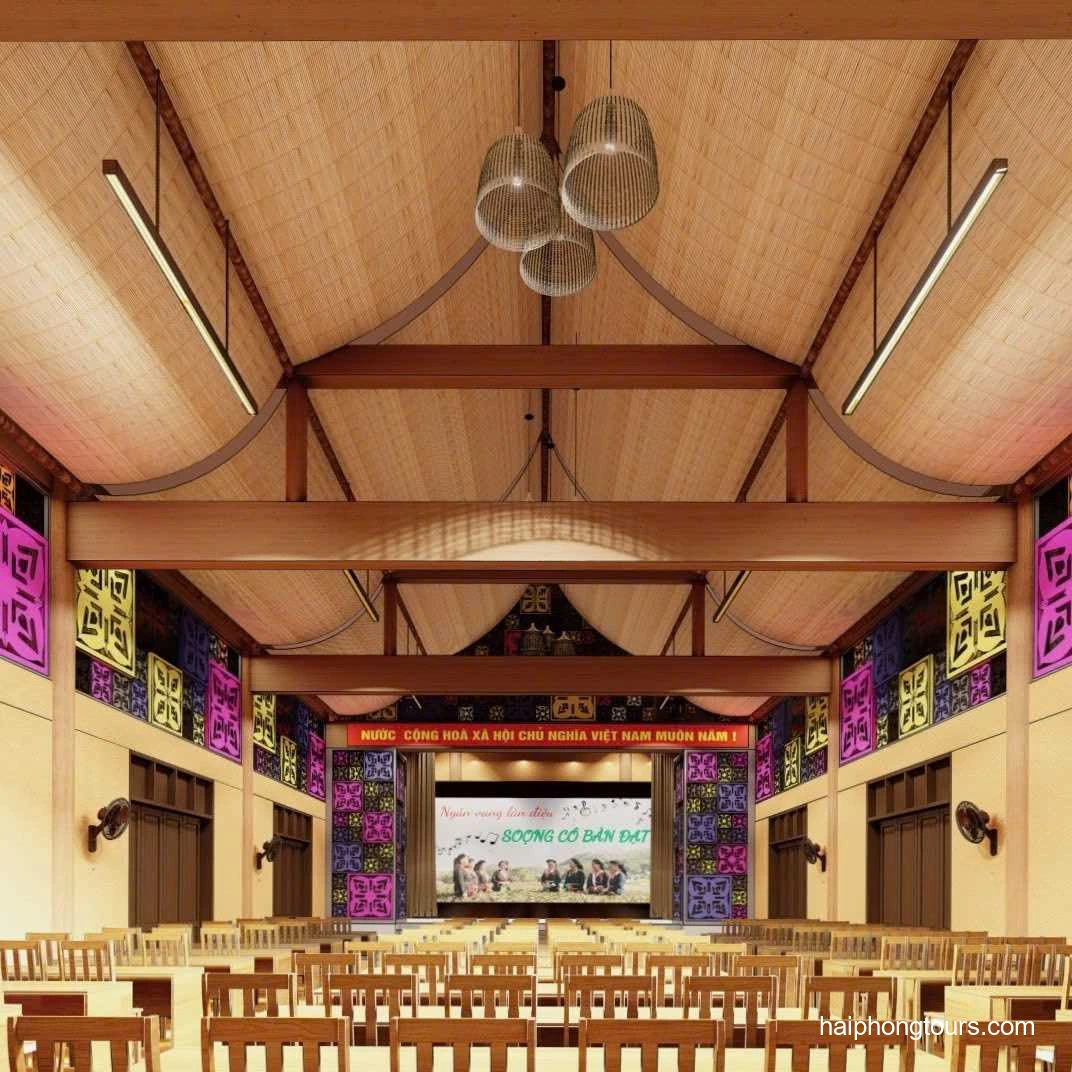
Look for the connections between everyday work, clothing, marriage and belief. A useful visit follows a few objects closely: ask who used each item, what it did and whether people still use it today. This makes household implements and ceremonial displays easier to understand than walking past them without explanation.
Arrange English interpretation if you want more than a visual look around. A driver who knows the location is not necessarily able to explain San Diu cultural terms. Ask who will accompany you through the exhibition and whether interpretation is included in the agreed cost.
Choose an activity with the community
Soong Co singing
Soọng Cô is a San Diu folk-singing tradition, including exchanges associated with courtship and community occasions. A hosted session can let you hear how singers respond to one another and learn the meaning of a short passage. Understanding the exchange is more rewarding than treating the song as background music.
If music is the reason for your visit, request a session specifically. Ask how long it lasts, whether a translation is possible and how the performers are paid. An ordinary exhibition visit should not be taken as a reservation for a singing group.
Cake making and a local meal
Traditional food experiences at the village include cakes known locally as bánh bạc đầu and bánh tày lồng. A session can focus on watching the method or joining the preparation, depending on what the host arranges. Confirm which format you are booking and whether ingredients, tasting or a meal are included.
Send dietary requirements before the host buys ingredients, and ask about fillings, cooking ingredients and shared utensils. For a meal, agree on the menu, number of people and total cost in advance.
Village activities and seasonal work
Community programs can include folk games and activities connected with farming or gathering local produce. These depend on the people available, season and conditions. Choose one activity you genuinely want to understand instead of asking for every advertised experience in the same short visit.
Hai Phong Tours recommends prioritizing time with a local host over adding another rushed stop. Pay for an agreed activity and interpretation, and let residents set the boundaries around homes, working fields and sacred spaces.
Plan the visit before arranging your driver
- Access: get confirmation that someone can receive you and open the exhibition at the agreed time.
- Program: specify exhibition, singing, food preparation or meal; ask which elements are actually available.
- Language: identify who will interpret in English, if required.
- Price: establish the total for your group and any separate activity, meal or guiding charge.
- Transport: agree on the exact entrance, driver waiting time and return pickup.
- Mobility: ask which exhibition areas require stairs and whether a suitable ground-floor visit is possible.
A Van Don accommodation or local guide can help contact the community and arrange these details in Vietnamese. For planning, leave roughly one to two hours for an explained exhibition visit and one short activity, excluding transport. Allow longer for a meal or a more involved workshop; this is a planning allowance, not a fixed tour duration.
A cultural stop alongside Van Don travel
If you are staying in Van Don, make the village your main cultural appointment and leave the rest of the day flexible. Cai Bau Pagoda and Cua Ong Temple offer a different focus on Buddhist and historical worship. Choose one compatible addition and ask the driver to price the complete route, rather than treating every place in Van Don as adjacent.
For an island trip, keep the village visit on a separate time allowance from your boat connection. The Quan Lan transport guide explains the distinction between the road journey to Ao Tien and the boat to your island pier. Do not turn a short interval before boarding into a village excursion.
Dai Phan festival and respectful participation
The San Diu community’s Đại Phan festival includes rituals expressing wishes for favorable weather, good harvests and well-being. It belongs to a specific community program, not an everyday attraction. For a festival-focused visit, obtain the dates and public viewing arrangements for that edition before making travel bookings.
Ask before photographing people, entering a home or recording singing. Follow the host around altars and ceremonial objects, and watch specialist ritual demonstrations from the designated spectator area. A respectful visit leaves room for explanation and conversation; it does not require residents to recreate a festival whenever visitors arrive.