
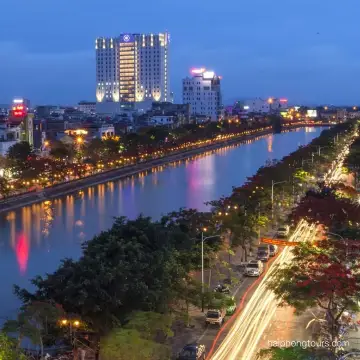
Tam Bac Lake is a landscaped public lake in central Hai Phong and works best as a 30- to 60-minute walk. Visit in the early morning or after the afternoon heat for a cooler promenade, local street life and views along the city’s historic central garden strip. You can walk beside the lake without buying an attraction ticket.
The lake lies in central Hong Bang Ward between Quang Trung and Nguyen Duc Canh streets. It is not the same as the longer Tam Bac River or the older riverside pedestrian street farther west. A useful first-time route begins near Tam Ky Temple at the Tran Nguyen Han end, follows the lakeside, and then continues from the Le Chan statue through the central gardens toward the flower kiosks and Hai Phong Opera House.
Tam Bac Lake visitor guide at a glance
- Best for: a short city walk, photography, gentle exercise and an introduction to central Hai Phong
- Time needed: about 30–45 minutes for a relaxed loop; allow 60–90 minutes if you continue through the gardens to the Opera House
- Best time: early morning or late afternoon; Friday and Saturday evenings are livelier during scheduled pedestrian-street events
- Admission: no ticket is required for the lakeside promenade
- Getting there: walking or a short taxi ride is simplest from the central hotel and railway-station area; traffic and parking arrangements can change during events
- Main limitation: this is an urban public space rather than a full-day attraction, and roads beside the lake remain busy outside temporary event closures
What to see around Tam Bac Lake
The lakeside promenade
Tam Bac Lake has a water surface of approximately 4.82 hectares and is commonly described as about 3 meters deep. Paved paths, benches and mature trees make the edge suitable for a gentle walk. The railing combines stone piers with decorative panels featuring flamboyant-flower and anchor motifs, references to Hai Phong’s red-flamboyant identity and port history.
Flamboyant trees add the strongest color in their usual late-spring and early-summer flowering season. Mature local si trees also remain part of the landscape. Shade is not continuous, so midday can feel exposed during hot or humid weather.
Tam Ky Temple
Tam Ky Temple stands near the Tran Nguyen Han end of the lake and is one of the area’s historic religious sites. It was recognized by the city as a historical and cultural relic in 2020. If the temple is open, dress respectfully, keep voices low and do not photograph worshippers without permission; public visiting times are not consistently posted.
Le Chan statue and the central gardens
At the end closest to the central gardens, the statue of General Le Chan marks the transition from the lake into Hai Phong’s long civic and garden strip. Le Chan is closely associated with the ancient An Bien settlement and the city’s early history. The surrounding open space is also used for festivals, exhibitions and public performances, so access routes may change during large events.
Flower kiosks and Hai Phong Opera House
Continue east through the gardens to see the traditional roofed flower kiosks known as Quan hoa, completed in 1944, and the exterior of Hai Phong Opera House. This extension makes the visit more rewarding for travelers interested in the city’s architecture. The Opera House is not a walk-in attraction on an ordinary day, so plan on viewing the exterior unless a public performance or event is advertised.
Do not plan your walk around Cho Sat, or Iron Market. The old market was cleared for redevelopment, and the site is not currently an operating traditional market or a sightseeing stop.
Current pedestrian street and night-food program
Hai Phong opened a central pedestrian and night-food space on 28 August 2026. It extends from the Quang Trung area in front of the Le Chan statue toward Tran Hung Dao and the Opera House, beside the city-center end of Tam Bac Lake rather than around the entire waterfront.
The initial program operates from 18:00 to 24:00 on Friday and Saturday evenings and is scheduled to run through 24 October 2026. It launched with nearly 30 food and local-product stalls. If you are visiting after that date, check the city’s current event notice before relying on the same hours or vendor lineup.
Outside the scheduled program, use the established cafes and restaurants around Quang Trung, Nguyen Duc Canh and the nearby central streets. Do not expect a permanent market of hundreds of stalls at the water’s edge. Depending on the vendors operating that evening, local foods may include banh da cua, nem cua be crab spring rolls, cha ruoi, banh cuon and tra cuc chrysanthemum tea; confirm the menu and price before ordering. If you see sui din, it is a sweet glutinous-rice dumpling dessert served in hot ginger syrup, not a sour soup.
How Tam Bac Lake was formed
The lake began as part of Liem Khe, a small waterway through the old An Bien–Gia Vien area that connected the Tam Bac and Cam rivers. In 1885, the French colonial administration straightened and enlarged it into the Bonnal Canal, approximately 2.8 kilometers long and 74 meters wide. The canal also formed a physical boundary between the colonial quarter and the Vietnamese and Chinese commercial neighborhoods.
In 1925, much of the canal between Hai Phong port and the area of today’s exhibition center was filled. The surviving section became popularly known as Song Lap, meaning the Filled River. In 1985, the city built the Tam Ky dam between Tran Nguyen Han and Quang Trung streets, converting this remaining reach into the present lake.
A simple walking route
- Start at Tam Ky Temple: view the Tran Nguyen Han end of the lake and visit quietly if the temple is open.
- Follow the promenade: notice the flamboyant and si trees, benches and port-themed railing details.
- Reach the Le Chan statue: pause at the open square and check whether a public event is taking place.
- Continue through the central gardens: finish at the flower kiosks and Opera House, or return around the opposite side of the lake.
The full route is mostly paved, but curbs and road crossings can make a completely step-free circuit difficult. Cross at designated points, keep children close beside active roads and carry water in warm weather. During heavy rain or thunderstorms, postpone the walk because the route is exposed and some surfaces may become slippery.
Frequently asked questions
Is Tam Bac Lake worth visiting?
Yes, if you want a calm, central walk that connects several Hai Phong landmarks. It is less suitable as a destination on its own for travelers looking for a full day of activities.
Is Tam Bac Lake the same as Tam Bac Walking Street?
No. Tam Bac Lake is the enclosed body of water between Quang Trung and Nguyen Duc Canh streets. The older Tam Bac riverside walking area follows the river farther west, while the pedestrian and night-food program launched in August 2026 occupies the central gardens beyond the Le Chan statue.
Can you eat beside Tam Bac Lake?
Food stalls operate during scheduled pedestrian-street programs near the Le Chan statue, and permanent cafes and restaurants are available on surrounding streets. The stall schedule is event-based, so it is safer to choose a specific restaurant if food is the main purpose of your visit.
Can you visit Tam Bac Lake at night?
Yes. The promenade and central gardens are popular in the evening, when the temperature is usually more comfortable and the city lights are on. Keep normal city precautions in mind, watch traffic at crossings and keep phones and bags secure.
Tam Bac Lake is most rewarding as one part of a wider central Hai Phong walk: begin with the lake’s layered history, continue past the Le Chan statue, and finish among the gardens and civic architecture near the Opera House. If you are going specifically for food or entertainment, confirm the current pedestrian-street program before setting out.