
Thanh Lieu is a woodblock-carving village in western Hai Phong, in the former Hai Duong area. Visit for the relationship between a carved wooden surface, printed paper and the people keeping this form of publishing alive. A worthwhile visit needs an appointment with an artisan; the village is not a drop-in museum with a guaranteed daily printing class.
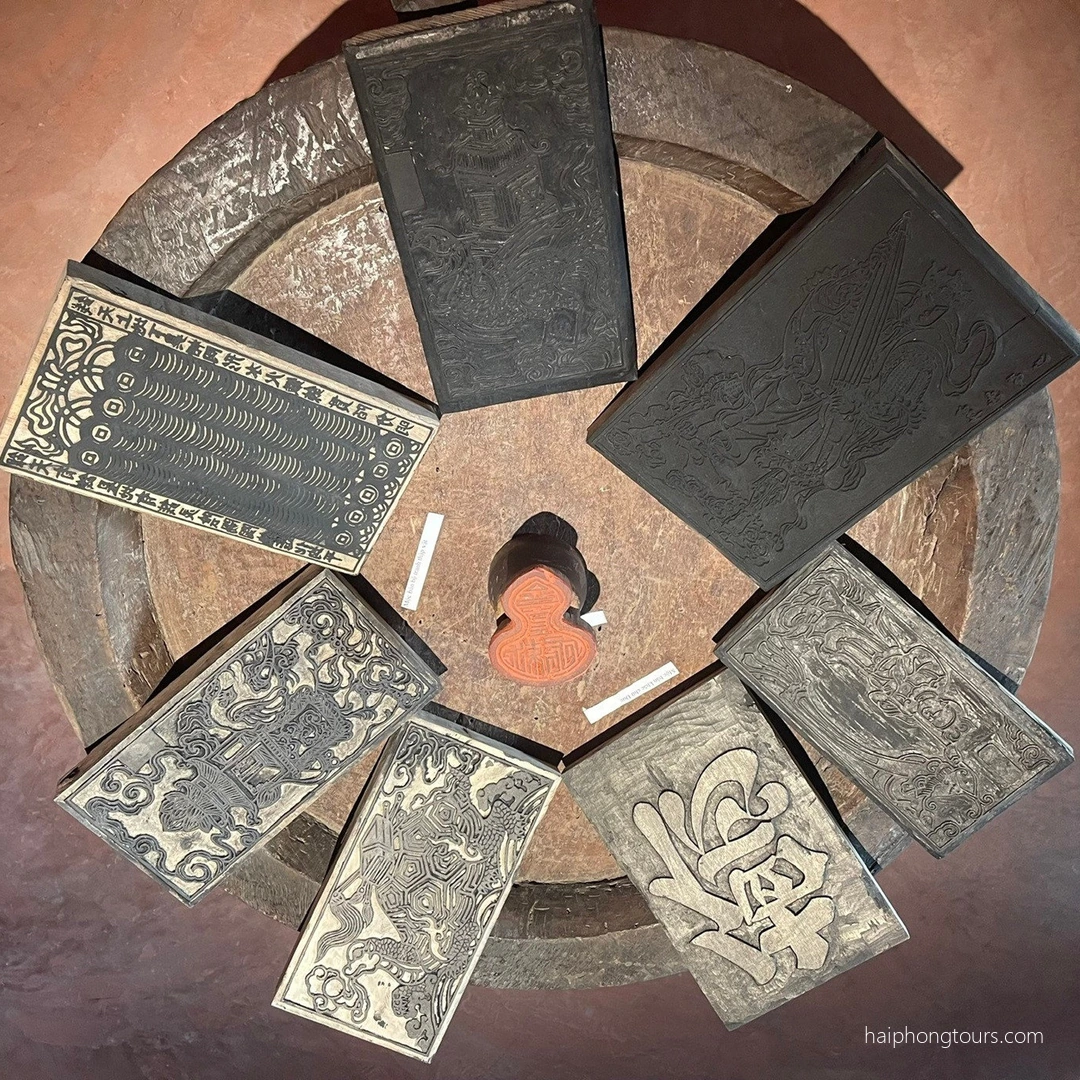
The strongest reason to go is an interest in printmaking, lettering or Vietnamese craft. Watching a skilled maker cut a fine line tells you something a finished picture cannot. If you mainly want a short activity for children, choose a confirmed printing session and establish what they can do before committing to the journey.
Find Thanh Lieu in the correct part of Hai Phong
The village is in Tan Hung ward, Hai Phong. Older addresses place it in Tan Hung ward, Hai Duong city and province. The useful Vietnamese destination is làng nghề khắc in mộc bản Thanh Liễu, phường Tân Hưng.
Keep the host’s name and exact meeting pin with that address. Hai Phong now covers a large area, and a village described as being in Hai Phong is not necessarily close to the Opera House or Cat Bi Airport. Ask your driver to calculate the journey from your accommodation to the actual workshop.
Thanh Lieu artisans also demonstrate their work at festivals, exhibitions and cultural venues elsewhere. A poster advertising their work in Hanoi or at Con Son–Kiep Bac does not give the location of a village appointment. Confirm where your session takes place before arranging transport.
What makes Thanh Lieu interesting
The craft’s history is associated with Luong Nhu Hoc, a fifteenth-century scholar and official honored as a founding figure of Vietnamese woodblock printing. The Thanh Lieu tradition extends beyond decorative pictures to books, religious texts and other written material. It offers a way to think about how knowledge circulated before modern printing.
Among its present-day practitioners are Nguyen Cong Trang and Nguyen Cong Dat, representing different generations of the craft. Their work includes contemporary images as well as the recovery of older designs and techniques. Ask which project is on the workbench that day: a current commission can provide a more revealing introduction than a general account of the village’s age.
Do not confuse an artisan’s new block with an antique from a temple collection. A new carving can demonstrate a historic technique without being an old object. This distinction matters both when listening to an explanation and when buying a piece.
Follow the journey from wood to paper
Start with the carved surface
Look at the relationship between the raised lines and the spaces cut away. With a relief-printing block, the remaining surface carries the ink. Letters must be arranged in reverse on the block to read correctly on paper. Ask the maker to show the same detail on a block and its print side by side.
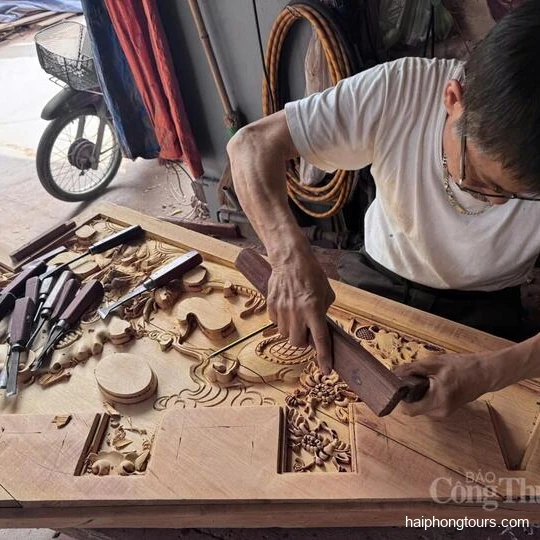
A characteristic tool is the dao ngang, a carving knife used for controlled cuts. Watching the hand position and the changing direction of a line is more informative than counting tools. Keep your hands clear while the artisan works and ask permission before moving a block or inspecting a blade.
Then watch the impression appear
Printing brings together the prepared block, ink, paper and pressure. Traditional do paper is used for this work. Small changes in how the paper is placed and rubbed can affect the clarity of the result; if the host has spare trial sheets, comparing them is a useful way to understand the skill involved.
Making a print from an existing block is a different activity from designing and carving a block yourself. For a first visit, a demonstration followed by a supervised impression is a sensible request. Detailed carving belongs to a longer learning process and should not be assumed to fit a brief tourist session.
Arrange the visit around a named host
Ask your accommodation or a local organizer to contact a Thanh Lieu practitioner, giving the village name and explaining that you want to learn about khắc in mộc bản. Request a named host and a confirmed meeting point. An art-sales page or cultural promotion project can be a starting point for an inquiry, but establish who will actually receive you in the village.

Hai Phong Tours recommends describing the experience you want before discussing the drive: seeing carving, trying a prepared printing block, and buying a finished work are three different requests. This helps the host prepare the right materials and keeps a visit from becoming only a shopping stop.
Agree on the following details together:
- The activity: observation, a guided printing attempt or a more specialized lesson.
- The timing: appointment length and whether the artisan is working in the village on your date.
- The explanation: who can interpret the process in English if you need it.
- The cost: the total for your party, materials and any print you may take home.
- Your group: children’s ages, seating needs and access from the vehicle to the work area.
Allow time for ink to dry and for your print to be protected before leaving. Ask the maker whether it should travel flat or rolled, and avoid folding it into a small bag. If ordering a custom image or inscription, approve the design, wording, dimensions and collection arrangement before work starts.
Build a focused Hai Duong-area outing
Keep the workshop appointment as the fixed point of your day. Arrange the return journey as well as the outward drive, and agree whether your car waits during the visit. For travelers arriving by train, the railway station is a separate transport step; organize the local journey to the host and leave a margin before your return departure.
Hai Phong Museum, Site 2, formerly Hai Duong Museum, is a useful alternative or companion stop for regional heritage. Its galleries add archaeological and ceramic context, while its craft activities require their own booking. A museum session is separate from a Thanh Lieu village visit.
Choose one substantial appointment and one optional stop, with road time between them. For a printmaking enthusiast, time to compare the block with its impression and talk to the maker is more valuable than a long list of nearby monuments. Confirm that exchange first, then build the rest of the day around it.
Useful guides for your trip
Would you like help fitting this experience into your trip? Contact us with your travel dates, starting point, available time and group size. Tell us about walking limits or special interests so we can suggest a practical itinerary.