
Thien Cung Cave, also called Heavenly Palace Cave, is a dry limestone cave on Dau Go Island in Halong Bay. You reach it by sightseeing boat, climb steps from the landing and walk through three chambers filled with rock columns, hanging formations and stone curtains. Choose a cruise itinerary that explicitly includes Thien Cung; many Halong day cruises visit Sung Sot Cave instead.
A four-hour cruise can combine Thien Cung with nearby Dau Go Cave and other stops on Route 1. Those four hours refer to the boat program, so allow additional time for travel to the port, boarding and your onward journey. The climb to the entrance also makes this a different outing from a boat-only sightseeing trip.
Thien Cung Cave at a glance
- Location: Dau Go Island, in the western part of Halong Bay.
- What you do: follow a walking route through three illuminated chambers; kayaking takes place elsewhere on the cruise itinerary.
- Walking: the route inside is about 190 meters long, with an additional stepped approach to an entrance roughly 20 meters above sea level.
- Time to allow: around 30–45 minutes inside is a practical estimate for a steady visit with photos. Your guide sets the actual time ashore, including the approach and return to the boat.
- Best fit: travelers interested in cave formations who can manage stairs and want a relatively short Halong sightseeing cruise.
What to look for inside the cave
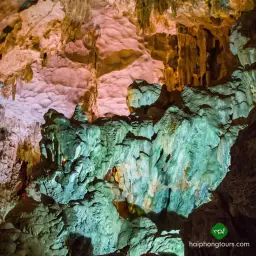
The narrow entrance opens into a much larger interior. Instead of trying to identify every named animal or mythical figure, look at how the shape of the rock changes between the chambers. Colored lighting emphasizes the formations; the blue, green and red effects are not the natural colors of the limestone.
The first chamber and Heaven Gate
The opening chamber introduces the cave’s dragon and phoenix imagery. One notable feature is a pair of opposing stone columns beneath a high arch, known as Cong Troi, or Heaven Gate. Pause where the path widens so you can see the arch without blocking people behind you.
The central chamber and four pillars
Four large pillars are the central chamber’s defining feature. Guides interpret their shapes as animals and vegetation, while smaller formations spread across the surrounding walls. Look upward as well as ahead: hanging clusters and folded stone curtains give this chamber much of its detail.
The final chamber and pools
The last chamber contains pools and formations associated with figures from local storytelling. The route then leads toward the exit and the path near Dau Go Cave. Check whether your cruise includes a separate visit to Dau Go before assuming you will enter both caves.
How the formations developed
Rainwater absorbs carbon dioxide and becomes mildly acidic. As it passes through cracks, it slowly dissolves limestone and helps enlarge underground spaces. When mineral-rich water enters a cave and releases carbon dioxide, it can deposit calcium carbonate again.
Stalactites grow downward from the ceiling, while stalagmites build upward from the floor. When they meet, they can form a column. Water spreading over a surface creates different shapes, including sheets and curtain-like folds. These processes explain why the cave contains more than rows of pointed hanging rocks.
Keep your hands off the formations, even when they are beside the path. Oils and dirt from touching can affect their surfaces, and broken pieces cannot be replaced within a visitor’s lifetime. Leave coins and other objects out of the pools.
The legend behind the Heavenly Palace name
A local legend connects the cave with a young woman named May, who grew up and married a dragon prince. Their wedding lasted seven days and nights, with mythical creatures gathering to celebrate. Guides use the surrounding rock shapes to bring the wedding scene to life.
The story also associates the pools with May bathing her children. Treat these names as folklore and imaginative interpretations of the formations; the chambers themselves were shaped by water and limestone over geological time.
How to book a cruise that visits Thien Cung
Thien Cung and Dau Go belong to Halong Bay’s VHL1 sightseeing route, commonly called Route 1. The route also includes scenery around Dog Islet, Ba Hang, Incense Burner Islet and Fighting Cock Islets. Boats on this route can depart from Tuan Chau or Halong International Cruise Port, so confirm your actual terminal before arranging a car.
The Hai Phong Tours private four-hour Halong Bay cruise lists both Thien Cung and Dau Go caves, with a kayaking or bamboo-boat activity at Ba Hang. The listed package includes an English-speaking guide, entrance fees and a meal. Road transfers are an additional service, so include your pickup location and return destination when requesting the total price.
If Thien Cung is your main reason for going, use the cave’s name in your booking request. A description such as “Halong day tour” or “six-hour cruise” does not establish which cave you will visit. Sung Sot is on a different sightseeing route, and a longer cruise does not automatically include Thien Cung as an extra stop.
Thien Cung, Dau Go and Thien Canh Son are different caves
Thien Cung and Dau Go are close neighbors on the same island, but they have separate entrances and visits. Dau Go has a broad, naturally lit entrance area, while Thien Cung’s narrow approach opens into chambers emphasized by artificial lighting. Thien Canh Son is a different cave in Bai Tu Long Bay; a booking that names it is not a booking for Thien Cung.
Entrance fees and visiting hours
The listed heritage admission fee for Route 1 is 250,000 VND per person per visit. This is the sightseeing admission component, not a complete boat tour price. Boat hire or a shared-cruise seat, terminal charges, meals, activities and road transfers must be checked separately unless your package explicitly includes them.
If you book a package with entrance fees included, ask the operator to confirm the inclusions before buying another ticket. For children or visitors eligible for concessions, provide the relevant age or eligibility details when requesting the quote.
The published visiting hours for Thien Cung and Dau Go are:
- April 16–October 31: 7:30 a.m.–5:30 p.m.
- November 1–April 15: 7:30 a.m.–5 p.m.
These are cave visiting hours, not a promise that a boat can depart at any point within that window. Your operator must fit the cave stop, other activities and return sailing into the permitted program. Weather restrictions can also affect departures, so keep a tight airport connection or other fixed onward booking out of the immediate return window.
Stairs, footwear and practical preparation
The visit is not step-free. Consider the boat’s boarding arrangement, the climb from the landing and the walk through the chambers when deciding whether it suits someone with limited mobility. Ask the operator about the actual route and assistance available; do not rely on the short distance inside as evidence that the whole visit will be easy.
If someone plans to skip the cave, arrange this with the operator before booking and confirm where they can wait safely. Keep children close on stairs, take your time on damp surfaces and choose shoes with grip rather than smooth soles.
Bring drinking water and keep your hands free for steps and handrails. During the visit, stay on the designated path, pause for photos where there is room and follow your guide’s return time. Thien Cung works well as the cave-focused part of a short cruise when the itinerary, walking requirements and complete transport plan are settled before departure.