
Thien Ton is a good short stop for travellers interested in the beliefs surrounding ancient Hoa Lu. Its main interest is the sanctuary within the mountain: a guardian deity framed by carved stone, Buddhist figures, inscriptions and ritual objects. A visit becomes much more rewarding when you distinguish those elements instead of treating everything inside as one collection of Buddha statues.
Use the current address and the right entrance
Use Chùa và Động Thiên Tôn, phường Hoa Lư, tỉnh Ninh Bình. Older material places it in Thiên Tôn town, and early-2025 reporting uses Ninh Mỹ ward. Ninh Mỹ subsequently became part of Hoa Lư ward under the 2025 administrative reorganisation.

The sanctuary is at Dũng Đương mountain, on the eastern approach to the old capital. It is a separate stop from the principal Dinh and Le royal temples. Give a driver the cave’s full name and entrance pin; a booking described simply as “Hoa Lu sightseeing” may be centred on those other monuments.
This is a land visit. You enter on foot, and a Trang An boat itinerary should not be assumed to include it. Allow 30–60 minutes at Thien Ton, with extra time if you have a guide explaining inscriptions. That is our suggested visit length, not a published opening session.
Read the cave from outside to inside
The traditional layout has an outer chamber, Hang Ngoài, and an inner chamber, Hang Trong. At the inner approach stands a long đình, a shrine structure made of stone and decorated with dragons and clouds. Within it, the bronze figure of Thiên Tôn stands on a turtle, holding a sword in front of the body.
Take in three elements in order: the natural rock around the sanctuary, the deliberately carved stone frame, and the figure placed within it. The frame creates a formal sacred setting inside an irregular cave. The sword and turtle help identify this particular deity, so they are useful details to look for before comparing the Buddhist images elsewhere in the complex.
A good photograph of the shrine should show the relationship between the frame and its surroundings. A tight image of the statue alone loses that setting. Remain outside altar boundaries, follow any photography restrictions and let people finish their prayers before standing in the main line of sight.
The complex also preserves 18 La Hán, or Arhat figures, and carved stone altar furnishings. Recorded motifs include paired dragons, phoenixes and floral decoration. Look for changes in pose and expression among the figures, then compare the more regular ornament on a ritual pedestal with the uneven natural wall behind it.
These objects are easiest to understand with selective interpretation. Ask a guide to identify the central deity and one Buddhist figure, then explain how both belong within the same sacred complex. That is more useful than assigning an unsupported age or identity to every object you pass.
The old bell and an inscription with a date
A notable bell is attributed to the Cảnh Hưng reign, 1740–1786. It has four striking bosses and is described in local reporting as producing different tones. The date range refers to a reign, not a verified single casting year. Observe its form and decoration; ringing it is a matter for the custodian, not an included visitor demonstration.
For a more precise historical marker, Ninh Binh’s culture authority records a ma nhai, an inscription cut directly into the rock, dated 1375, the third Long Khánh year under Trần Duệ Tông. The same heritage account identifies Thien Ton’s earlier role as a Taoist sanctuary for Trấn Vũ and records national heritage recognition in 1962.
The inscription gives you a concrete question for a guide: which writing belongs to that dated record, and what does it commemorate? A dated text anchors one layer of the site. It does not establish that every statue, altar or architectural repair is from the same period. Read or photograph inscriptions from the visitor route without rubbing, tracing or touching their surfaces.
Why Thien Ton guards the east
In Hoa Lu’s guardian tradition, Thiên Tôn protects the eastern approach. The other directions are associated with Cao Sơn to the west, Đức Thánh Nguyễn to the north and Quý Minh to the south. This sacred geography helps explain why shrines appear around the capital’s wider landscape rather than only inside the royal temple grounds.
Local tradition connects Đinh Bộ Lĩnh with the cave: before defeating rival warlords, he is said to have sought the deity’s protection. Accounts also associate the area with an outpost and the reception of foreign envoys before their entry to the capital. Treat the prayer story as religious tradition, while considering how the location served the idea of a protected approach to the court.
That makes a paired visit to the royal temples coherent. At Thien Ton, concentrate on guardian worship and the cave setting. At the main Hoa Lu monuments, turn to the rulers and the history of the capital. You will get more from two distinct themes than from asking each site to tell the entire story.
Interpretation and the annual festival
A QR interpretation point was installed outside the complex in October 2024. Look for the panel on arrival and use it if available. For detailed explanation in English, arrange a guide when booking the day; the existence of a QR panel does not establish a staffed English-language service.
The tourism authority gives the annual festival as the 6th–8th days of the third lunar month. Those dates move within the Gregorian calendar, and the annual programme determines the actual ceremonies. Choose a festival day for community worship, or an ordinary day if close study of the objects is your priority.
Wear clothing covering shoulders and knees. Keep conversations quiet around prayer, and follow the custodian’s directions about footwear and photographs. Natural rock and paving can create changes of level; shoes with grip are preferable, particularly in damp conditions. Anyone needing a route without steps should establish the approach and cave thresholds before travelling.
Opening information, fees and contacts
We have not verified a current official daily opening schedule or admission tariff for Thien Ton. Arrange daylight access through your host or guide before making a special journey. Treat any parking charge, donation and admission fee as separate items, and obtain the amount at the site rather than borrowing a tariff from another Hoa Lu attraction.
For visitor information, the Ninh Binh Tourism Information and Promotion Centre lists 1900 0117, +84 229 388 4101 and xuctiendulichninhbinh@gmail.com. The office is at 77 Lương Thế Vinh, Hoa Lư ward, Ninh Bình. These are provincial information contacts, not a direct temple reservation line. Use the office number or email when the domestic hotline cannot be reached from your phone.
A focused half-day with ancient Hoa Lu
A practical sequence from central Ninh Binh is Thien Ton first, then the Dinh and Le royal temples, followed by lunch. Budget 30–60 minutes for the cave sanctuary and roughly 60–90 minutes for the principal temple visit, adding road travel and any guiding separately. These are planning allowances, so keep the return time flexible if your group wants longer explanations.
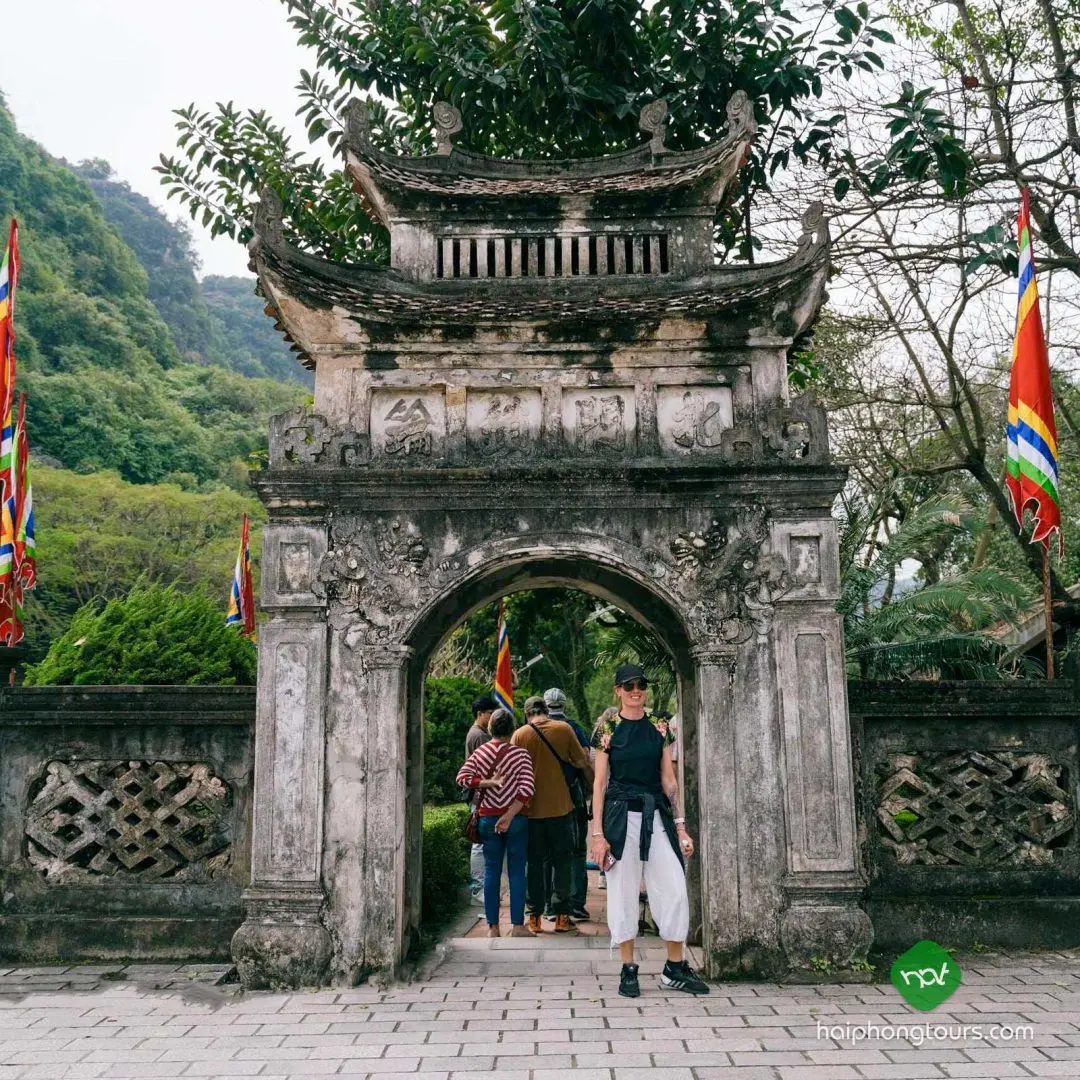
The province’s 2026 price table lists admission to the main Hoa Lu ancient-capital site at 20,000 VND per adult and 10,000 VND for children aged 6–15. Its listed contact is +84 229 362 0099. That price and phone belong to the ancient-capital visitor site; they do not establish Thien Ton’s admission arrangements.
Read our Hoa Lu Ancient Capital guide for that part of the day. For an itinerary with Thien Ton explicitly included, send Haiphong Tours your date, hotel, group size and whether you need historical interpretation in English. We can build the route around those requirements and quote transport and guiding separately.