
Thuy Duong, now in Thuy Nguyen Ward, Hai Phong, is known for square banh chung made with sticky rice, mung beans and pork. The useful visitor experience is a purchase from an identified maker, with a short look at preparation if the family can receive you. Tet brings the largest orders, while some producers also work throughout the year.
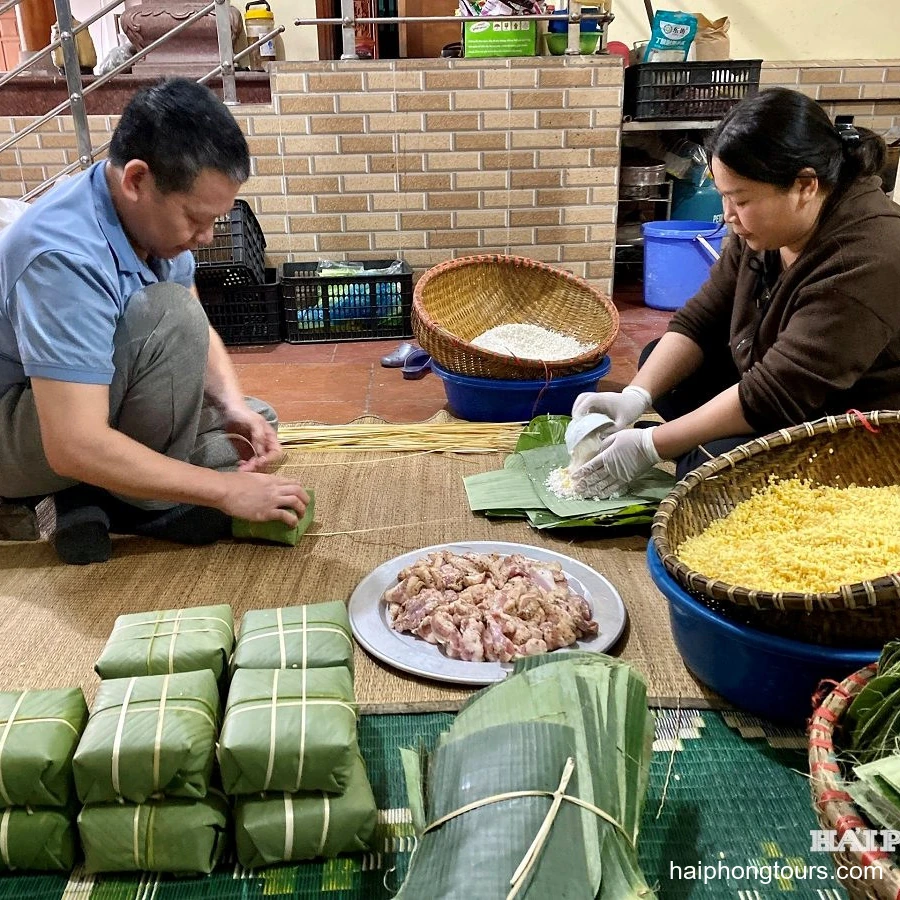
Finding the craft neighborhood
Use the name bánh chưng Thủy Đường and the current locality phường Thủy Nguyên, Hải Phòng. Older reports and business descriptions say Thuy Duong Commune, Thuy Nguyen District. Recent local reporting identifies cake-making households in Bấc 2, so that neighborhood name can help when discussing a producer with a Vietnamese-speaking driver or host.
There is no verified central visitor reception desk or common opening timetable. Hai Phong’s official tourism portal lists 0945 132 599 as its city tourism hotline. It is an information contact, not a cake seller’s order line. For an arranged visit, obtain the actual family’s name and house pin before setting out.
What makes this a substantial savory cake
The rice forms the outer body of the cake, with mung beans and pork inside. A February 2026 report describes local makers choosing nep cai hoa vang sticky rice, peeled mung beans, fresh pork, pepper and salt. The finished slice combines dense, sticky rice with a softer bean layer and richer meat filling. It works as part of a meal or as a shared tasting.
The wrapper is also part of the craft. A local photo report documents both dong leaves and additional banana leaves at some households, as well as pork seasoned with fish sauce and pepper. Recipes differ, so a green wrapper does not identify a meat-free product. Anyone avoiding pork, fish or another ingredient should discuss the complete recipe before ordering.
For your first taste, ask whether one cooked cake can be cut and shared. Looking at a cross-section is useful: you can see how the rice and filling are distributed, rather than judging only the neatness of the outside. Arrange plates and utensils with the seller or your accommodation; a production kitchen may simply hand over a wrapped cake.
Four stages worth watching
| Stage | What to observe |
|---|---|
| Preparing the leaves | The maker selects, washes and arranges the leaves before the rice goes in. Watch how overlapping layers create a wrapper large enough for the parcel. |
| Measuring the filling | Rice, beans and meat are portioned for a particular cake size. Ask to see the intended size before choosing how many to buy. |
| Folding and tying | Experienced Thuy Duong wrappers shape square cakes by hand without a mold. The folds and ties must hold the parcel through cooking. |
| Cooking and pressing | Boiling is followed by draining and pressing. These are separate stages from wrapping, so an uncooked cake you see being made will not be a quick takeaway. |
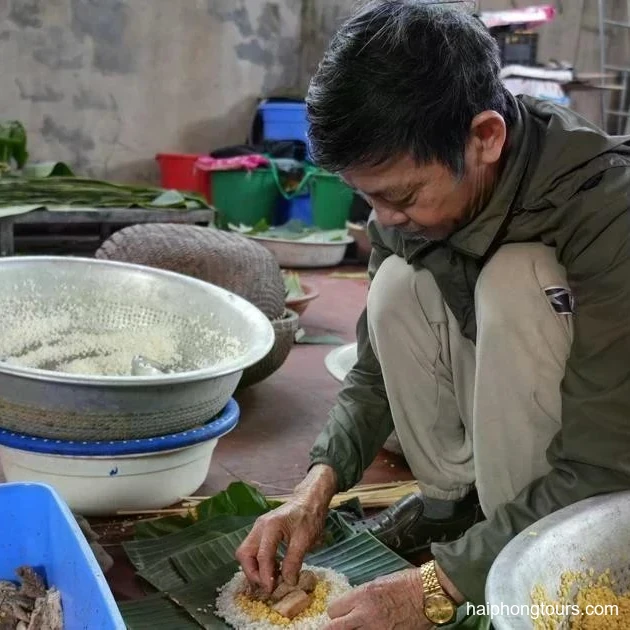
Modern equipment also belongs to the story. Agricultural reporting describes electric cooking alongside the handwork. If you watch wrapping and want a cake to eat that day, order a cooked one separately; the parcel on the workbench is still at an earlier stage.
A useful short appointment concentrates on whichever stage is actually running. Keep clear of the pots and leave food handling to the maker unless participation has been agreed. Watching skilled hands form one complete parcel often explains more than walking through several busy kitchens.
When to come: Tet and ordinary orders
Tet production is lively because the cakes serve family meals, gifts and holiday traditions. Order capacity can fill before the final days: a January 2026 report described one producer accepting holiday orders only through the 25th day of the twelfth lunar month. This was that household’s cutoff, not a village-wide closing date.
There is also evidence of work outside the holiday. In February 2026, maker Nguyen Tat Lo described ordinary-day orders and additional demand on the first and fifteenth lunar days. This supports asking about a batch during the rest of the year, while giving no guarantee that every family has cakes ready each morning.
If you want a practical lesson, make that a separate request. Company-organized cake-making activities were reported around Tet 2026, but no standing tourist class with a published price was verified. A family receiving an observer is not automatically offering ingredients, instruction and a cake to take home.

Price, size and a clear order
The report published on 23 January 2026 gave a seasonal reference of VND 80,000–120,000 per cake. It did not specify a standard weight. Treat this as context from that Tet season, not a current quote for a particular seller or a fixed price per kilogram.
Request the weight, filling and price for the same item. The phrase “Bánh này bao nhiêu gam?” means “How many grams is this cake?” For freshness, “Bánh được luộc hôm nào?” asks which day it was cooked. Record the quantity and collection time with the maker so an order for two cakes is not confused with two gift sets.
For a larger gift order, distinguish the cake price from boxes, labels and delivery. Ask for the producer’s contact on the package and instructions the recipient can understand. Avoid buying more than you can use simply because a larger order appears cheaper per piece.
Eating and carrying the cakes
Plan where you will eat or refrigerate your purchase before collecting it. Vietnam’s Food Safety Authority advises refrigerated storage in hot weather, cutting only the portion needed and covering the remainder. Chilled banh chung can be reheated by steaming or boiling. Follow the maker’s instructions for the specific product rather than assigning every cake the same shelf life.
Vacuum packaging alone does not establish safe storage for a long journey. The authority’s advice on handmade vacuum-packed foods stresses production-date information and rejects swollen packaging, slime, mold or unusual odors. A cake that looks normal still needs appropriate handling. For a trip involving several hotels, eating it locally is simpler than carrying it between unrefrigerated bags and vehicles.
A practical food-and-heritage outing
Allow roughly 45–60 minutes with an agreed producer for an explanation and purchase. If pairing the visit with Kien Bai Communal House, plan the heritage stop before collecting food, unless the producer’s working time requires another order. Keep the cake pickup near your return to a meal or suitable storage.
Want to include Thuy Duong in a Hai Phong visit? Contact Hai Phong Tours with your date, starting point, group size and dietary requirements. Tell us whether you want to buy cakes, watch wrapping or request a separately arranged activity, so the itinerary matches the host’s capacity.