
Tien La Temple is a worthwhile stop for travelers interested in Vietnam’s living religious traditions and the craftsmanship of its shrines. Its distinctive feature is the stone Middle Hall, set between timber buildings in a temple dedicated to the female commander Vu Thi Thuc. Come on an ordinary day to look closely at the architecture; choose the third lunar month if the festival itself is your reason for traveling.
The temple stands in Tien La village, Tien La commune, Hung Yen province, in the area formerly called Doan Hung commune, Hung Ha district, Thai Binh province. Allow roughly an hour to an hour and a half for a considered visit, excluding the drive. This is a planning allowance for the grounds and accessible halls, rather than a scheduled guided tour.
Find the right Tien La Temple
Give your driver the name Đền Tiên La, thờ Bát Nạn tướng quân Vũ Thị Thục, together with both the current and former address. The temple occupies Kim Quy mound beside the Tien Hung River. Keeping the deity’s name with the destination is more useful than relying on the temple name alone.
Arrange the outward journey and return collection together. For a countryside heritage day, have the driver check the actual temple entrance, waiting place and road connections between your chosen stops before agreeing on the itinerary. A booking to a city center does not settle the final journey to the temple.

For help reaching the management, contact the commune office. Request a referral to Tien La Temple and explain whether you need an architectural visit, an interpreter or information about a particular ceremony. This is a local-government inquiry route, not a temple ticket office; arrange any guided visit with the person or organization that will actually receive you.
Who is worshipped here
Vu Thi Thuc, also called Thuc Nuong and Bat Nan General, is honored as a female military leader associated with the Trung Sisters’ uprising. Worshippers also address her as a protective Mother figure. Understanding that combination helps explain why a site associated with a commander remains an active place for prayers, offerings and devotional visits.
Local legends describe her arrival in the area, resistance and final sacrifice. Treat these stories as part of the temple’s religious memory rather than as a literal account of everything visible in the buildings. The complex has undergone repeated repairs; the antiquity of the figure being honored does not make every roof, carving or altar equally old.
Look closely at the change from wood to stone
Follow the main approach through the gateways and courtyard toward the sequence of front, middle and rear halls. Instead of photographing only the facade, compare the structures as you move inward. The change of material is the clearest way to appreciate what makes this temple distinctive.
The timber Front Hall
The five-bay Front Hall, or Tien Te, has a wooden structure with carvings of dragons, kylins, turtles and phoenixes, together with familiar plant motifs. Look at how the carving follows the supporting timber rather than searching for a single isolated ornament. A guide can help identify the motifs without interrupting the worship taking place below them.
The stone Middle Hall
The Trung Te is a square hall with a layered roof and stone structural members, including columns and beams. This is the section to spend time studying: notice how stone performs work that timber commonly does in a traditional temple. It is the Middle Hall’s construction that is distinctive, not a claim that the entire complex is made of stone.
The rear sanctuary
The three-bay rear sanctuary returns to a wooden structure and centers on the worship of Vu Thi Thuc, with her parents also honored. View it from the areas open to visitors and follow the caretaker’s direction. A shrine’s religious significance is not an invitation to enter behind an altar or handle an object.
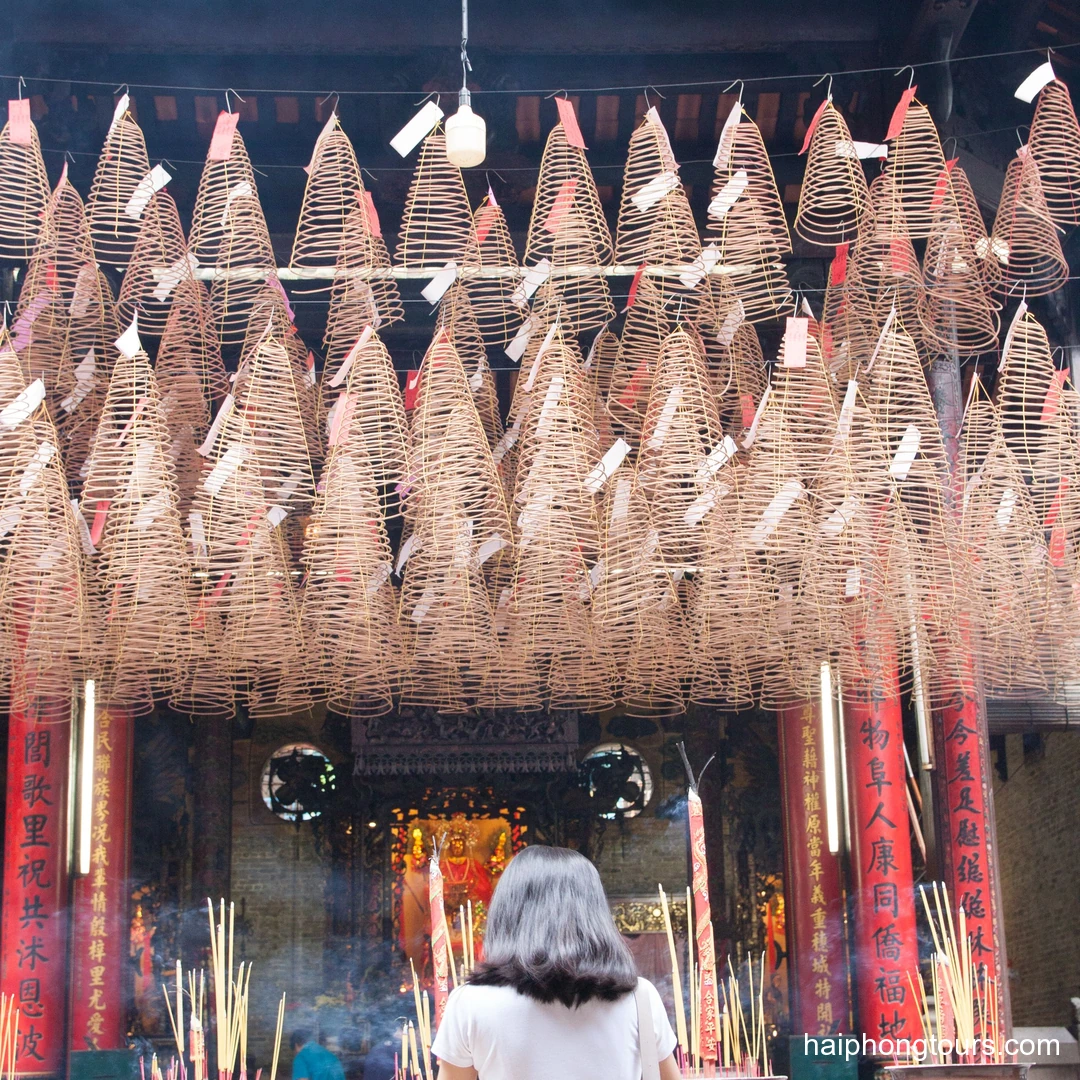
Give the roof structures and changing sightlines some attention before taking more photographs. For interpretation, a useful request is to have someone explain the relationship between the halls and the main deity, rather than simply listing dates. If you need English, arrange it in advance instead of assuming an English-speaking guide will be waiting at the gate.
An ordinary visit or the third-lunar-month festival
The main annual commemoration falls on the 17th day of the third lunar month, with festivities taking place around it. Lunar dates move against the international calendar, and the full program can extend across several days. Get the program for your actual travel year before booking transport around a procession.
The water procession connects the temple’s worship with the importance of water to agricultural life. Festival activities can also include rice-cake pounding and traditional games. These belong to particular programmed occasions; an ordinary afternoon visit is an opportunity to see the temple and its worship, not a guaranteed performance.
Choose a non-festival day if your priority is examining the halls at your own pace. Choose the festival if you want to observe communal worship and can allow extra time for crowds and road management. Agree on a recognizable collection point with your driver before separating, and avoid building a festival day around several tightly timed appointments.
Make the visit comfortable and respectful
A morning or mid-afternoon arrival leaves room to adjust to a ceremony or a temporarily closed hall. Confirm access before a long dedicated journey, especially if seeing the interior is essential to you. For a group, clarify any admission arrangements, interpretation charge and vehicle parking separately; offerings or donations should not be confused with a quoted guiding service.
Wear clothing suitable for a place of worship and keep the central approach clear when people are praying. Ask before photographing worshippers or ceremonies. Travelers who need a route without steps should check the actual entrance and hall thresholds with management, rather than treating a courtyard photograph as an accessibility guarantee.

Choose one useful contrast for the same heritage day
The Tran royal tombs at Long Hung provide a different focus on dynastic commemoration and the royal burial landscape. Pair them with Tien La if you want to explore different ways that history and worship meet. Have your driver work out the road connection and leave enough time for interpretation at both.
For a stronger architectural comparison, Keo Pagoda in Vu Tien shifts the emphasis to a Buddhist complex and timber construction. It is a separate journey, so choose it because that contrast interests you, rather than adding every temple in the former Thai Binh area. Tien La is most rewarding when you give its stone hall and living devotional setting time to make sense together.
Would you like help fitting this experience into your trip? Contact us with your travel dates, starting point, available time and group size. Tell us about walking limits or special interests so we can suggest a practical itinerary.