
Tra Phuong Pagoda is worth a detour from Hai Phong if you enjoy Vietnamese sculpture, royal history and small places of worship. Its main draw is a pair of sixteenth-century stone portraits: Emperor Mac Dang Dung and Empress Dowager Vu Thi Ngoc Toan, both recognized as national treasures.
Plan this as a focused cultural stop, preferably paired with the Mac Dynasty Memorial, rather than a full day at one attraction. Allow roughly 30–45 minutes at the pagoda as a planning estimate, plus road travel, and confirm access to the worship hall before making a special journey to see the statues.
Find the correct Tra Phuong Pagoda
Save the destination as Chùa Trà Phương, thôn Trà Phương, xã Kiến Thụy, Hải Phòng. Older listings use Thuy Huong commune in the former Kien Thuy district; they refer to the same village. The pagoda is around 20 kilometers from central Hai Phong, depending on your starting point and route.
You may also see the names Thiên Phúc Tự and Chùa Bà Đanh. Neither is unique to this location. Give your driver the full Tra Phuong name and a saved map pin, rather than asking only for “Ba Danh Pagoda” or “Thien Phuc.”
For a first visit, arrange a taxi or car with waiting time and the return trip agreed in advance. Check the road estimate from your own hotel; a distance from “Hai Phong” is not useful if it starts from a different part of the expanded city. Leave room for village approaches and finding the entrance instead of treating the navigation estimate as a guaranteed arrival time.
What makes the two stone portraits special
Mac Dang Dung: an emperor shown as a Buddhist devotee
The seated figure of Mac Dang Dung combines religious devotion with royal identity. Look at the meditation posture, then the hat and the dragon motif on the chest. Those details explain why this is more than a generic Buddha statue.
The portrait has a distinctly human face and compact proportions. The carving does not depend on the scale or brilliant gilding of a large modern temple statue. Give yourself time to look at the expression, the folds of the clothing and the relationship between the face and headdress, from the position where visitors are permitted to stand.
Vu Thi Ngoc Toan: a royal patron with a village connection
Vu Thi Ngoc Toan came from Tra Phuong and supported the pagoda. Her stone portrait is a relief carved into a recessed panel, which makes a useful contrast with the emperor’s figure carved in the round. Look for the seated pose and the leaf-shaped frame around her.
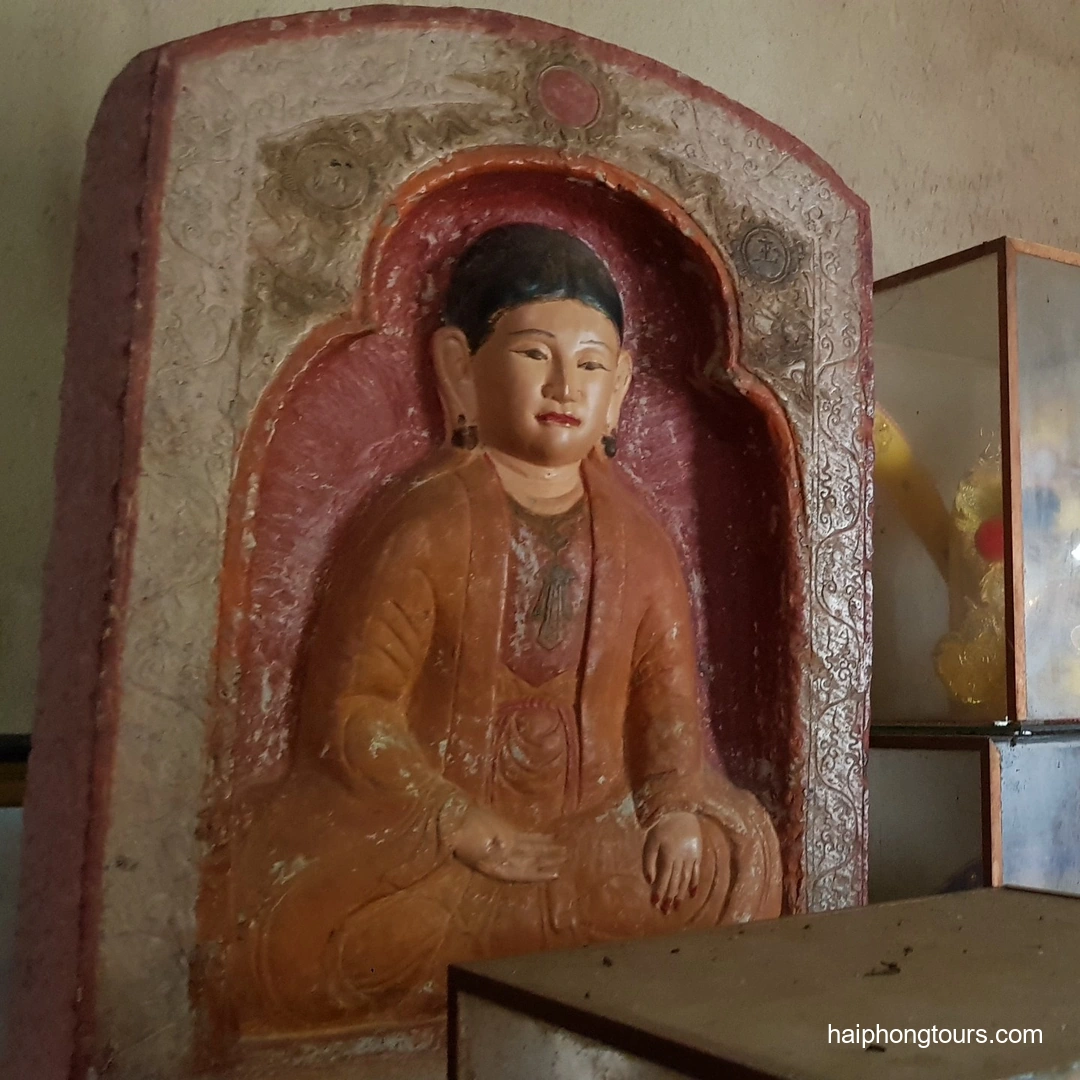
Her importance here extends beyond being the emperor’s wife. Stone inscriptions record gifts of land and support for Buddhist institutions. Understanding that role turns the visit from a quick look at two old objects into a story about how royal patronage sustained a village’s religious life.
Both portraits date to the Mac period and received national-treasure recognition in 2020. Their value lies in the surviving original sculpture; the buildings around them have been rebuilt and repaired at different times. A traditional roof does not mean that the whole structure is an untouched sixteenth-century building.
How to visit without missing the main reason to come
Start by asking the person looking after the pagoda which halls are open and whether visitors can see the two portraits. This is an active place of worship, so access to an inner area can depend on what is happening that day. Choose daylight and avoid making a late-afternoon arrival your only chance to visit.
If you are arranging an English-speaking guide, mention the two stone portraits specifically. Ask for an explanation of the difference between a statue and a relief, the royal clothing, and Vu Thi Ngoc Toan’s support for the pagoda. A short explanation of those details is more useful here than a long list of dynasty dates.
- Dress: cover shoulders and knees, and follow instructions about removing shoes before entering worship spaces.
- Photography: ask before photographing inside or taking close views of the treasures. Keep flash off and avoid photographing worshippers without permission.
- Conservation: do not touch carved surfaces, move offerings or step onto an altar platform for a better angle.
- Access: expect changes of level and raised thresholds around the halls. If a step-free route is essential, have your hotel or guide confirm the exact approach to the portraits before arranging transport.
- Costs: check any current admission or parking charge when arranging the visit. Keep voluntary offerings separate from agreed transport and guiding costs.
A useful message to show a local helper is: “Chúng tôi muốn tham quan chùa Trà Phương và xem hai bảo vật quốc gia. Hôm nay có thể vào thăm lúc nào?” It asks when you can visit the pagoda and see its two national treasures.
Pair the pagoda with the Mac Dynasty Memorial
The most coherent second stop is the Mac Dynasty Memorial in Kien Hung. The memorial explains the dynasty’s connection with its homeland through a larger commemorative setting; Tra Phuong offers a more intimate encounter with surviving period sculpture.

The two locations belong to the wider Mac heritage landscape of Duong Kinh. They are separate destinations, so send both pins when booking a car. Do not assume that entry to one means the other will be open or that the same person can guide both.
Hai Phong Tours recommends letting access to the portraits determine the order of this outing. If a custodian can receive you at a particular time, build the drive and the memorial stop around that arrangement. For two sites, leave a half-day in your plan rather than squeezing them between fixed transport departures.
If you would prefer a different royal story, Mo Temple and Pagoda in Nghi Duong is associated with Princess Quynh Tran. Choose it as an alternative second stop when that subject interests you; adding every nearby religious site can leave too little time to understand any of them.
Who should make the detour
Tra Phuong is a good match for travelers who enjoy examining small historical objects, asking questions and slowing down in a living religious setting. Children may engage with identifying the dragon, the headdress and the different carving styles, provided they are comfortable keeping quiet and leaving the objects untouched.
If you have only a short gap in the city or want a visit with predictable tourist facilities and interpretation on arrival, keep your plan closer to your accommodation. The Hai Phong travel guide helps you choose between central landmarks and a separate countryside outing. For Tra Phuong, the essential preparation is simple: confirm the hall can be visited, save the correct village pin and arrange your ride back.
Useful guides for your trip
Would you like help fitting this experience into your trip? Contact us with your travel dates, starting point, available time and group size. Tell us about walking limits or special interests so we can suggest a practical itinerary.