
Dai Nghiep is a woodworking village south of central Hanoi where a visit can focus on carved furniture, relief panels and furnishings for ancestor worship. The most rewarding plan is a prearranged meeting at a workshop whose work interests you, followed by a short village walk. Large decorative pieces are a particular reason to come: close inspection reveals depth, construction and finishing that a catalog photograph can conceal.
Location and the names to use
The current address is Dai Nghiep Village, Chuyen My Commune, Hanoi. Older workshop listings say Tan Dan Commune, Phu Xuyen District. Save both the village’s Vietnamese name, Đại Nghiệp, and your host’s location pin. An address that names the whole village is a starting point for arranging a visit, not a precise drop-off point.
Travel with a driver who can wait while you visit. Set the meeting at the maker’s premises rather than beside a general village sign, particularly if you are carrying samples or discussing a delivery. Reserve the morning or afternoon for Dai Nghiep; road time should be calculated from your actual Hanoi accommodation.

From Tre village to Dai Nghiep
The village was formerly called Tre and took the administrative name Dai Nghiep in 1948. In a field report, a member of its craft club traced woodworking to the eighteenth century using local accounts and verse. That is a community account of the craft’s origins, rather than a documented founding day.
The same reporting describes work divided across specialist activities, including sanding and spray finishing. This matters when planning: the place displaying a finished cabinet may not be the place where its carving or finishing happens. Request the stage you want to understand so your host can select the appropriate workspace.
Recognize the main types of woodwork
The district’s craft-tourism account highlights elaborate relief pictures, ceremonial furniture, ornamental creatures and standing clocks. Useful distinctions include:
| Vietnamese term | What you are looking at | A detail worth examining |
|---|---|---|
| Tranh go | A picture or relief made in wood | How foreground figures stand out from the background, and how the frame joins the panel. |
| Tu che | A traditional household display cabinet | The relationship between storage, display surfaces and carved decoration. |
| Sap | A substantial raised wooden platform | The top, supporting structure and the space needed to use it. |
| Sap tho or ban tho | Furniture made for worship | The intended ceremonial use, proportions and decorative program. |
A worship furnishing is not simply a large decorative table. Describe its intended use when discussing a commission, particularly when measurements and inscriptions matter to the family receiving it.
A direct workshop contact and a published price
Tranh Mai Huong identifies its wood-picture production base in Dai Nghiep. Contact 0968 911 950 by phone or Zalo, or +84 968 911 950 from abroad. Its address uses the older Tan Dan, Phu Xuyen wording. The business also handles other craft materials at other locations, so specify the Dai Nghiep wood workshop.
For a concrete price reference, its A9906 Phu Dung Cong carved panel was listed at VND 46,000,000 per piece in November 2026, described as gỗ gõ đỏ wood with a PU finish. Obtain a fresh quotation for the selected design, timber, dimensions and frame. A listing price does not establish that the photographed piece is available to inspect on your visit.
Arrange the meeting before traveling. There is no verified public demonstration timetable or village-wide visitor ticket in the sources checked for this guide. Include interpretation and any host fee in the appointment rather than assuming a sales inquiry includes a guided workshop session.
How to look closely at a carved panel
Begin several steps away to read the overall composition. Then move sideways: raised fish, feathers or leaves create changing shadows, which make the depth easier to see. Finally, examine one small section close up with the owner’s permission. A broad impression of intricacy is less useful than understanding how an individual branch or tail was formed.
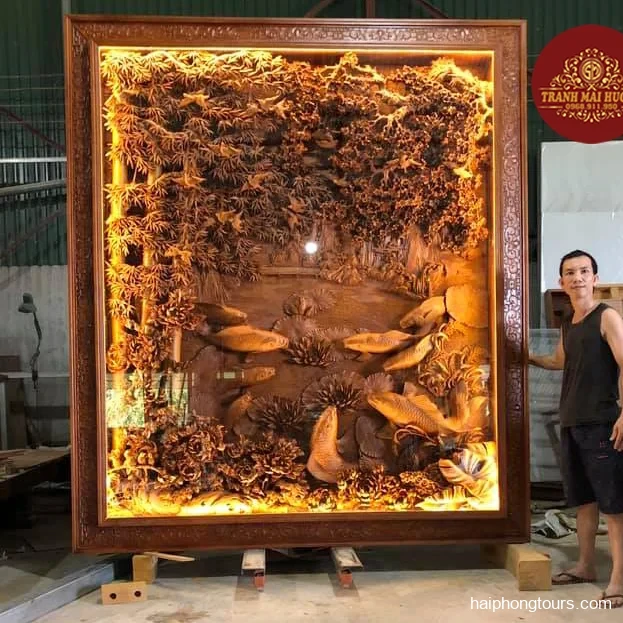
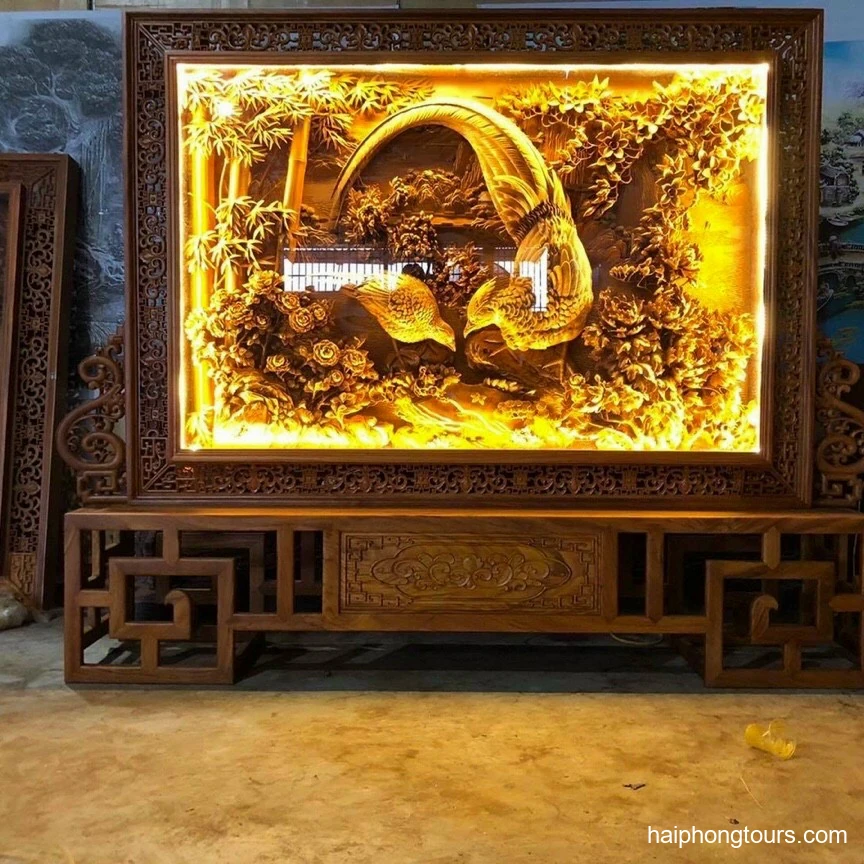
In the fish panel above, follow the branches into the background and compare them with the projecting bodies of the fish. In the peacock composition below, study the curved tail, individual feathers and the open spaces between foliage. These are useful subjects for discussing the work even if you have no intention of buying.
Keep the panel, its frame, its stand and any lighting separate in your notes. Ask which parts are carved from one piece, which are joined, and what is included in the quoted price. The display as a whole can look like a single object even when it consists of several components.
Choose a useful production visit
A 45–60 minute appointment can work well if it follows one object: a rough blank or unfinished panel, a detail being shaped, and a completed example. This is a suggested format to propose to a host, not a scheduled activity sold by the village.
Compare the same motif at different stages. Notice which surfaces still show tool marks and which have been smoothed. Ask the maker to explain the contribution of machinery and hand finishing to that particular item. Avoid assigning a technique to every product from the village based on one demonstration.
Wear closed shoes and stay with the host near cutting machinery or finishing areas. For children, a short explanation beside an inactive workbench or finished object is a better request than access to tools. Photography should fit around production and respect workers who prefer not to be pictured.
Add the communal house and village shrine
Dai Nghiep’s communal house honors Hien Cong, titled Ho Quoc Dai Vuong. The village also has a shrine to Princess Hoa Dung. Their inauguration ceremony took place on 8 December 2024 following building work supported by residents and people originally from the village.
The communal house had suffered wartime destruction and later served as a village meeting hall before returning to its religious role. Treat the present structure as a place with successive repairs and rebuilding. The story is about continuity of community worship as well as old craftsmanship.
Allow around 20 minutes if the grounds are accessible. Ask your host to help identify the two places and obtain permission for interiors; the ceremony report does not provide ordinary visiting hours. Observe worship quietly and avoid treating altar objects as furniture samples.
Pair carving with mother-of-pearl work
Chuyen My’s wider craft area includes both woodworking and mother-of-pearl inlay. A second prearranged stop in Chuon Ngo creates a useful comparison: a carved surface develops volume, while inlaid shell introduces contrasting material into a surface.
For a manageable day, visit Dai Nghiep in the morning, leave a proper lunch break, then continue to one inlay workshop. Select two hosts before departure and keep the heritage stop flexible. You will learn more from following two processes carefully than from collecting brief showroom visits across several villages.
Plan for the size of anything you buy
Before a deposit, record the design, material, overall dimensions, finished weight, included frame or stand, completion date and warranty. For a wall panel, agree how it will be packed and installed. Have the destination’s installer assess the wall and fixing method rather than choosing hooks from a photograph.
Get transport and insurance priced separately for the actual destination. A large carved work may be a commission with later delivery, while a casual visitor may prefer simply to document the process and keep the maker’s details.
Would you like a Dai Nghiep craft day from Hanoi? Contact Hai Phong Tours with your date, starting point, group size and interest in carving, worship furniture or buying a specific piece. Include any workshop already contacted and whether you want to add Chuon Ngo.