
The Vietnam Military History Museum is a substantial visit in western Hanoi, with a chronological indoor exhibition, historically important aircraft and vehicles, and large outdoor displays. Set aside roughly half a day including transport, with about three hours on site as a useful starting point. It is especially worthwhile if you want to understand military history through objects and the people associated with them.
Go to the new museum at Km 6+500 Thang Long Avenue, Xuan Phuong, Hanoi. The operating collection moved here in November 2024. Its regular public hours are 8:00 a.m.–4:30 p.m. on Tuesday, Wednesday, Thursday, Saturday and Sunday; Monday and Friday are not normal walk-in visiting days.
The new museum and the old Hanoi Flag Tower address
Older travel guides often place the museum beside the Hanoi Flag Tower on Dien Bien Phu Street. That address belongs to its former central site. It will not take you to the large current exhibition on Thang Long Avenue.
Save the full new address before ordering a car. If a driver or booking description shows the Flag Tower, clarify the destination before departure. The Thang Long Imperial Citadel remains a separate central-Hanoi history visit; it is not an entrance to the relocated museum.
Likewise, this museum is distinct from Hanoi Museum on Pham Hung Street and the Vietnam National Museum of History in central Hanoi. Similar English names can conceal very different subjects and journeys.
Decide whether it fits your Hanoi trip
Choose this museum when military history, major campaigns, aircraft or armored vehicles are a real interest. The scale allows you to move between broad chronology and individual artifacts, but it also means considerable walking and a journey away from the main Old Quarter sightseeing area.
If you have only an hour between central-Hanoi appointments, choose a more compact stop. If you want family traditions, art or the history of Hanoi itself, the Hanoi museum comparison will help you select a closer match.
The museum tells the history from the perspective of Vietnam’s armed forces and national defense. Read the accounts with that purpose in mind, distinguishing original objects, personal testimony, commemorative displays and the wider institutional interpretation.
Use the six chronological themes to orient yourself
The main exhibition is organized into six periods. You do not need to read every panel equally closely, but following the sequence helps prevent a visit from becoming a collection of unrelated vehicle photographs.
- Early state formation and defense: the introductory story leads to the Bach Dang victory of 938.
- Independent dynasties: defense of the country from 939 through the mid-19th century.
- Colonial rule and independence movements: the period from 1858 to 1945.
- The war against France: 1945–1954, including the campaign at Dien Bien Phu.
- The divided country and war through 1975: the museum’s 1954–1975 narrative.
- The period after 1975: reconstruction, border defense and the development of the armed forces.
Start with the period that gives you context, then spend longer with the subject you came to see. A traveler interested in the 1972 air war will gain more from carefully reading that section than from attempting to absorb every earlier dynasty on the same visit.
Four important objects to look for
The museum’s National Treasures include two different MiG-21 aircraft, tank 843 and the Ho Chi Minh Campaign planning map. Their identifying numbers and stories matter: objects of the same general type are not interchangeable.
MiG-21 number 4324
This aircraft is displayed suspended in the main exhibition building. Its markings connect the machine with its combat history and the several pilots who flew it, rather than with a single anonymous aircraft type.
Read the explanation of the red stars and the aircraft’s service record before moving on. Looking at the object from a distance shows its shape; reading its history explains why this particular aircraft was preserved.
MiG-21 number 5121
Number 5121 is a separate aircraft, associated with pilot Pham Tuan and the December 1972 air campaign. Check the number rather than assuming every photograph of a MiG in the museum shows the same plane.
This is a useful place to connect a large object with the surrounding accounts of air defense, individual service and the war’s effects on northern Vietnam. The physical aircraft and its interpretation complement each other.
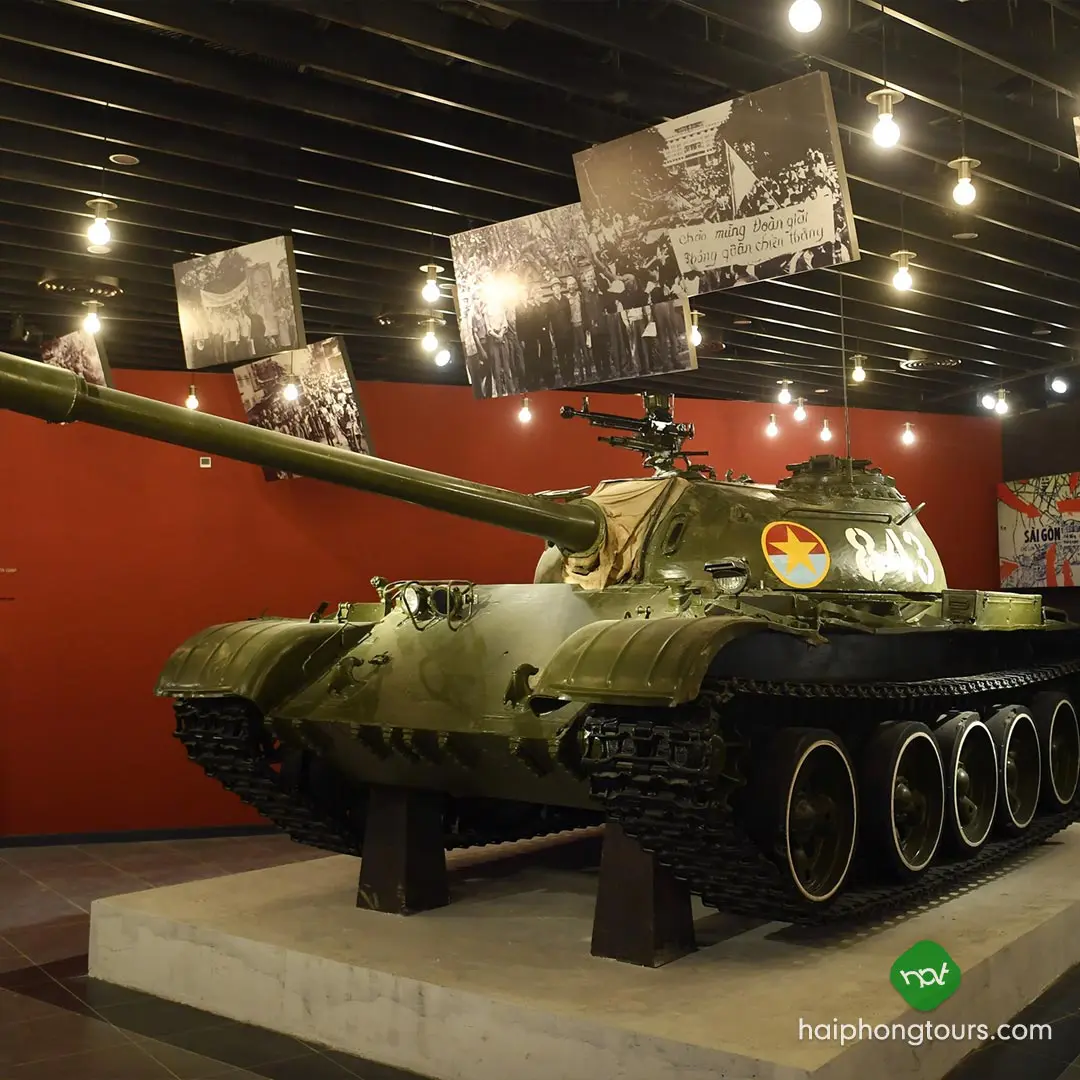
T-54B tank number 843
Tank 843 is associated with the events at Independence Palace in Saigon on April 30, 1975. It reached the palace’s side gate; tank 390, a different vehicle, broke through the main gate. Keeping those identities separate avoids a common confusion in simplified retellings.
Look for the crew and event information as well as the vehicle itself. The museum setting lets you place a familiar historical image within a specific sequence of events.
The Ho Chi Minh Campaign planning map
The map provides a different kind of evidence from the machines. It records the campaign’s planning and bears signatures associated with its command, making it useful for understanding how the museum connects individual objects with a larger operation.
Give this quieter display attention as well as the aircraft and tank. Maps, documents and personal belongings often supply the context that a large vehicle cannot communicate on its own.
A practical route for about three hours
Begin with the entrance map and choose your priorities before committing to a long circuit. A workable first visit is 15 minutes for orientation, around 90 minutes through selected indoor themes, a short break and 45–60 minutes for favorite objects and outdoor displays. These are planning estimates, not an official tour schedule.
In hot or wet weather, give the indoor exhibition priority and shorten the outdoor portion. On a comfortable morning, you can reverse that balance and look at the outdoor equipment before spending longer inside. Keep enough time for the main historical narrative either way.
A specialist visitor may want four hours or more. Families may prefer a shorter route with a few named objects and a clear stopping point. Arrive early enough to finish the route you chose before the 4:30 p.m. closing time.
Tickets, visiting days and English interpretation
Standard admission is VND 40,000 per person per visit, including the listed adult foreign-visitor ticket. Confirm the correct category at the ticket desk if traveling with children or requesting a concession. Age or student status alone does not establish eligibility for a foreign visitor; concession conditions can depend on nationality and supporting documents.
The regular public schedule excludes Monday and Friday. Registered groups may arrange visits on those days, but an independent traveler should not turn up assuming the group arrangement means normal public opening. Call +84 24 6253 1367 or +84 765 614 402 for a specific arrangement.
Holiday schedules can differ from the normal week, and occasional free-admission dates are tied to particular announcements. Plan around the regular schedule unless a notice specifically covers your visit date.
The displays use a mixture of objects, photographs, maps and multimedia interpretation. If detailed English commentary is important to you, contact the museum before visiting to establish which guide or audio options are available for your date and what they cost. Do not assume that an admission ticket includes an English-speaking guide.
Getting there and returning to central Hanoi
Taxi or ride-hailing car
A car is the simplest option when you want direct travel from your hotel. Enter the museum’s full Thang Long Avenue address and check the map pin. Allow for cross-city traffic, then add the on-site visiting time rather than treating the museum as a brief detour.
Arrange the return pickup at an identifiable visitor pickup point. Keep the museum address and your hotel destination saved, and leave a buffer before a flight, train or another fixed appointment.
Public bus
Bus routes serving the museum area include VinBus E05 and E07. Use the current VinBus or Hanoi bus route planner with the Vietnamese stop name Bao tang Lich su Quan su Viet Nam, rather than choosing a bus only because its general destination is western Hanoi.
Check the return journey before you board the outbound bus. The museum’s bus guidance routes some return trips through the Smart City bus terminus, so the way back is not necessarily a matter of crossing the road and waiting opposite. Follow the current route and stop directions; do not cross the main carriageway to improvise a shortcut.
Similarly named services can have different routes and stops. Confirm the exact bus code, direction and final walking approach for the journey you intend to make.
Children, access and respectful photography
Large aircraft and vehicles can engage children, but this is a museum about conflict and remembrance. Choose displays suitable for your child’s age and interests, and make room for breaks. Equipment is for observation: do not climb on vehicles or touch artifacts.
Follow staff instructions for bags and the permitted photography areas. Flash photography of museum objects is prohibited, and food is not allowed in exhibition areas. Wear comfortable walking shoes and plan sun or rain protection for the outdoor sections.
If you require a wheelchair, a step-free route or frequent seating, contact the museum about the exact areas you want to visit. A modern building and a ticket concession are not substitutes for checking the route that works for you.
After this visit, the North Vietnam history and heritage guide can help you connect museum interpretation with historic places. One well-chosen site or campaign is a stronger next step than trying to fit every western-Hanoi museum into the same day.