
The Nho Que boat visit is a separate excursion below Ma Pi Leng, with several connections before and after the time on the water. To see Tu San Canyon, specify the Nho Que 1 reservoir route toward Tu San. The name “Nho Que River” alone is too broad: another reservoir experience near Khau Vai offers a different landscape and does not reach this canyon.
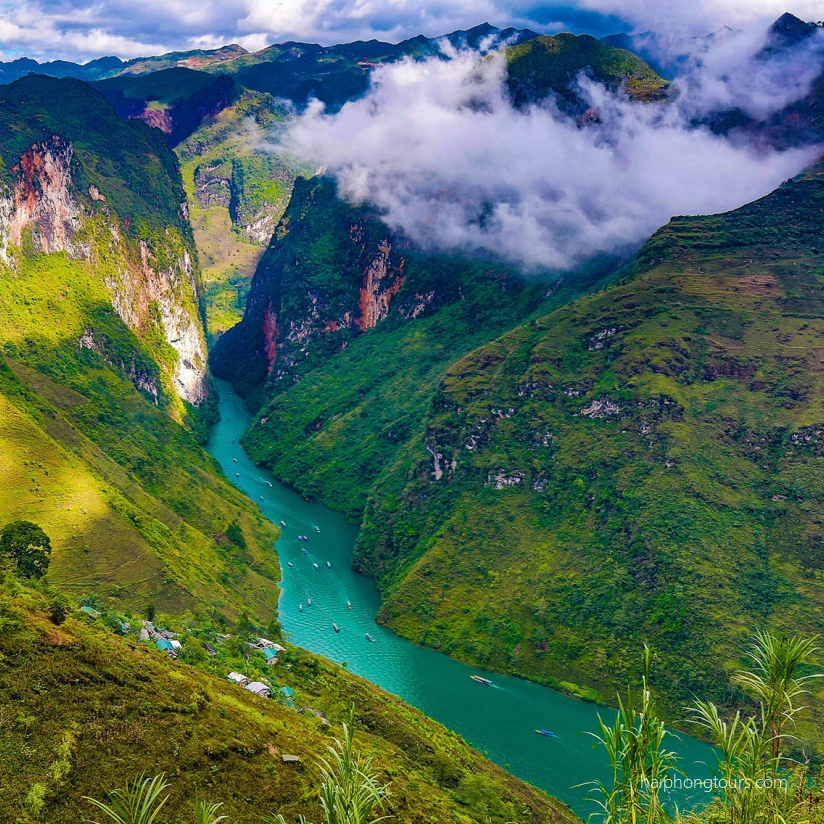
Plan the outing around your whole group, including the descent to the visitor area, boarding and the return uphill. A scenic boat ride can suit travelers who do not want a mountain hike, but it is not automatically a step-free or effortless alternative.
Understand the place you are booking
The provincial tourism authority identifies the service with Nho Que 1 Hydropower Company and Tu San Agricultural and Tourism Services Cooperative. The boat experience takes place on the reservoir landscape beneath the pass. Use those names when checking a ticket or an excursion description, rather than assuming a reseller’s photograph identifies the actual operator.
The canyon is the narrow, dramatic part of the landscape that many visitors come to see. An itinerary should state whether its boat route approaches that section, where it starts and where it returns. Water conditions or operating instructions can alter what is possible on the day.
Choose a regular shared service or a specifically quoted private arrangement according to your group. A private road vehicle does not automatically mean a private boat, and a boat ticket does not normally describe every part of a hotel-to-hotel excursion.
Follow the access sequence from the main road
Provincial visitor reporting describes the approach from the Pa Vi junction off National Road 4C toward the Nho Que 1 visitor parking area, with roughly ten kilometres on that approach. This is route context, not a promise that every vehicle can use every section or that an old navigation shortcut remains appropriate.
- Agree the visitor parking and ticket point with your driver before leaving the main road.
- At the service area, identify the ticket being sold and the current transfer arrangement to the pier.
- Keep the return ticket or other proof of payment accessible through boarding and the return transfer.
- Return to the agreed collection point before beginning the next road stage.
Do not put a generic canyon pin into a taxi booking and assume it means the correct arrival area. Some maps emphasise a viewpoint, a water-level landmark or an older descent route. The useful endpoint for a driver is the actual visitor arrival point accepted by the boat service.
Separate the charges before buying
Read the posted tariff or your provider’s written breakdown. Establish whether the quoted amount includes the boat, the site transfer to and from the pier, parking and any guide. A package advertised by a hotel may add transport from the hotel, while a counter ticket starts at the site.
No stable direct-operator tariff or public booking telephone is established here, so this guide does not turn a reseller’s price into a guaranteed fare. The practical alternative is to buy through the identified service counter or obtain an itemised confirmation from the provider arranging your excursion. For children, state ages and ask for the applicable category rather than assuming a height or age rule from another attraction.
Keep time separate from price. Provincial accounts describe the water portion as around an hour to an hour and a half, but queueing, site transfers and the road approach extend the outing. Reserve a generous part of the day instead of fitting it into a gap equal to the advertised boat duration.
Check boarding suitability before committing the group
For someone who has difficulty with steps or balance, request a current photograph of the boarding point, the height change into the boat and the seat arrangement. A smooth ride after departure does not remove the boarding difficulty. Ask whether assistance is available and what it involves; do not infer wheelchair access from a vehicle reaching the parking area.
For children, establish that a correctly sized life jacket is available before boarding. Wear the provided safety equipment as instructed, remain within the areas the crew permits and keep the group seated when directed. Do not stand on an edge or remove a jacket to reproduce a photograph.
Carry water, sun or rain protection and a small bag that leaves your hands free for boarding. Secure phones and cameras before moving between the pier and boat. Leave bulky luggage with the agreed vehicle or accommodation rather than creating an extra transfer problem at the water.
Arrange the return before losing mobile signal
Save the driver’s name, vehicle identification and collection point offline. Agree whether the driver waits at the visitor area and how an overrun is handled. If your next bed is in Pa Vi village, give the full property name and section; “Meo Vac” is not an exact homestay destination.
If the service is suspended or conditions make boarding unsuitable, keep the road-level Ma Pi Leng experience and move on. Do not look for an unofficial substitute boat because you have already driven down. An excursion can be abandoned without losing the rest of the day.
Combine the river with one other priority
A pass viewpoint and the boat visit make a coherent scenery-focused day. A long hike and a major market morning make the timetable much tighter. Choose the activity that matters most and preserve daylight for the next road section.

Use the Dong Van geopark guide to place the river in the wider landscape. The local boat and pier arrangements belong with the excursion provider that confirms them.
Would you like help fitting this experience into your trip? Contact us with your travel dates, starting point, available time and group size. Tell us about walking limits or special interests so we can suggest a practical itinerary.