
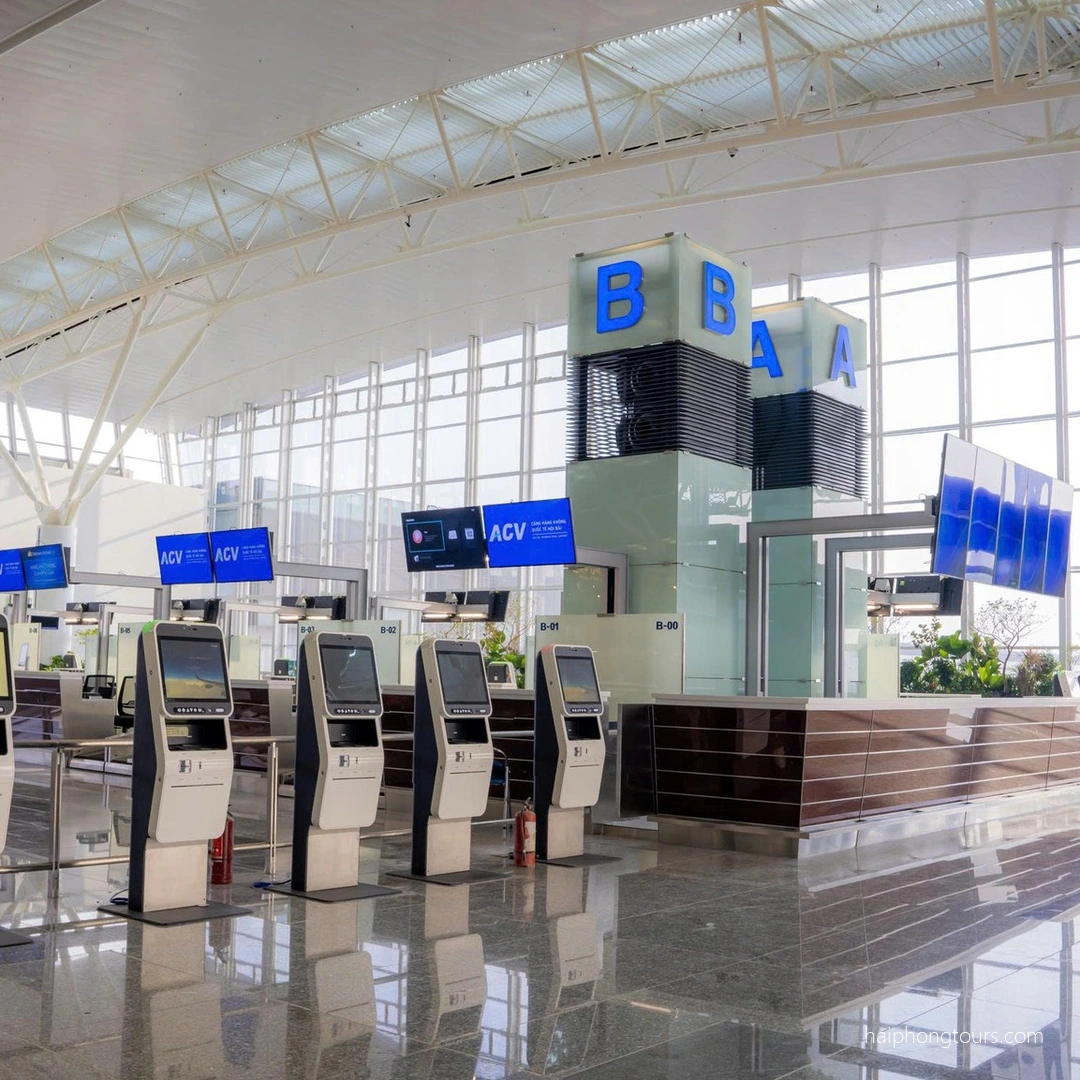
You can buy a Vietnamese SIM or eSIM after arriving at Hanoi’s Noi Bai Airport. For an international arrival, look for the staffed telecom counters in T2’s public arrivals hall after entry and baggage procedures. Bring your original passport, use an unlocked compatible phone and leave the counter only after testing mobile data. Compare the full SIM-plus-plan price, not just the advertised data-package fee.
A working connection is useful immediately for contacting your driver, opening a hotel address and messaging your travel companions. You do not need to choose the largest plan at the first counter. Match the product to the length of your stay and whether you need a Vietnamese calling number as well as internet access.

Where to buy and what to bring
Viettel’s own tourist guidance identifies an airport kiosk in Noi Bai’s international arrivals hall and describes its red-and-white branding. If you cannot find the staffed sales point, ask airport information rather than following an unsolicited offer outside the terminal.

A seller may handle more than one network or package. Read the network name on the actual product and receipt. A logo on a sign does not tell you the data allowance, activation date or support arrangements for the specific SIM being offered.
- Bring the original passport used for your trip.
- Know your phone’s exact model and whether it accepts another carrier.
- Have your email available if buying an eSIM delivered electronically.
- Keep your hotel address and transfer contact saved offline.
- Allow time for registration and a live connection test.
VinaPhone’s airport-purchase guidance also states that international customers use a passport for subscriber registration. Do not treat a ready-to-use card registered to an unknown person as equivalent to a SIM properly issued for you.
Physical SIM or eSIM?
| Choice | Useful when | Check before paying |
|---|---|---|
| Physical SIM | Your phone has a suitable SIM slot and you prefer a card installed at the counter | Carrier unlock, SIM size and where to keep your home SIM safely |
| Local carrier eSIM | Your exact phone model supports eSIM and you want a digital local line | Device compatibility, registration, installation method and included calls |
| Travel data eSIM bought in advance | You want connectivity ready soon after landing | Vietnam coverage, validity trigger, data allowance and whether a local number is included |
| Existing home-plan roaming | Your carrier offers a suitable Vietnam allowance | Total roaming charges and any limits for calls, data or tethering |
eSIM support varies by model and regional version. Do not assume that every phone with the same family name has the same SIM capability. A device can also support eSIM but remain locked to its original carrier.
On an iPhone, Apple’s current guidance identifies the carrier-lock field under Settings, General, About; an unlocked phone shows No SIM Restrictions. For other devices, use the manufacturer’s instructions or ask your home carrier before travel. An airport seller cannot solve every home-network lock while you wait.
Published Viettel tourist package examples
Viettel’s tourist guidance lists the following packages. These are package fees excluding the SIM price, not complete airport-counter quotes:
| Package | Validity | Published data allowance | Package fee |
|---|---|---|---|
| 5G60T | 7 days | 5 GB per day | 60,000 VND |
| 5G80T | 15 days | 5 GB per day | 80,000 VND |
| 5G150T | 30 days | 5 GB per day | 150,000 VND |
The carrier describes these tourist eSIM products as coming with a new number. That does not mean the data-focused package includes unlimited outgoing calls. Ask which calls, messages or account credit are included and what happens after the daily data allowance is used.
Use the package names to compare like with like at the counter. A higher quote may bundle the SIM, a different plan or another service; ask for the components rather than assuming it is the same product. The selected package and complete payable amount should be clear before activation.
Questions that make the purchase clear
Ask when validity starts: payment, activation or first use can produce different practical results. If you arrive late at night or leave after midnight, compare the actual expiry date with your travel dates rather than simply counting the number of hotel nights.
- What is the total price including the SIM or eSIM?
- Is the allowance per day or for the whole trip?
- What is the exact expiry date and time?
- Does it include a Vietnamese number and outgoing calls?
- Can you share data with a laptop or another device?
- How do you view the remaining allowance and get support?
Choose the answer that fits your use. Maps, messaging and occasional browsing are different from uploading video or working through a laptop hotspot. A daily allowance is useful only if it is sufficient on your busiest day; unused data on a quiet day may not be available later.
Register and activate before leaving the counter
Complete the carrier’s registration using your own documents and review the information for spelling or passport-number errors. Keep the receipt and any contract or activation confirmation. Give personal information only through the carrier’s stated process, and retain control of your passport and phone during the transaction.
For an eSIM, connect to a working Wi-Fi network if required, then use the phone’s Add eSIM or Add Mobile Plan function to install the profile supplied by the carrier. Label the new line clearly, such as Vietnam, so it is easy to choose the correct data connection later.
For a physical SIM, store the removed home card in a small labeled holder rather than loose in a pocket. Set the new line for mobile data. If keeping your home line active for messages, review that carrier’s roaming settings so it does not become an unintended data connection.
The two-minute test before you walk away
- Turn Wi-Fi off temporarily so the test uses the new mobile service.
- Open a fresh webpage and load the route to your hotel.
- Send a message to your travel companion or transfer contact.
- If calls are included and you need them, ask staff to demonstrate a permitted test call.
- Record your Vietnamese number, expiry and support method.
- Reconnect to Wi-Fi only after confirming mobile data works.
If a signal appears but data does not work, let the seller review the active data line, plan activation and network settings before you leave. Do not delete an eSIM profile as the first troubleshooting step; reinstalling it may require the carrier’s help.
Late arrivals and onward northern travel
Airport counters should not be assumed to operate around the clock. If the relevant sales point is closed, use airport Wi-Fi to contact your driver, keep the hotel address offline and buy from an official city store later. A prearranged transfer reduces the need to solve every phone issue in the arrivals hall.
A Hanoi Airport purchase does not guarantee continuous reception on every mountain road or remote bay. Download the essential route and accommodation details before leaving the city. Keep the person coordinating your next pickup informed of the number or messaging account you will use.
For help arranging the arrival and onward journey, contact Hai Phong Tours. The Noi Bai Airport guide also explains the terminal layout and meeting sequence.