
Ha Long Bay cruise meal times follow the vessel’s activity schedule, not a universal dining timetable. Lunch may start soon after boarding, dinner follows the afternoon program, and the final morning can contain both a light breakfast and a later breakfast or brunch around an excursion, checkout and disembarkation. Use the current itinerary for the exact vessel and sailing.
Write each meal beside the activity immediately before and after it. That exposes real conflicts, such as an early cave visit between two breakfast services or cabin checkout overlapping the end of breakfast. A published time is a planning reference, while the cruise manager’s onboard program controls the day if weather or operations change the sequence.
Why the vessel name matters
Two cruises visiting the same bay can organize food very differently. A compact one-night itinerary may serve lunch as the ship leaves port, dinner after a cooking activity, and brunch before returning. Another vessel may separate an early pastry service from a main breakfast and omit lunch on disembarkation day.
Trip length alone is not enough. A three-day program can add a full breakfast before guests move to a day boat, lunch on that boat, and dinner after returning to the overnight vessel. The traveler needs both the meal times and the venue, especially when a dietary arrangement must follow them to a second galley.
Hai Phong Tours recommends using the exact product itinerary as the starting point, then rechecking the daily program after boarding. Do not copy times from a review, another ship in the same fleet or an older PDF without confirming that they still apply to the booked departure.

One-night schedules can use different names
The current Athena Cruise two-day itinerary starts lunch at 12:00, schedules dinner at 19:00, and begins the second morning with Tai Chi and breakfast at 06:30. Guests then visit Luon Cave at 07:30, check out and have brunch at 09:00, and reach the port at 11:00.
That sequence gives travelers three practical decisions. They should arrive ready for lunch rather than expecting a long settling-in period, choose whether the early activity fits their sleep and mobility needs, and pack before the 09:00 checkout and brunch period. A passenger who skips the 06:30 service should still verify what food is offered at brunch.
Paradise Elegance publishes a different final morning. Its program places a light breakfast at 07:00, a cave visit from 07:45 to 08:45, breakfast from 08:50 to 09:50, bill settlement and key return from 09:40 to 10:15, and disembarkation from 10:15 to 10:30. Breakfast and checkout overlap, so packing and settling extras need to be planned before the final minutes.
A three-day itinerary adds another dining venue
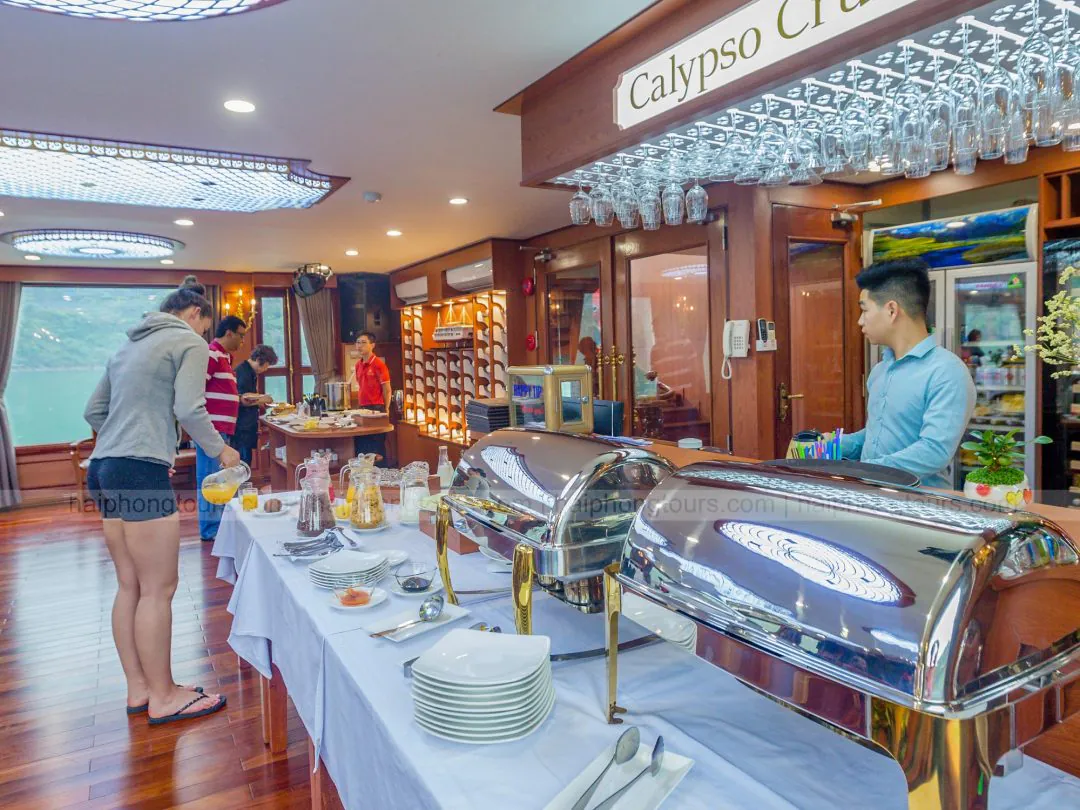
Ambassador Cruise I publishes a three-day program that illustrates the middle-day pattern. It lists a light breakfast at 06:30, a full breakfast buffet at 08:00, transfer to the Sunshine Cruise at 08:45, and a set lunch on the day boat at 11:45. Guests return to the overnight ship later in the afternoon before the evening dinner.
Its final day uses another sequence: light breakfast at 06:30, a Titov Island visit at 07:15, full breakfast at 08:30, checkout at 09:30 and disembarkation at 10:15. The early service is therefore useful before the shore visit, while the main breakfast follows the activity. Someone staying onboard should ask when and where the later breakfast is served.
 Overnight Cruise
Halong Bay & Lan Ha Bay
Oriental Sails 3 day 2 night tour
 Overnight Cruise
Halong Bay & Lan Ha Bay
Starlight Cruise 3 day 2 night tour
 Overnight Cruise
Halong Bay
Athena Cruise 3 day 2 night tour
 Overnight Cruise
Halong Bay
Catherine Cruise 3 day 2 night tour
For a dietary request, confirm both kitchens. A meal prepared correctly on the overnight vessel does not establish the ingredients or cross-contact controls on the day boat. Send the traveler name, cabin, day-boat date and required exclusions before the operator’s deadline, then identify the request to the day-boat team.
Build a schedule that includes transitions
Do not place meal and activity times back to back in your own plan. Allow time to return from the tender, remove wet footwear, reach the cabin, shower if needed and move to the restaurant. A guest with limited mobility may need a route that avoids repeated stairs or a table reached without rushing.
Dinner can follow a cooking demonstration, sunset program or late excursion. Ask whether the published time is the start of one fixed seating, a serving window or an expected gathering time. If the vessel uses a set menu, arriving late may mean missing a course rather than simply entering an open restaurant.
On the final morning, pack most luggage before the first activity. Keep medication, travel documents, a change of clothing and any approved backup food accessible. Cabin checkout, bill settlement and luggage collection are separate tasks even when the itinerary prints them in one short block.
Handle activity and meal conflicts before leaving
Show the conflict to the cruise manager before an excursion departs. State the meal, return time and practical need. Ask whether the meal is held, served in a defined window, moved to another venue or unavailable after the group leaves. Do not assume a replacement plate will be produced when the galley has closed that service.
When planning the day, move a spa appointment, private photo session or other optional activity if it overlaps a published excursion or meal window. This avoids creating a conflict that the galley may not be able to solve later. If an essential medical eating time cannot fit, settle the alternative before boarding rather than trying to solve it during a tender transfer.
Weather and port instructions can change an excursion or the timing of a meal. Wait for the revised onboard announcement, then ask what happens to any meal, medication schedule or dietary plate affected by the change. A sample itinerary should not be treated as a guarantee that the minute-by-minute order will remain fixed.
Use meal times to choose the right cruise pace
A one-night cruise suits travelers comfortable with lunch soon after boarding, an active afternoon, an evening meal and an early final morning. It can feel compressed for anyone who needs long rest periods, a slow breakfast or more time to pack. Compare the schedule before choosing the cabin, because a larger room does not create a later checkout.
A two-night cruise adds time in the bay but not necessarily a relaxed restaurant day. The middle day may start early and move guests to another boat for several hours. It is a better fit when the traveler wants the extra excursion and can manage another transfer, not simply because it adds more meals.
A day cruise has the simplest dining decision. Check the boarding time, lunch start, meal format and return time. Eat before the road transfer when the itinerary does not include breakfast, and plan dinner ashore when the boat returns before the evening meal.
Final timing check
- Exact vessel, date and itinerary length.
- Every meal name, start time, serving window and venue.
- Excursion meeting and return times around each meal.
- Day-boat kitchen details on a longer itinerary.
- Cabin checkout, bill settlement, luggage handoff and disembarkation.
- Dietary plate, medication timing and a confirmed fallback if the program changes.
Use published times to decide whether the cruise pace suits you, then follow the vessel’s live program onboard. The useful plan is not just “breakfast at eight.” It is breakfast after a named activity, before a named checkout step, with enough time to reach the restaurant and complete the next commitment.