
You can learn about the people who live below Yen Tu without making another mountain ascent. At Khe Su, the Dao Thanh Y cultural exhibition provides the clearest starting point; a hosted embroidery, food or music experience is a separate arrangement. The exhibition’s display of a ceremony is not a ticket to attend that ceremony in a private household.
This is a community-focused visit, distinct from the organised Lang Nuong craft activities and evening show. Choose Khe Su when you want to understand local objects, clothing and domestic life through the people who maintain those traditions.
The right place and the right name
Ask for Nhà trưng bày không gian văn hóa người Dao Thanh Y, Khe Sú. Earlier material places the exhibition in Khe Su 2, Thuong Yen Cong, Uong Bi; current reporting identifies the community as Khe Su in Yen Tu ward. Keep the exhibition’s full name with the map pin rather than relying on “Yen Tu cultural village”.
Recent local reporting identifies community leader Đặng Văn Khởi as someone directly involved in interpreting the exhibition. This is evidence of active local interpretation, not a promise that he personally conducts every visit or speaks English. An arranged visit should identify whoever will meet your party on the day.
From a foothill hotel, send the exhibition pin to your driver and arrange a return pickup. Do not assume it shares a reception desk with Lang Nuong or Legacy Yen Tu. Those accommodation and performance spaces are separate from a residential neighbourhood’s cultural building.

Five themes that make the exhibition worth a stop
The documented display has Vietnamese and English interpretation and is organised around five subjects:
- Men’s and women’s clothing: look at the different pieces together, rather than reducing an outfit to one colourful item.
- The cap sac rite: a life-size model and supporting explanation introduce a religious and social tradition.
- Earthen-wall housing: a reconstructed model helps visitors understand a domestic building type.
- The kitchen: the cooking area places household objects in an everyday setting.
- Daily life and culture: photographs and objects connect the other themes with community life.
Use the labels first, then ask a focused question. For example: which clothing pieces are worn for an ordinary occasion and which belong to a ceremony? Which household objects are still used? This approach gives a host something meaningful to explain without expecting a complete cultural lecture on demand.
A reconstructed room or model is an interpretation tool. It does not mean that every local family now lives in exactly that arrangement. Ask how the present-day community uses or remembers the tradition, and allow for differences between households.
Cap sac: understand the display without requesting a performance
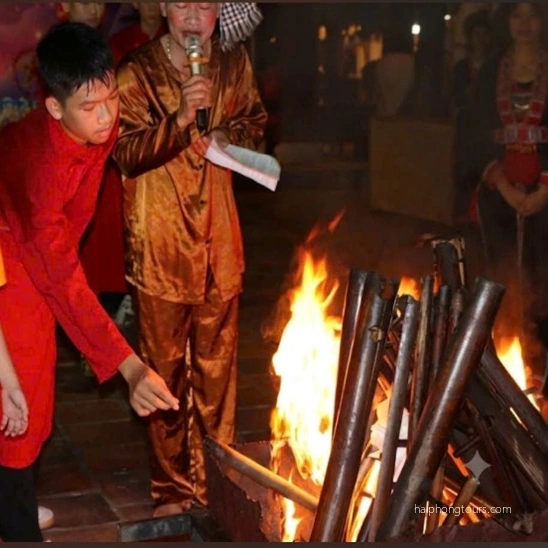
The exhibition introduces lễ cấp sắc, but an actual rite belongs to the people observing it. A model can be viewed during an agreed exhibition visit; attendance at a household ceremony depends on a genuine invitation and the family’s rules.
Do not ask a host to stage a sacred part simply to fill an itinerary slot. If a public programme includes a cultural explanation or demonstration, establish what it represents. A narrated demonstration, a folk-song performance and participation in a private ritual should never be sold or described as the same experience.
Follow the keeper’s photography instructions. If a photograph includes a person, an altar or a private activity, ask before taking it. Permission to photograph an exhibition object does not carry over automatically to the family’s own religious space.
A named community experience beyond the exhibition
Official tourism reporting documents Làng Dao quê em, developed by Trương Thị Thanh Hương in the Khe Su community. It describes embroidery, responsive singing, folk games and local food or herbal-bathing experiences. A subsequent visitor-development account places the community experience roughly a 10–15-minute walk from the exhibition.
These descriptions provide a real enquiry lead, not a universal daily package. Select one activity that interests you and have the host specify what happens. For embroidery, that might be a demonstration, an explanation of patterns, or a supervised attempt at stitching. Materials, take-home work and instruction time should be stated rather than assumed.
If music is the priority, request an explanation of the song and its setting, not simply a group in costume. A short translated introduction can be more valuable than adding several performances whose meaning visitors cannot follow. Interpretation should be arranged explicitly even though the exhibition itself has bilingual labels.
Herbal bathing is an optional cultural or leisure service, not something this guide presents as medical treatment. It can be left out entirely if the group prefers objects, conversation and craft.
A workable half-day below the mountain
The following is a planning framework, not an advertised package or timetable:
- Begin with the exhibition. Allow about 45–60 minutes for the displays and a conversation if a keeper is available. Agree the opening arrangement before travelling.
- Continue to one booked community activity. Use the host’s actual meeting point. The documented short walk is a connection estimate, not a guarantee of a step-free route.
- Finish with an arranged meal or return to your accommodation. A food demonstration does not necessarily include a full lunch, and an exhibition booking does not reserve a restaurant table.
Keep this visit on the lower-area day of a slower Yen Tu stay. After a tiring ascent, an exhibition-only visit may be enough; there is no need to add a long walk merely to make the day appear full.
Opening, charges and practical limits
The sources used for this guide do not establish a dependable everyday opening timetable, published admission tariff, workshop minimum or fixed English-guiding price. Treat Khe Su as an arranged community visit, not a guaranteed walk-in attraction. The absence of a published fee is not proof that hosting, guiding or activities are free.
Have one confirmation cover the meeting point, person receiving you, language, activity, number of participants and total. Include toilet access and the walking route if anyone has limited mobility. A building below the mountain is not automatically step-free, and a map’s walking line does not describe thresholds or surfaces.
Choose a modest programme the hosts can deliver well. If only the exhibition is available, enjoy that rather than substituting an unannounced visit to somebody’s home. If no access arrangement can be made, keep your existing foothill plans and visit Khe Su on another occasion.
Would a Khe Su cultural stop fit your Yen Tu journey? Contact us with your accommodation, preferred activity and language needs. We can help assess the transfer and sequence while the community host confirms access and any programme.